
What We Heard: Adapting Northern fisheries to a changing climate
(Northwest Territories, Inuvialuit Settlement Region, and Yukon)
Note: Fisheries and Oceans Canada (DFO) held a series of 7 regionally focused workshops to discuss climate change impacts, barriers to adaptation, and actions to support the resilience of Canada’s wild-capture fish harvesters and harvesting industry.
What we heard report: Regional perspectives on adapting Canadian fisheries to a changing climate
On this page
- Disclaimer
- Executive summary: key takeaways
- Report
- Impacts of a changing climate and barriers to adaptation
- Looking to the future
- Results of the polling exercise
- Question 1: Choose all of the following that apply to you and your role
- Question 2: On a scale from 1 to 5 (1 being the lowest and 5 being the highest), please indicate the extent to which you agree or disagree with the following statements
- Question 3: What could increase the agility and flexibility of the fisheries management regime to respond to future challenges
- Participant list
Disclaimer
The following report contains opinions expressed by those who attended the regional workshop sessions and do not necessarily reflect the views of Fisheries and Oceans Canada (DFO).
Throughout this report, participant views are represented as received by DFO. However, in some instances there are discrepancies between participant interpretations and what is authorized by DFO. As such, participant comments may not correspond to the statutory, regulatory, and policy framework as understood by DFO. In addition, participant recommendations noted below reflect general consensus but should not be interpreted as having received unanimous consent.
Executive summary: key takeaways
Participants reported experiencing several impacts from climate change on their fisheries, including:
- A sharp decline in fishing participation due to environmental challenges like strong winds, and unpredictable ice conditions.
- Low water levels in rivers, thawing permafrost, and fluctuating water levels in the Great Slave Lake are disrupting fish migration, spawning and local ecosystems.
- The rise of invasive species and species experiencing northward expansions. For example, North American beavers are expanding their range into the Arctic and are blocking fish migrations.
- The increasing frequency of wildfires and their effects on aquatic life are adding new pressures on fisheries.
- Concerns about fish health, including signs of disease and poor reproduction rates, particularly among salmon populations, associated with warming waters and altered river conditions.
Participants are taking actions to adapt to the impacts of changing conditions, including:
- Actively monitoring and researching fish stocks, water chemistry, and the effects of climate change.
- Working to restore habitats and protect species like salmon by modifying creek beds, supporting hatcheries for juvenile salmon survival, and managing beaver impacts.
- Improving safety through infrastructure upgrades, adjusting fishing practices, and mapping reefs to ensure safer navigation.
Participants identified key barriers to adaptation, including:
- Limited resources for adaptation, including inadequate funding and capacity to support restoration and policy efforts.
- Uncertainty around environmental conditions and costly logistics are making it harder to implement research and adaptation strategies.
- Public awareness of climate change impacts and jurisdictional complexities are barriers to broader support and coordinated efforts.
Participants identified several actions to support adaption efforts, including:
- Standardizing data collection and improve technology to respond faster to climate impacts.
- Share resources across regions and organizations, and provide flexible funding to support local projects.
- Adapting fisheries management to be more flexible, and putting a stronger focus on habitat restoration and biodiversity.
Report
Impacts of a changing climate and barriers to adaptation
How is climate change impacting your fisheries? What are your biggest areas of challenge and concern? What has changed the most
Participants highlighted several ways that climate change is impacting fisheries. A major concern raised is the sharp decline in the number of people who are able to continue fishing, which they largely attribute to environmental challenges. They noted that these changes are happening more quickly than anticipated, with disruptions to ecosystems and the loss of fish habitats, particularly due to activities like clear-cutting. They reported that the rapidly changing environment is also making fishing more dangerous. Strong winds have become more frequent, resulting in more incidents of capsized boats and unsafe conditions. Fish harvesters shared that they are trying to use tools to predict wind conditions, but these tools are often unreliable, especially on the water where conditions can change quickly. Shifts in ice conditions were also highlighted, with earlier ice breakup and later freeze times posing challenges for those who rely on ice fishing. In areas like Great Slave Lake, participants noted that ice now lasts only about two weeks, compared to the traditional six months, making fishing seasons both unpredictable and hazardous.
Water levels and permafrost thawing are also causing additional issues. Participants reported that rivers such as the Kakisa and South Slave are experiencing historically low water levels, which prevent fish from migrating and spawning. Great Slave Lake has seen significant fluctuations in water levels, disrupting local ecosystems. Thawing permafrost is contributing to land slumping and affecting water quality, which further harms fish habitats. Participants also expressed concern about the decline in salmon populations, particularly Chinook and Chum in the Yukon River. These declines are attributed to warming waters, migration challenges, changes in seasonality and impacts to breeding grounds. Fish health is also a growing concern, with some participants observing sores and signs of algal growth on fish.
Invasive species and species undergoing northward range expansions are adding new pressures on fisheries. Participants reported a significant increase in the number of beavers, whose dams are blocking fish migration. Additionally, animals like otters and grizzly bears are moving into northern areas, potentially disrupting the balance of local ecosystems. Wildfires are another growing concern, with ash and contaminants from these fires entering rivers and lakes, harming fish and other aquatic species. Participants highlighted the need to strengthen monitoring capacity, noting that current staffing levels of fishery officers may be insufficient to effectively oversee fish populations and water quality. They emphasized that enhancing monitoring efforts could help prevent environmental issues from being overlooked.
The rapidly changing environment is making it more difficult to predict conditions from year to year, and to gather accurate data. Participants spoke about the increasing unpredictability of fish behavior, including changes in spawning and migration patterns, which are creating additional challenges for fisheries management. Fluctuating fish populations, including significant decreases in whitefish numbers, were raised as being a serious concern for food security in communities. Many participants expressed concern about the pressure of facing multiple stressors each year, such as flooding, beaver dam blockages, and rising water temperatures, all of which are happening faster than expected and creating a sense of uncertainty about future fishing seasons.
What actions are you taking to adapt to the impacts of changing conditions
Participants shared a range of actions being taken to adapt to the impacts of changing conditions in fisheries, with the majority focused on monitoring and research. Across the Northwest Territories, ongoing long-term monitoring efforts include water chemistry testing and data collection as part of broader research on aquatic ecosystem health and its impacts on fisheries. Research into the cumulative effects of climate change, habitat loss, and pollutants on fish populations was also highlighted as an ongoing priority. Community-based monitoring in Yellowknife is helping residents track changes in fish populations and distinguish the effects of climate change from other factors, such as mining and commercial fishing. Participants noted that monitoring empowers communities with the knowledge needed to advocate for their fisheries.
The importance of habitat restoration and protection was also discussed. Collaborative efforts with Fisheries and Oceans Canada (DFO) are underway, such as building a weir on the Hornaday River to monitor fish populations and modifying creek beds to improve fish habitats and support spawning. There was also a focus on efforts related to specific species, particularly salmon. Participants highlighted ongoing initiatives to support juvenile salmon survival, especially in hatcheries, by identifying the optimal conditions to improve their chances of survival. Efforts to understand and address the declining numbers of Chinook salmon in collaboration with biologists were also discussed. Active beaver management emerged as another key focus, with funding directed at mitigating the impact of beavers on local ecosystems and fisheries.
Additionally, participants highlighted efforts to improve safety and infrastructure in their communities, such as mapping reefs for safer navigation and upgrading docks, particularly on the south side of the Great Slave Lake. In the Inuvialuit Settlement Region (ISR) and Gwich’in regions, cautious harvest management practices have been implemented to protect fish populations and avoid overfishing. Some harvesters reported adjusting their fishing practices, including setting nets deeper and fishing earlier in the season due to warmer conditions affecting the ice. Lastly, subsistence harvesters discussed their ongoing advocacy to ensure governments address the challenges they face as conditions continue to change.
What do you think are the biggest barriers to adaptation
Participants identified several key barriers to adapting to climate change impacts on fisheries, with funding and capacity being major concerns. They highlighted that adaptation efforts, such as habitat restoration, are costly and limited funding makes it difficult to support these activities. While science receives funding, participants noted there often is not enough capacity or flexibility to address other pressing needs, such as policy development or restoration projects. First Nations communities, in particular, expressed that they face capacity challenges in managing fisheries restoration, even when funding is available. It was shared that additional challenges, such as road closures from wildfires and the impact of beaver dams, further strain the time and resources required to implement essential projects.
In addition to these resource challenges, participants highlighted that uncertainty and unpredictability further complicate adaptation efforts. For example, changes in water levels are often unpredictable, making it challenging to collect data or plan for future conditions. High costs and difficult ice conditions are also a barrier to overwintering monitoring, presenting challenges in collecting temperature and outmigration data. Participants also noted that the vast size of the region and high transport costs of the region add to the difficulty of conducting research and monitoring. Shifting government priorities and changing regulations were raised as additional barriers, impacting funding and focus. Finally, public perception was flagged as a concern, with many participants noting that the public is unaware of the impacts of climate change on fisheries, which makes it harder to build support for adaptation efforts. Jurisdictional issues, particularly around Great Slave Lake where the majority of the water comes from outside the Northwest Territories, were also mentioned as complicating local planning and response efforts.
What do you need to better adapt
Participants identified several key needs to better adapt to climate change impacts on fisheries. One major priority is standardized data collection and better data management systems. While First Nations are using data loggers to track temperature, there is currently no consistent methodology for comparing data sets. This makes it harder to forecast trends and respond to changes. Participants emphasized the need for investment in technology to process accumulated data more efficiently, allowing for quicker, more responsive adaptation efforts and faster translation of science into appropriate management measures that can help harvesters. They also advocated for democratizing science, ensuring that the tools and methodology for data collection are accessible to all communities, with workshops and training to help communities collect and analyze data using standardized protocols.
Capacity sharing was another key theme. Rather than building capacity from scratch, participants suggested that regions and organizations should share resources and knowledge to scale-up adaptation efforts. They noted that this approach could help make comparisons across sectors, such as water quality monitoring, and lead to more effective, coordinated actions. Participants also called for more flexible funding to address emerging challenges and support local projects that can quickly adapt to changing conditions. Additionally, participants emphasized the importance of compensating harvesters for adaptation efforts and losses or reduced harvest levels, which would help ease the transition as fish stocks are managed more sustainably. In terms of management, there was strong support for climate-ready fisheries management systems that are more adaptable to the evolving challenges posed by climate change. Existing systems were seen as not responsive enough to ongoing shifts; participants therefore recommended faster feedback loops, flexibility in policies and changing licensing approaches to improve fisheries management.
Finally, participants emphasized the importance of restoration and biodiversity efforts. They suggested actions such as planting trees for shade along water bodies to reduce temperature increases and providing shelter above fish passage routes to protect fish habitats. More focus on restoring ecosystems was seen as a key strategy to improve long-term adaptation. Alongside these efforts, participants highlighted the need for enforcement and guardianship programs, particularly in the summer, to ensure compliance in communities and to protect fish populations from growing threats. This comprehensive approach, combining technology, capacity sharing, and adaptive management, was seen as essential to building resilience in fisheries and adapting to the impacts of climate change.
Looking to the future
What is your future vision for climate-adapted northern fisheries? What does success look like
Participants shared their vision for climate-adapted northern fisheries emphasizing the need to prioritize future generations and ensure that communities can continue to harvest species while sustaining Indigenous Knowledge (IK). They noted that success is about prioritizing the health of fish populations over the amount harvested, ensuring future generations can continue to harvest species. Participants emphasized the importance of focusing on long-term resilience, including protecting vital species like salmon, which are seen as crucial for both the environment and people. They also called for more marine environment studies that bring all stakeholders together to better understand and address the impact of activities like trawling. Success, according to participants, would be measured by the abundance and health of wildlife, especially salmon stocks, and the ability to reconnect communities with these vital species.
Participants emphasized the importance of including First Nations in decision-making and integrating IK into adaptation efforts. They expressed the need for collaboration across governments, with a focus on working together to address the challenges of climate change. Strengthening Guardian programs and supporting community-based research were seen as key to building local knowledge and ensuring that adaptation efforts reflect the needs of communities.
Finally, participants emphasized the importance of conservation, with a focus on addressing the damage humans have caused to ecosystems. They raised the need to reconnect communities with important species and to increase awareness of the cascading impacts of biodiversity loss, especially how salmon decline affects other species like eagles and bears. The participants expressed a strong desire to pass on IK but noted that declining harvests make it harder to transmit these traditions to younger generations.
What are the best opportunities to support adaptation to get us there? These can include individual and/or collective actions
Participants identified several key opportunities to support adaptation to climate change and strengthen fisheries resilience. A major focus of the discussion was on fostering resilient fish systems and reducing stressors that can help species like salmon adapt to climate change. Participants emphasized the importance of co-management and incorporating IK into fisheries management. They also highlighted the value of supporting IK alongside scientific data to ensure more comprehensive and effective management strategies. Participants noted the need for a strong conservation focus, with data collected by DFO playing a key role in management efforts. Local-led fisheries management and knowledge exchanges between communities were seen as essential for adaptation, as these initiatives empower communities to address emerging challenges. Additionally, platforms for communication and data sharing were identified as opportunities to enhance collaboration across regions, sectors, and communities.
Collaboration was seen as crucial for developing more effective solutions. Participants stressed the importance of engaging various sectors, including government agencies, industry, and academia, in discussions around adaptation strategies. One opportunity participants identified was the creation of research centres on climate change, which could aid in cross-sectoral collaboration and the development of effective actions. Another key opportunity was climate scenario planning, which would allow diverse groups to plan for a range of possible futures and help prepare for climate impacts as well as other potential impacts, like market changes and new technologies.
Finally, participants saw significant potential in empowering communities and harvesters, particularly younger generations, to get more involved in observing environmental changes and learning about adaptation. As adaptation efforts move forward, participants stressed the importance of balancing economic development with environmental protection, particularly when it comes to preserving vital ecosystems like those that support fish habitats.
What is the most useful way to continue these conversations
Participants suggested that the most useful way to continue the conversations around adapting fisheries to climate change would include additional workshops and educational opportunities led by DFO, particularly to explain fisheries science processes and sharing up-to-date findings, and what they mean for fisheries. These workshops should be designed to engage a wider range of community members and focus on increasing awareness about the impacts of climate change on the marine environment.
Participants also highlighted the importance of engaging diverse groups in collaborative climate scenario planning, where different futures could be mapped and participants can discuss how to adapt fisheries management to each scenario. There was a strong emphasis on involving harvesters and youth in these discussions, particularly to get younger generations more involved in observing changes in their environment and understanding the challenges ahead. Several participants noted the significance of the United Nations Declaration on the Rights of Indigenous Peoples (UNDRIP) as a valuable framework to foster collaboration between DFO and Indigenous communities. Additionally, improving organizational collaboration and data sharing practices across sectors through these conversations, particularly through the FAIR (Findable, Accessible, Interoperable, and Reusable) principles, was seen as crucial for successful adaptation. Finally, creating dedicated forums for subsistence harvesters to engage directly with DFO was suggested to ensure that the concerns of those most impacted by changes are heard and addressed in decision-making.
Results of the polling exercise
After the workshop, participants were asked to take part in an anonymous polling exercise. Participant responses are displayed below. Please note that Question 3 required participants to provide an open-text response; responses reflect the text as submitted.
Question 1: Choose all of the following that apply to you and your role
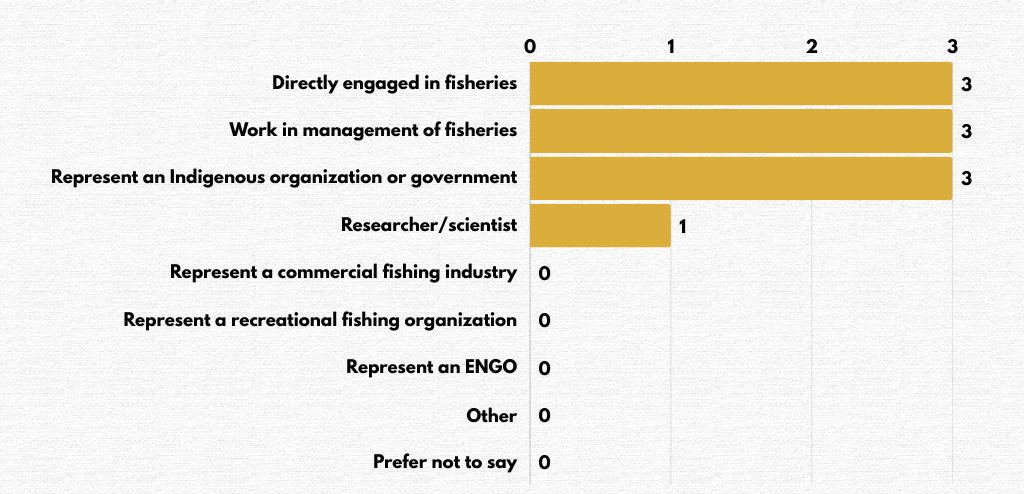
- 3 participants worked in fisheries management
- 3 participants directly engaged in fisheries
- 3 participants represented an Indigenous organization or government
- 1 participant was a researcher or scientist
Question 2: On a scale from 1 to 5 (1 being the lowest and 5 being the highest), please indicate the extent to which you agree or disagree with the following statements
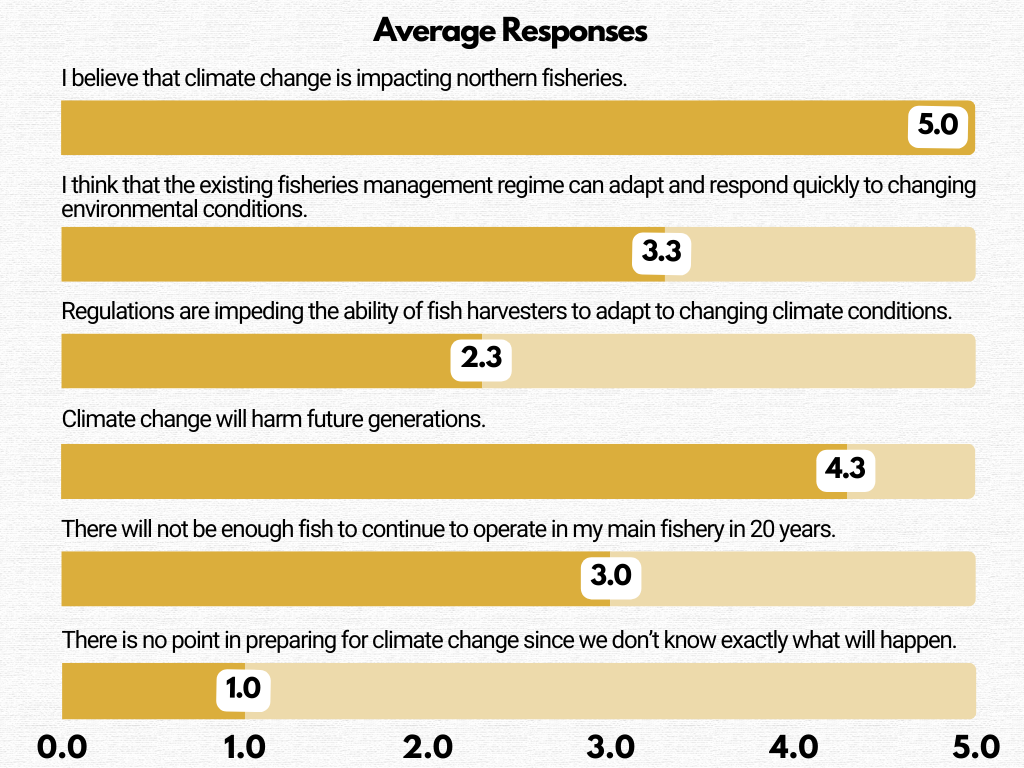
- I believe climate change is impacting Northern fisheries. Average response: 5.0
- I think that the existing fisheries management regime can adapt and respond quickly to changing environmental conditions. Average response: 3.3
- Regulations are impeding the ability of fish harvesters to adapt to changing climate conditions. Average response: 2.3
- Climate change will harm future generations. Average response: 4.3
- There will not be enough fish to continue to operate in my main fishery in 20 years. Average response: 3.0
- There is no point in preparing for climate change since we do not know exactly what will happen. Average response: 1.0
Question 3: What could increase the agility and flexibility of the fisheries management regime to respond to future challenges
Open text responses:
- Having enough people aware and that care, having enough people on the same page and involved in the process.
- Continued investments in climate change adaptation to reduce risks and management opportunities.
- Decoupling management systems from political bodies and industries. The influence of economics and Odum’s Ratchet Footnote 1 needs to be reduced. Science and cultural management boards need decision making power.
- Economic systems compensating fishers while taking pressure of stocks by reducing/removing harvest. Large marine and freshwater protected areas with adjustable boards. Inland, freshwater food fish farm.
- Science and cultural management boards with appointed positions, government funding and decision-making authority with government oversight for accountability. Investment in technology improvements.
Participant list
Representatives from the following organizations, groups, environmental non-governmental organizations, institutions, and/or governments attended the workshop. In alphabetical order:
- Akaitcho Territory Government
- Canadian Wildlife Federation
- Carcross/Tagish First Nations
- Council of Yukon First Nations
- Environmental Dynamics Inc
- eOceans
- Fisheries Joint Management Committee
- Government of Northwest Territories - Environment and Climate Change
- Government of Yukon - Fisheries Department
- Gwich'in Renewable Resources Board
- Inuvialuit Game Council
- Inuvialuit Regional Corporation (IRC)
- Kwanlin Dun First Nation
- Memorial University
- Nature United
- Pacific Salmon Foundation
- Ta’an Kwäch’än Council
- Tlicho Government
- Tr’ondëk Hwëch’in
- University of Quebec in Rimouski
- Wildlife Conservation Society
- Yukon First Nations Salmon Stewardship Alliance
Page details
- Date modified: