
What We Heard: Adapting Newfoundland and Labrador fisheries to a changing climate
Note: Fisheries and Oceans Canada (DFO) held a series of 7 regionally focused workshops to discuss climate change impacts, barriers to adaptation, and actions to support the resilience of Canada’s wild-capture fish harvesters and harvesting industry.
What we heard report: regional perspectives on adapting Canadian fisheries to a changing climate
On this page
- Disclaimer
- Executive summary: key takeaways
- Report
- Impacts of a changing climate and barriers to adaptation
- Looking to the future
- What is your future vision for climate-adapted fisheries in Newfoundland and Labrador? What does success look like
- What are the best opportunities to support adaptation to get us there? These can include individual and/or collective actions
- What is the most useful way to continue these conversations
- Results of the polling exercise
- Question 1: Choose all of the following that apply to you and your role
- Question 2: On a scale from 1 to 5 (1 being the lowest and 5 being the highest), please indicate the extent to which you agree or disagree with the following statements
- Question 3: What could increase the agility and flexibility of the fisheries management regime to respond to future challenges
- Participant list
Disclaimer
The following report contains opinions expressed by those who attended the regional workshop sessions and do not necessarily reflect the views of Fisheries and Oceans Canada (DFO).
Throughout this report, participant views are represented as received by DFO. However, in some instances there are discrepancies between participant interpretations and what is authorized by DFO. As such, participant comments may not correspond to the statutory, regulatory, and policy framework as understood by DFO. In addition, participant recommendations noted below reflect general consensus but should not be interpreted as having received unanimous consent.
Executive summary: key takeaways
Participants reported experiencing several impacts as a result of climate change, including:
- Species distribution changes.
- Temperature and ice condition changes.
- Changes to seasonality/timing of harvesting.
- Change in population abundance and productivity.
- Increase in frequency and intensity of storms.
- Invasive species and predation changes.
Participants reported several threats to Newfoundland and Labrador fisheries in the era of climate change, including:
- Lack of science and data, including robust stock assessment and surveys.
- Management challenges (lack of flexibility, cohesion, projections, modelling, etc.).
- Challenges in communication, education, and transparency.
- Difficulties with collaboration.
- Lack of resources and funds.
- Insufficient strategic plans, standards, and tools.
- Uncertainty about the impacts of climate change in the future.
- Threats to community and socioeconomic impacts for the area.
Participants are taking actions to adapt to the impacts of changing conditions, including:
- Looking into electric or low emission vessels.
- Adjusting to go out to harvest as early as possible within their harvesting season.
- Diversification of licence holdings.
Participants identified several key barriers to adaptation, including:
- Lack of data and scientific information.
- Slow and inflexible fisheries management incapable to keep up with the rapidly changing conditions.
- Lack of education/communication in sharing scientific information and building awareness on the threats of climate change.
- Limited collaboration opportunities between Fisheries and Oceans Canada (DFO) and Indigenous communities, industries, harvesters, and fisheries organizations.
- Lack of resources and funds to expand on research and better support harvesters and communities to adapt to climate change.
Participants identified several actions and/or opportunities to support adaption efforts, including:
- Improve education, communication, and collaboration between DFO and Indigenous communities, harvesters, industries, and fisheries organizations around data collection, research, management decisions, and policy planning.
- Expand data collection and analysis to include further information (such as climate change indicators in stock assessments).
- Further implement an ecosystem based approach to fisheries management and implement quicker and more flexible management processes.
- Develop a strategic plan with Indigenous Peoples, stakeholders, and communities to ensure more cohesive planning and decision making.
Report
Impacts of a changing climate and barriers to adaptation
How is climate change impacting your fisheries
Workshop participants highlighted a variety of climate change impacts that have been noticed in Newfoundland and Labrador. The primary impacts expressed were: warming water temperatures, changes in ice condition, and increases in the frequency and intensity of extreme weather (e.g., storms).
Another important impact mentioned by many participants throughout the meeting is the change in species distribution. Participants explained that while this change can lead to positive impacts in certain communities, others may face negative impacts, including socio-economic consequences. They are also noticing changes in migration patterns, as well as in the reproductive and life cycle patterns of different species. Harvesters shared that it is now taking longer to access the stock they are fishing and also taking them longer to catch their quotas, partly because of these distributional changes. This not only has an impact on their costs (increased fuel costs due to traveling longer distances), but also on their safety (having to travel longer distances and spending more time on the water).
Participants also mentioned changes in the population abundance and productivity of certain species, leading to impacts on stocks and the outcomes of stock assessments. They noted that the rise in invasive species and changes in predation further complicate these challenges, with direct impacts on livelihoods and communal fisheries. Finally, uncertainty and unpredictability related to climate change and its impacts were recurring themes during the meeting. Changes in the timing and seasonality of various harvesting activities were noted as creating additional complexity.
What are your biggest areas of challenge and concern? What has changed the most
Impacts from environmental changes are leading to significant challenges and concerns in Newfoundland and Labrador region. One major concern raised in regards fisheries management was: how can fisheries be sustainably managed with these changes happening, while also considering the socio-economic aspects of local communities? Participants are worried about managing fisheries in a way that both protects stocks, while also ensuring the viability of the commercial fishing industry in the future. They are worried about new species that are moving northward, including invasive species, raising concerns about the ability of fisheries management to respond. Participants also raised concerns regarding “spatial squeeze” where increasing numbers of ocean users are limiting the ability of fisheries to easily adapt.
Another important challenge that was highlighted many times during the workshop is uncertainty. Participants felt that the uncertainty surrounding the actual impact of environmental changes on fisheries is very challenging. Some also expressed concerns around the communication of scientific information, particularly long-term projections (referring to a particular study with projections over the next 75 years). They highlighted that the uncertainties around those long-term projections need to be communicated carefully, as it affects harvesters’ ability to plan and sell their licenses in the future.
Participants attributed some of this uncertainty to what they perceive to be insufficient science, data, and stock assessments, which may complicate decision-making and hinder adaptation, potentially putting the livelihoods of communities on the line. Participants explained that sound decision-making and management requires robust science and data to provide a good understanding of what is actually happening. There was also concern expressed around having sufficient information to understand species interactions and the effects of climate change on ecosystems. They highlighted that distinguishing between climate change impacts and changes resulting from other stressors in the ecosystem (e.g., wind turbines affecting water temperature and microplastic impacts on certain species) is challenging. The current political context also raised concerns, especially with expected budget cuts.
In the face of uncertainty, some participants voiced frustrations with Canada’s fisheries management regime, which they felt tends to be overly cautious with quotas, relying heavily on the precautionary approach. In addition to the challenge of uncertainty, participants shared concerns regarding the governance of Canada’s fisheries overall. Workshop participants expressed a need to increase flexibility for DFO to address changes needed in managing harvesting practices and allocation (e.g., changes in timing and areas for harvesting), which also leads to reduced safety concerns. They shared that there is a lot of support from harvesters to increase both resources for stock assessments and transparency regarding where that funding goes, who receives it, and how it is allocated. They also indicated that consistent data collection by DFO from harvesters could be improved, along with ensuring to provide clarity when communicating across all generations, particularly with older harvesters.
Finally, there were significant concerns regarding the safety of harvesters related to climate change impacts. With the need to travel farther out for quotas and the increasing frequency and intensity of storms and extreme weather events, participants expressed concerns about the safety of harvesters on the water.
What actions are you taking to respond or adapt to the impacts of changing conditions
A few key actions in response to the impacts of climate change were raised during the workshop. Participants mentioned a desire to change the timing of fishing seasons to adapt to the changing conditions (i.e., fish earlier in the season). They also noted actively acquiring additional licences to diversify their portfolio and planning for the future state of the environment. Harvesters are looking into making the shift to electric vessels, hoping to help with greenhouse gas emissions, but also with the increasing cost of fuel brought on by longer fishing routes. Participants are also looking for DFO to increase flexibilities where possible. This would help harvesters avoid taking unnecessary risks at sea (e.g., more flexible fishing windows, allowing harvesters to choose safer times to be at sea).
Regarding research and decision-making, participants are keen to get more involved. They are looking for ways to bring information directly from harvesters to decision-makers frequently and quickly. Some participants have been exploring partnerships with DFO within their communities to do research on the changes that are happening and how their community could adapt to and benefit from them.
What do you think are the biggest barriers to adaptation
For many of the participants, the biggest barriers to adaptation in Newfoundland and Labrador can be summarized into two broad categories: uncertainty and a lack of data and transparency.
Uncertainty was identified as one of the biggest limiting factors to adaptation. Participants explained that shifts in seasonality and the optimal timing of harvest could change from one year to the next. Participants noted that consistent alignment of season dates with these will reduce challenges to business planning. They also raised that there is uncertainty in the complexity of ecosystem changes in knowing what changes are due to climate change and what changes are due to other factors. The compounding impacts from other environmental drivers, aside from climate change, also makes adaptation difficult for everyone.
Regarding the lack of data and transparency, communities want to work in partnership with DFO to conduct research on the changes they are seeing and how to improve the situation for their communities. Having an efficient process to share observations with DFO would help improve data sufficiency. Participants also expressed that increased sharing of information and data by DFO would improve the ability of harvesters, industries, and communities to adapt.
Funding was another barrier mentioned during the workshop. It was highlighted that in order to have better core science, sufficient, improve data and enhance management, there needs to be investments made. Participants noted that there is a growing demand for scientific information with smaller budgets, and explained that while there have been many studies and policy changes, there remains great opportunity to increase engagement by consulting with harvesters.
Looking to the future
What is your future vision for climate-adapted fisheries in Newfoundland and Labrador? What does success look like
Workshop participants shared different elements of their future vision and what success would look like for climate-adapted fisheries in their region. A key element was the goal of having well-managed fisheries in the future that are both profitable and sustainable. This would require having the capacity, resources, and information needed to make informed decisions, ensuring commercial fisheries can produce food for the world and provide economic opportunities for harvesters and their communities.
Participants shared that fisheries management would need more flexibility, more engagement from harvesters in decision-making, and processes that would allow for quicker decision-making. They mentioned that this could include dynamic reference points and systems in place that are built to adapt by default, instead of having to go through regulatory frameworks to make changes. Participants expressed that their ideal future vision would include a plan for minimizing risks for harvesters and reducing safety concerns (e.g., addressing safety concerns related to timing, areas for harvesting, and extreme weather events like storms).
An ecosystem-based approach for managing fisheries was highlighted as an important initiative for climate-adapted fisheries. Participants emphasized that this should include having the proper tools and frameworks for better planning, in addition to a common definition of an “ecosystem approach” to build a solid foundation. This approach should also take species interactions and environmental conditions into account, helping to protect ecosystem productivity in a sustainable way.
Participants also envisioned a future for Canada’s fisheries that would include state-of-the-art and robust core stock assessments and modelling that factor in environmental variables. They emphasized that climate indicators should be integrated into stock assessments and management processes to better understand the changes happening and distinguish between long- and short-term trends. Participants noted that consistency on what is measured across all assessments and the capacity to support these robust stock assessments would allow for forward-looking management that considers the long-term sustainability of fisheries.
A few other elements of the participants’ vison of the future include: vessels running on renewable energy (including electric or low-emission vessels); stability in access and allocation; greater transparency and collaboration in fisheries for decision-making; investment in education for future generations of harvesters; improved domestic market access; protection of food security; and, enabling a diversification of fisheries.
What are the best opportunities to support adaptation to get us there? These can include individual and/or collective actions
One of the main points discussed was the need to work collaboratively to resolve these complex issues. Participants noted that this means communities working in partnership with DFO to conduct research, industry collaborating on data collection, analysis, and research, and increasing Indigenous-led science, research projects, and opportunities. They also highlighted the importance of continuous dialogue with representatives from various harvesting interests to discuss priorities, and the sharing of resources and information among all parties involved (DFO, industries, etc.). They would like this to involve making investments of both money and resources to better share information and understand climate impacts. Participants also raised the importance of transparency in funding, for example: showing what funding is available, how money is spent, and what scientific capacity exists for specific stocks in various regions. Participants indicated that transparency would help build trust between all parties, ensuring that the observations and considerations of Indigenous Peoples, harvesters, industries, and communities are considered. It would also promote more transdisciplinary research and help reduce overlap between initiatives.
Further to this collaborative work, participants mentioned that it would also be important to have a strategic plan developed to ensure more cohesive decisions. This strategic plan would need to be built by engaging with Indigenous Peoples, harvesters, industries, and communities. Furthermore, it was suggested that scenario planning and mapping projections should be pursued to better understand natural variability and directional changes. Having greater information available would allow stakeholders to respond more effectively to sudden changes. Tools like artificial intelligence could help to process the data available. Participants further reinforced the need for implementing an ecosystem approach to support adaptation.
Finally, participants expressed the need to keep thinking about the long-term. For example, they suggested that DFO should be looking at the type of gear harvesters will need and the economic investments that might be needed to address the impacts from climate change. Safety was also identified as a key consideration for adaptation. Participants discussed how policy could help mitigate safety or economic concerns for harvesters. In this case, they noted that greater flexibility from both DFO and harvesters would be needed regarding seasonality, responsive options for harvesters, and the diversification of license holdings.
What is the most useful way to continue these conversations
Above all, participants agreed that more opportunities for similar workshops and meetings like this one would be needed and that in-person discussions would be even more beneficial than virtual workshops. Many highlighted that industry representation at the workshop was low and that a greater industry presence would be beneficial for the discussions. Participants appreciated hearing from a diverse range of people and perspectives.
Participants added that engagement in strategic plans and priorities would also be a useful way to continue these conversations, ensuring that all voices are included and heard in the process.
Results of the polling exercise
During the workshop, participants were asked to take part in an anonymous polling exercise. Participant responses are displayed below.Please note that Question 3 required participants to provide an open-text response; responses reflect the text as submitted.
Question 1: Choose all of the following that apply to you and your role
Figure 1
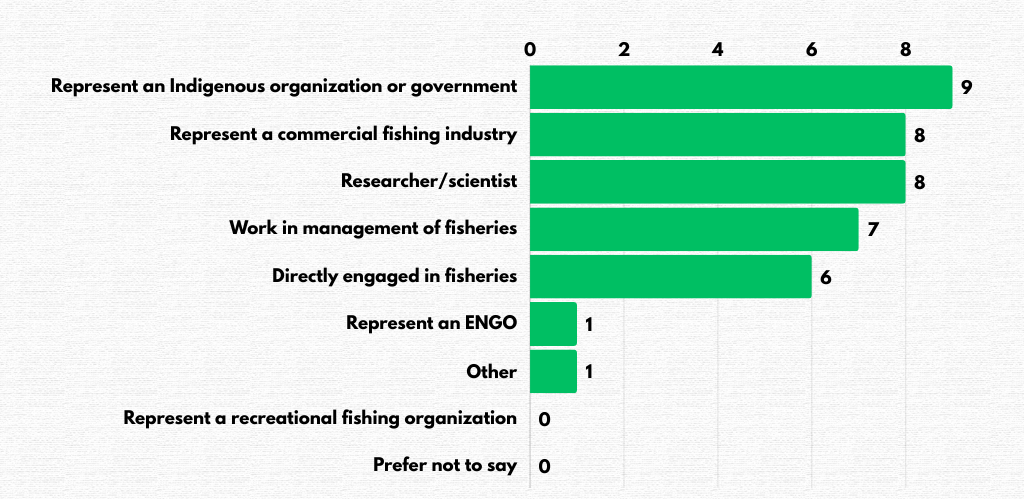
- 9 participants represented an Indigenous organization or government
- 8 participants were researchers or scientists
- 8 participants represented a commercial fishing industry
- 7 participants worked in fisheries management
- 6 participants were directly engaged in fisheries
- 1 participant represented an environmental non-governmental organization
- 1 participant selected ‘other’ as their role
Question 2: On a scale from 1 to 5 (1 being the lowest and 5 being the highest), please indicate the extent to which you agree or disagree with the following statements
Figure 2
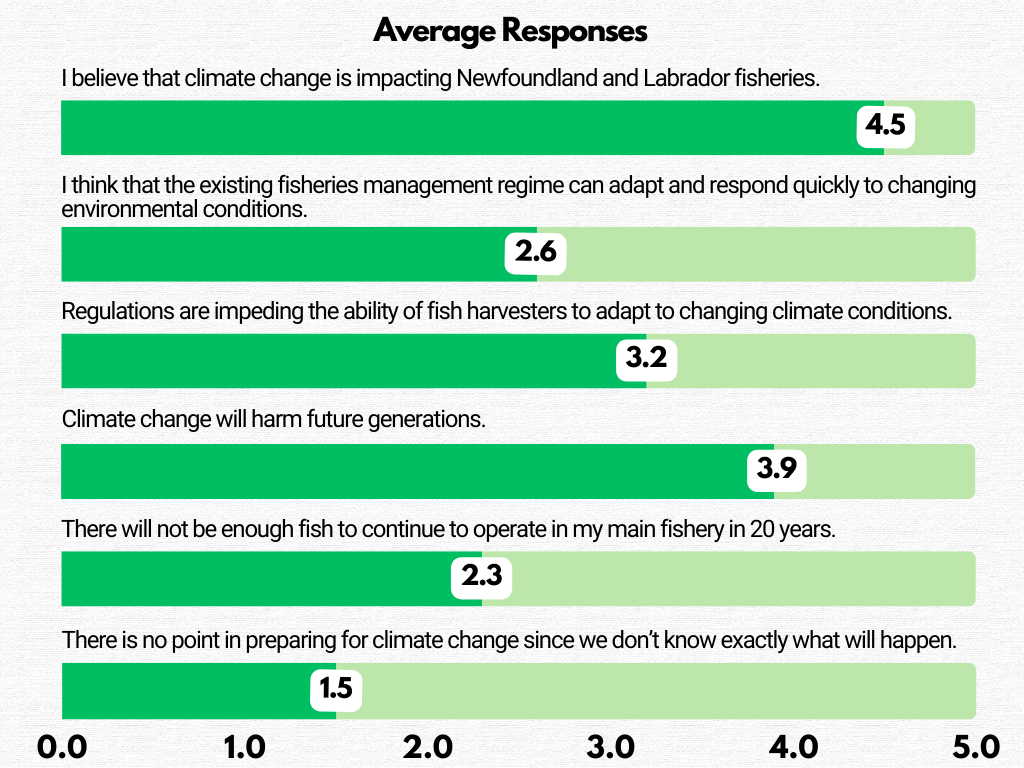
- I believe climate change is impacting Newfoundland and Labrador fisheries. Average response: 4.5
- I think that the existing fisheries management regime can adapt and respond quickly to changing environmental conditions. Average response: 2.6
- Regulations are impeding the ability of fish harvesters to adapt to changing climate conditions. Average response: 3.2
- Climate change will harm future generations. Average response: 3.9
- There will not be enough fish to continue to operate in my main fishery in 20 years. Average response: 2.3
- There is no point in preparing for climate change since we do not know exactly what will happen. Average response: 1.5
Question 3: What could increase the agility and flexibility of the fisheries management regime to respond to future challenges
Open text responses:
- Dynamic reference points.
- A national climate change strategy for fisheries, more resources (funding, human resources), political will to address climate change.
- Gather more information from harvesters. They are on or near the water every day and are therefore well positioned to see changes that are happening in the marine environment.
- Productivity based decision tools.
- To start chatting and doing more research with fishers and Indigenous Peoples.
- Multidisciplinary teams in science, including social sciences as fisheries are at the base of socioeconomic resources in coastal communities in Canada. Scenario planning is also a viable option.
- Work towards ecosystem-based fisheries management and use a climate risk index to determine how vulnerable commercial species/stocks are to different climate scenarios in the future.
- Incorporate local ecological knowledge.
- Faster response and inclusion of observational data in stock assessments. More emphasis on experimental fisheries to determine if observational data is persistent and repeatable.
- Increased resources for core fisheries science work (e.g., Management Strategy Evaluation development, Research Vessel (RV) surveys, availability of and succession planning for stock assessment experts, etc.)
- Transparency, more leverage to science.
- Tracking movement and seasonality. No relying on a single survey fixed in time (RV) or space (mackerel) without other data. Listen and respect on the water experience. Not projecting 50 years forward.
- Adaptive management, but this will be severely constrained/precluded by the precautionary approach and data limitations that will handcuff DFO management.
Participant list
Representatives from the following organizations, groups, environmental non-governmental organizations, institutions, and/or governments attended the workshop. In alphabetical order:
- Atlantic Groundfish Council
- Atlantic Policy Congress of First Nations Chiefs Secretariat
- Canadian Association of Prawn Producers (CAPP)
- Canadian Sealers Association
- Fish, Food and Allied Workers Union
- of Newfoundland & Labrador - Fisheries, Forestry and Agriculture (FFA)
- Innu Nation - Ueushuk Fisheries
- Marine Institute of Memorial University
- Miawpukek First Nation
- Miawpukek First Nation/Netukulimk Fisheries Ltd
- Nature United
- Newfound Resources Ltd.
- NunatuKavut Community Council Inc.
- Ocean Choice International (OCI)
- Oceans North
- Professional Fish Harvesters Certification Board (St. John’s, NL)
- Qalipu First Nation
- Wild Ocean Research
Page details
- Date modified: