
What We Heard: Adapting Maritimes fisheries to a changing climate
Note: Fisheries and Oceans Canada (DFO) held a series of 7 regionally focused workshops to discuss climate change impacts, barriers to adaptation, and actions to support the resilience of Canada’s wild-capture fish harvesters and harvesting industry.
What we heard report: Regional perspectives on adapting Canadian fisheries to a changing climate
On this page
- Disclaimer
- Executive summary: key takeaways
- Report
- Impacts of a changing climate on Maritimes’ fisheries
- Adapting to a changing climate
- Looking to the future
- Results of the polling exercise
- Question 1: Choose all of the following that apply to you and your role
- Question 2: On a scale from 1 to 5 (1 being the lowest and 5 being the highest), please indicate the extent to which you agree or disagree with the following statements
- Question 3: What could increase the agility and flexibility of the fisheries management regime to respond to future challenges
- Participant list
Disclaimer
The following report contains opinions expressed by those who attended the regional workshop sessions and do not necessarily reflect the views of Fisheries and Oceans Canada (DFO).
Throughout this report, participant views are represented as received by DFO. However, in some instances there are discrepancies between participant interpretations and what is authorized by DFO. As such, participant comments may not correspond to the statutory, regulatory, and policy framework as understood by DFO. In addition, participant recommendations noted below reflect general consensus but should not be interpreted as having received unanimous consent.
Executive summary: key takeaways
Participants reported experiencing several impacts from climate change on their fisheries, including:
- Major shifts in species distribution: Participants reported that many fish species are moving northward, causing a decline in native populations in the Maritimes. Tropical fish are emerging due to warming waters, complicating bycatch predictions.
- Changes to fishing timing: Participants reported that fishing is starting earlier in spring due to ice-free waters, but fluctuating sea temperatures result in unpredictable catches.
- Invasive species: Participants reported seeing more invasive species such as green crabs and sea vomit.
Participants reported several concerns regarding fisheries in the era of climate change, including:
- Policy concerns: Participants questioned existing policy’s ability to address climate-driven changes, particularly regarding shifting species abundance and distribution.
- Impacts on coastal communities: Participants highlighted broader challenges, including employment, infrastructure, and the service sector, urging a focus on supporting thriving communities.
- Data gaps: Participants communicated a need for more research on the impacts of climate change on predator/prey relationships and beyond target species.
Participants are taking several actions to adapt to the impacts of a changing climate, including:
- Enhancing data collection and research efforts such as using satellite telemetry to track nesting habitats and migration routes, expanding research to include environmental data alongside biological sampling, using genomics research to ensure species survival in warmer waters, as well as studying sea level rise and storm events.
- Diversifying fisheries, fishing gear, and harvesting methods, such as developing tools for safer fishing practices, exploring alternative harvesting methods to reduce environmental impacts, developing new trawling technologies to minimize bycatch, researching access to adjacent fisheries, and exploring new fishing gear.
Participants highlighted what they consider to be some of the biggest barriers to adaptation, including:
- Slow and siloed fisheries management systems, causing coordination issues and slow adaptation to climate.
- Rigid regulations on fishing times and gear types, with very slow processes to change them.
- Lack of future projections and predictions about climate impacts, predator-prey relationships, and species movements.
Participants shared ideas for specific actions, or opportunities, to support adaptation efforts including:
- Diversifying fish species and exploring new economic opportunities.
- Communicating both short-term and long-term climate risks, while developing strategies to mitigate these risks.
- Implementing more inclusive, interactive consultation approaches such as a climate change working group focused on mixed-table discussions. Participants highlighted the need for building capacity across industry, government, and environmental non-governmental organizations to engage in effective climate change adaptation.
- Considering future management scenarios to facilitate in-season management decisions and to support long-term planning.
- Raising public awareness on the impacts of climate change of fisheries, including the shared responsibility for change and adaptation across all sectors.
Report
Impacts of a changing climate on Maritimes’ fisheries
How is climate change impacting your fisheries
Workshop participants highlighted various climate change impacts and vulnerabilities, particularly the shifts in species distribution. Many noticed changes in migration patterns and routes, with species moving northward, leading to a decline in native populations in the Maritimes region. The warming waters are bringing new fish from tropical regions, complicating the prediction of bycatch and non-target species. A key concern for many was the impact of these shifts on food availability for target species, as they relocate to different areas or depths.
Additionally, Participants raised concerns about changes in the timing of fisheries have, noting they are now fishing at times they had not before—starting earlier in the spring —as ice-free waters have become more common. However, fluctuating and less predictable sea surface temperatures have led to lower and more unpredictable catches. As fish migrations and aggregations shift, participants said this is affecting fish quality and availability, and in some cases, leading to gear conflicts. These distributional and timing shifts were also described as causing more conflicts among harvesters. Moreover, participants noted that the overlapping changes in fisheries across international borders have increased tensions, particularly with harvesters from the United States, given that many fisheries are shared across jurisdictions.
We heard that lobster fisheries have been heavily impacted, with harvesters noting rapid changes in seasonality, size distribution, and product quality. It was highlighted that the southern regions are seeing declines in lobster populations, while the northern areas are experiencing gains, creating inequitable impacts. Discussions around lobster season changes have been frequent, with warmer and colder bottom temperatures affecting the timing of lobster moults and changes to the age of maturity.
Participants shared concerns over the inability to harvest traditional species, such as salmon, noting the significant cultural impacts this has on Indigenous communities. They also highlighted how climate change is deeply affecting commercial fishing and the broader processing chain in coastal communities. The increased frequency and severity of storms are raised safety concerns for harvesters, while also threatening infrastructure and leading to increased gear loss. Additionally, there isa sense that churning waters are disrupting species patterns and behaviours, making fishing less predictable.
The rise of invasive species like green crabs and sea vomit has become a growing concern, particularly in relation to at-risk species like salmon and eels, as these invaders outcompete native species for resources. In addition, participants reported an increase in diseases and vibrio, especially among shellfish like scallops and oysters. These combined climate change impacts are leaving both harvesters and Indigenous communities struggling to adapt, contributing to a growing sense of concern over the future predictability of fishing in the Maritimes region.
What are your biggest areas of challenge and concern related to these climate impacts
Participants raised a number of significant concerns, many of which are linked to shifting environmental conditions and the impact this is having on fisheries. One of the most pressing concerns heard from participants was regarding current fisheries policies and management approaches. Participants noted that current policies and regulations require amendments to effectively address the extensive, climate-driven changes to fisheries. In particular, a key concern raised was how policies will respond to the shifting abundance and distribution of species. One major question that came up was how access to resources will be determined when species shift away. Species distribution and who should have access to resources in light of these changes were highlighted as a key concern.
Participants emphasized that a holistic approach to fisheries management that goes beyond the science of individual stocks to consider the broader picture, including all fisheries and communities, will allow Fisheries and Oceans Canada (DFO) to make future decisions. Expanding the current single-species management system will improve flexibility and increase the speed of response to rapid climate changes, with participants calling for a more proactive and flexible management regime, including in-season decisions to address anomalies.
The incorporation of climate impacts into management plans was another key point, with participants requesting that more attention and resources be directed towards incorporating climate considerations into all fisheries decisions going forward. Many expressed that existing fisheries management processes should be updated in the near future to address increases in new species emerging in Canadian waters, disappearing stocks, and changing seasons as a result of climate change.
Participants also highlighted the broader impacts and challenges of climate change on coastal communities, including employment, the service sector, and infrastructure. Some suggested that changes should be considered not only to ensure fisheries survive but to allow them to thrive in support of coastal communities. There was also a notable concern about how Indigenous fisheries will be managed amid uncertainty, with questions about how Canada will ensure that its commitments to Indigenous communities and fisheries are upheld in the face of climate change.
Bait availability and the approval process for new bait were raised as concerns, particularly regarding the use of green crab as bait for lobster fisheries. Some participants are worried about the risks that green crab poses to lobster, such as spreading diseases like white-spot syndrome virus and other parasites.
Participants emphasized the need for increased data beyond target species to understand the impacts of climate change on predator/prey relationships, which are critical for managing fisheries. Additionally, increasing the capacity of coastal infrastructure, trying to reduce operating costs for replacing gear, and improving coordination between federal and provincial governments in accessing infrastructure were discussed. Extreme weather events and their impacts on fishing operations, science surveys, and fish food sources were also noted as significant concerns.
Participants expressed concerns about the impact of climate change on mollusks, particularly in relation to salinity, calcium carbonate production, food availability at increased depths, increased turbidity from storms, and the timing of algal blooms. The potential effects of climate change on salmon were also highlighted, especially in relation to changes in migration routes, spawning success, and the availability of prey, which are affecting salmon reproduction and survival rates.
A number of lobster-specific concerns were also raised, particularly related to the timing of lobster moults, which affect their survivability during transport. Additionally, it was noted that soft-shelled lobsters are facing increased mortality and loss of value due to increased handling during this vulnerable stage.
Finally, participants wrestled with the challenge of balancing precautionary measures with the need to support coastal communities that depend on fishing. The dilemma lies in planning for reduced yields while still allowing some fishing to take place to sustain local economies, raising tough questions about how to strike a balance between sustainability and economic livelihoods.
What has changed the most in your fisheries
Participants reported that species patterns are becoming increasingly unpredictable, making fisheries more complex to manage. The impacts on productivity have varied dramatically across different species, with some experiencing declines while others are shifting to new areas or emerging in unexpected locations. This unpredictability has added significant challenges to forecasting fish populations, making it harder to plan fishing efforts and manage resources effectively. As a result, there is growing concern about how to adapt to these changing conditions and ensure the sustainability of fisheries in the face of such variability.
Adapting to a changing climate
What actions are you taking to respond or adapt to the impacts of changing conditions
Participants shared several ongoing and planned actions aimed at adapting to the challenges posed by climate change. Below, you will find some examples of key adaptation strategies being implemented in the Maritimes region.
Many participants are taking actions to enhancing data collection and research efforts, such as:
- Gathering critical data on Atlantic salmon using satellite telemetry, including nesting habitats and migration routes. This data is being shared with decision-makers and the public to improve understanding and management of salmon populations.
- Creating a framework to assess the impacts and risks of climate change on marine wildlife and working in collaboration with an ENGO to translate findings into actionable outputs for harvesters and fisheries management personnel, to support informed decision-making.
- Advocating for more tailored research. This includes gathering data on water temperature and catch trends for community fisheries, which can help inform adjustments to fishing seasons.
- Expanding research to include more environmental data alongside biological sampling. There is a particular focus on tracking changes in bait sourcing and lobster movements to adapt to new conditions.
- Training students to become future leaders in fisheries and climate change adaptation, alongside securing funding for continued fisheries research.
- Developing tools for shellfish monitoring. Genomics research is underway to understand how shellfish can be more tolerable to higher water temperatures helping to secure the future of these vital marine resources.
- Studying sea level rise and storm events, particularly in the intertidal zone, to assess their impact on seaweed and shellfish fisheries, with a focus on resilience and adaptation strategies.
Participants shared some of the actions they are taking, aimed at diversifying fisheries, fishing gear and harvesting methods, such as:
- Researching into other fisheries and exploring ways to access adjacent fisheries.
- Exploring new fishing gear for commercially viable species.
- Developing tools to make fishing practices safer for whales and reduce environmental risks.
- Adjusting fishing activities to adapt to shifting species habitats.
- Exploring alternative harvesting methods to reduce environmental impacts, alongside pushing for changes in fishing seasons and quotas through regulatory bodies.
- Indigenous nations are adjusting their fishing practices and traditional ways of life in response to environmental changes, ensuring the resilience of their communities and cultural practices.
- Developing new trawling technologies aimed at minimizing bycatch.
Participants emphasized the need to work collaboratively in adapting to climate change and shared a few examples of their strategies:
- Collaborating with DFO to help improve climate risk tools and identify species at highest risk.
- Advocating for collaborative, precautionary decision-making at advisory tables to ensure sustainable practices.
- Focusing on regional coordination and the consolidating information across branches to identify priority areas for investment in climate adaptation.
These collective efforts reflect a comprehensive and multi-faceted approach to adapting to the challenges posed by climate change, with a strong emphasis on research, innovation, collaboration, and the integration of both environmental and social science considerations.
What do you think are the biggest barriers to adaptation
Participants identified several significant barriers that are making it harder for harvesters to adapt to the impacts of climate change on fisheries. Participants identified a significant need for more cohesive and flexible regulations in fisheries management, especially as climate change accelerates. The current regulatory systems could be amended to achieve a more holistic approach, reducing issues with licensing for harvesters and improving coordination between policies affecting different species and areas, and enabling DFO to act more swiftly and with more flexibility in response to emerging fisheries and species distribution shifts.
Participants explained that the current fisheries regime and regulatory system overall is too slow to adapt. For example, participants shared that regulations on fishing times and gear types take too long to change, making it difficult to remain agile in the face of shifting conditions. Participants called for a shift from reactive to proactive decision-making, implementing plans for likely crises, such as those linked to climate change, to promote industry stability and mitigate risks. Additionally, participants suggested that an increased breadth of data be used by DFO to improve future projections and predictions about climate impacts, predator-prey relationships, and species movements.
The politicalization of fisheries decisions was identified as a major barrier. Participants find it challenging when policies and decisions shift based on political cycles rather than sound, long-term planning, and feel that it creates instabilities for harvesters. Furthermore, increasing enforcement could create a more harmonious environment for harvesters, improve certainty and strengthen the ability to achieve meaningful change. To improve the situation, participants called for a more integrated management approach that includes input from harvesters and environmental scientists, and a more balanced consideration of both adaptation and mitigation strategies. The decision-making process must include a broader understanding of regional and local dynamics, as well as support for owner-operator businesses and infrastructure investment. Participants noted that a fragmented regulatory framework and regional inconsistencies in decision-making could be addressed by a more unified, forward-thinking, and inclusive approach to address the challenges facing the fisheries industry, with particular attention to climate change and long-term sustainability.
What do you need to better adapt to the impacts of changing conditions
Participants highlighted several areas of support that are needed to better adapt to climate change, focusing on proactive, flexible approaches to fisheries management and greater collaboration. The following key themes emerged at the workshop:
- Proactive and flexible management: Participants stressed the importance of adopting a proactive, flexible fisheries management approach that takes into account the evolving challenges faced by harvesters and communities. This includes better communication, more inclusive decision-making, and a deeper understanding of these challenges. Suggestions included considering experimental or short-term season changes and finding ways to adjust outside the constraints of current regulations and advisory board schedules.
- Transparency and inclusivity in decision-making: A key theme was the need for clearer communication and a more inclusive decision-making process. Participants called for better specificity in conveying the information and considerations behind fisheries decisions. They emphasized the importance of improving understanding among harvesters about the complexities of these decisions and called for DFO to review its processes to become more agile and responsive.
- Financial stability: Participants called for more certainty in helping harvesters to secure financing for new equipment and vessels.
- Comprehensive approach to fisheries management: Given the increasing impacts of climate change, participants stated that a comprehensive approach to fisheries management could be better accomplished by including social, cultural, and economic considerations when setting long-term goals.
- Education: Education was also identified as critical, particularly in engaging youth through fisheries-focused programs in schools, which would increase awareness of ocean conservation.
- Relationship building: Strengthening the relationships between harvesters and DFO is seen as a crucial step toward collaboration in adapting to challenges associated with climate change, and could be achieved by an increase in accepting valuable experiential knowledge from harvesters.
- Evolving fisheries management tools: As offshore wind and other ocean-related changes emerge, there is a need for fisheries management tools to evolve. Participants called for more openness in DFO, particularly in adjusting stock assessments based on real-time data. They shared that management methods, including gear types and deployment times, must be flexible to keep pace with changing conditions. They also noted that new tools are needed to manage emerging species in Canadian waters, and a collaborative approach to science, involving harvesters with multi-species experience, was seen as essential.
- Improved fisheries monitoring and data collection: Reliable decision-making in an era of change requires increased fisheries monitoring and data collection. Participants highlighted the importance of frequent stock assessments, baseline studies for comparison, and increased engagement with stakeholders to gather insights from all sectors. Participants also suggested integrating third-party consultants for more accurate stock assessments, which would improve the overall reliability of fisheries data.
- Broader knowledge integration: To effectively adapt, participants stressed the need to integrate a broader range of knowledge, including harvester-based insights and social sciences. This includes frequent stock assessments, ongoing stakeholder engagement, and a commitment to predictive work. Additionally, collaboration with climate scientists was recommended to identify the necessary data for better decision-making.
- Socio-economic considerations for coastal communities: Finally, participants emphasized the importance of considering the socio-economic needs of coastal communities in fisheries management. Increased collaboration with provincial governments was seen as essential in finding community-beneficial solutions to ensure long-term sustainability and resilience in the face of climate change.
In summary, participants called for a more flexible, inclusive, and transparent approach to fisheries management, one that recognizes the evolving challenges of climate change and integrates diverse knowledge and perspectives. Through ongoing dialogue, education, and collaboration, we can work towards sustainable fisheries.
Looking to the future
What is your future vision for climate-adapted Maritimes fisheries
Participants shared their future visions for climate-adapted Maritimes fisheries. Their visions emphasized a collaborative, team-oriented approach to fisheries management, prioritizing stakeholder and partner engagement to ensure sustainable and thriving fisheries.
A key priority identified at the workshop was maximizing collaboration within the fisheries sector and reducing conflict. A collaborative approach encourages mutual support and resource sharing, where all parties —Indigenous Peoples, stakeholders, environmental non-governmental organizations, and others—are brought together to work towards common goals. Participants emphasized the importance of inclusive stakeholder meetings that allow everyone to contribute to the decision-making process, while also breaking down barriers between different groups. A vision for successful future fisheries would incorporate a diverse range of voices, ensuring that the interests of all stakeholders are taken into account. Participants also highlighted the importance of ensuring that Indigenous and local communities are central to the fisheries decision-making process, ensuring that economic, ecological, and socio-cultural goals are aligned. The aim of climate-adapted Maritimes fisheries should be to support the health of fish populations while also nurturing vibrant, sustainable communities.
Participants emphasized the need for climate change to be at the forefront of fisheries management decisions. In participants’ future vision, DFO would play an active role in implementing policies and strategies focused on climate-related issues. Management approaches would be nimble and responsive to climate challenges, providing harvesters with confidence in the adaptability of the system. A focus on integrating climate considerations at all stages—from data collection to decision-making— was identified as a crucial step in building resilient fisheries that can adapt to changing environmental conditions. To adapt to climate change, fisheries management should adopt agile practices that allow for quick, flexible responses to emerging challenges. Participants stressed the importance of predictive modelling, especially around surface and bottom temperatures, to help forecast changes and inform decision-making. Management systems should be integrated, with active involvement from diverse stakeholders, to ensure that fisheries remain resilient in the face of climate change.
Workshop participants’ future vision for climate-adapted Maritimes fisheries revolves around collaboration, resilience, and inclusivity. Through a more integrated approach, with diverse stakeholders working together, the region can create sustainable fisheries that thrive economically, ecologically, and socially. The goal is to ensure that both the fisheries and the communities that depend on them remain resilient as they face the ongoing impacts of climate change.
What does success look like
Participants identified several key perspectives on what successful fisheries could look like in the face of climate change. Success in fisheries management incorporates effective information sharing among DFO and stakeholders and discussion during advisory committee meetings which will enhance. agility, improve collaboration, and increase transparency with harvesters. It is also essential that meeting notes capture conflicts and encourage more efforts to seek consensus among stakeholders.
Incorporating predictive modelling into all stock assessment surveys was seen as a crucial step in guiding management decisions more effectively. Success also hinges on creating an inclusive environment for new entrants into the fishing industry, as they bring fresh perspectives and ideas for fisheries. Long-term sustainability should be incentivized, potentially by encouraging new entrants to invest in scientific research and adopt a longer-term view, even if this means sacrificing some short-term opportunities.
There is growing competition for space in the marine environment, with increasing pressures from marine protected areas, offshore wind development, transportation routes, and oil and gas projects. Success will require recognizing these spatial constraints and developing strategies that account for the impact of these pressures, particularly in the context of climate change. As stock ranges shift due to climate change, fisheries may face spatial limitations, with some needing to move into areas already constrained by other ocean uses or protections. Flexibility in management is key in responding to these challenges. Planning should focus on multispecies management, ecosystem approaches, and a climate-informed strategy that prioritizes both prosperous coastal communities and healthy oceans.
Participants advocated for new survey methodologies that can better capture climate change impacts. Additionally, participants put a strong emphasis on establishing a value-based management system. This system should be rooted in core values such as sustainability, long-term thinking, and holistic, collaborative approaches, such as taking inspiration from IK and practices, which advocate for a seven-generation perspective.
What are the best opportunities to support adaptation to get us there
Participants identified several important opportunities to better position Maritimes fisheries to respond to the challenges posed by climate change. These actions emphasize structural changes, stronger collaboration, and increased awareness to ensure long-term sustainability.
- Identifying specific action steps: There was a call for clearer, tangible specifics, including identifying available resources, understanding the level of collaboration possible with DFO, and establishing steps to ensure flexibility and agility in decision-making. Participants stressed a focus towards real, actionable progress that can be implemented in the short term.
- Diversification and innovation: Diversification within the fisheries sector is necessary to ensure sustainability. Participants highlighted the importance of preventing overexploitation of individual stocks by exploring new opportunities and innovative products. This will require a renewed focus on safeguarding vital fishing areas through intentional management mechanisms like protected areas.
- Collaboration with Indigenous groups: Participants highlighted that there is significant potential for collaboration between industry stakeholders and Indigenous groups, especially in safeguarding critical areas and ensuring their future sustainability. This collaboration should focus on shared interests in the long-term health of fisheries, while respecting IK and governance systems.
- Raising public awareness: Raising public awareness on the impacts of climate change on fisheries is important. This includes stressing the shared responsibility across all sectors, such as conservation, Indigenous groups, and commercial interests. Participants emphasized the importance of educating the public, particularly children, and ensuring that harvesters understand not only local but global climate risks.
- Balancing short-term and long-term goals: It is essential to balance the immediate concerns of harvesters with the broader, long-term goals for the sector. Developing regional scenarios that account for uncertainties, while also leveraging the knowledge available to shape future outcomes, is vital for preparing for the challenges ahead. Participants also urged for a clear definition of “adaptation,” with a focus on both short-term survival and long-term, thriving fisheries.
- Restructuring advisory committees: Participants stressed the desire to revamp advisory committees. One suggestion for this revitalization would be to make written submissions mandatory for all participants, ensuring a more transparent and comprehensive decision-making process.
- Access to fisheries and supporting coastal communities: Participants shared that protecting access to fisheries for individual owner-operator enterprises within coastal communities is critical and that supporting these enterprises through funding and adaptation trials will help them remain resilient in the face of climate change.
- Reevaluating consultation methods: Participants suggested that a climate change working group be created, focused on mixed-table discussions be created to ensure that climate considerations are incorporated into the decision-making process using inclusive, interactive approaches. Participants highlighted the need for capacity-building across industry, government, and environmental non-governmental organizations to engage in effective climate change adaptation. Solutions may not be perfect from the outset, but fostering a willingness to engage and adapt will be essential to long-term success.
- Diversifying: As part of adaptation, diversifying harvested species and exploring new economic opportunities is crucial for the future of the industry. Participants emphasized the need to communicate both short-term and long-term risks, while developing strategies to mitigate these risks.
To ensure the Maritimes fisheries are resilient to climate change, a collaborative, proactive approach is needed. Key actions include ensuring more inclusive consultation processes, diversifying the sector, and increasing public awareness. A long-term commitment to adaptability and sustainability, with a focus on protecting vital areas and fostering innovation, will be critical in navigating the climate uncertainties of the future.
Results of the polling exercise
During the workshop, participants were asked to take part in an anonymous polling exercise. Participant responses are displayed below. Please note that Question 3 required participants to provide an open-text response; responses reflect the text as submitted.
Question 1: Choose all of the following that apply to you and your role
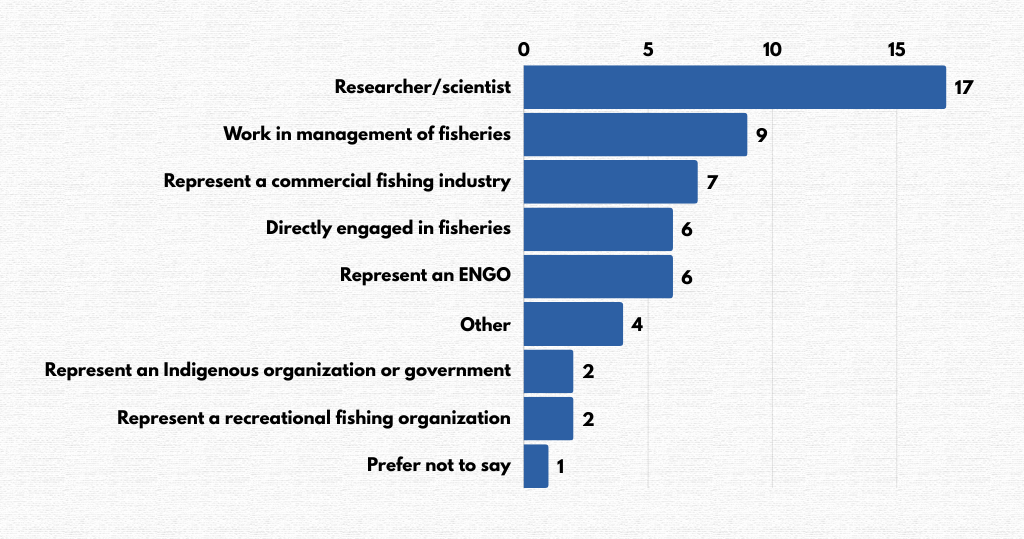
- 17 participants were researchers or scientists
- Nine participants worked in fisheries management
- Seven participants represented a commercial fishing industry
- Six participants were directly engaged in fisheries
- Six participants represented an ENGO
- Four participants selected “other” as their role
- Two participants represented an Indigenous organization or government
- One participant selected “prefer not to say” as their role
Question 2: On a scale from 1 to 5 (1 being the lowest and 5 being the highest), please indicate the extent to which you agree or disagree with the following statements
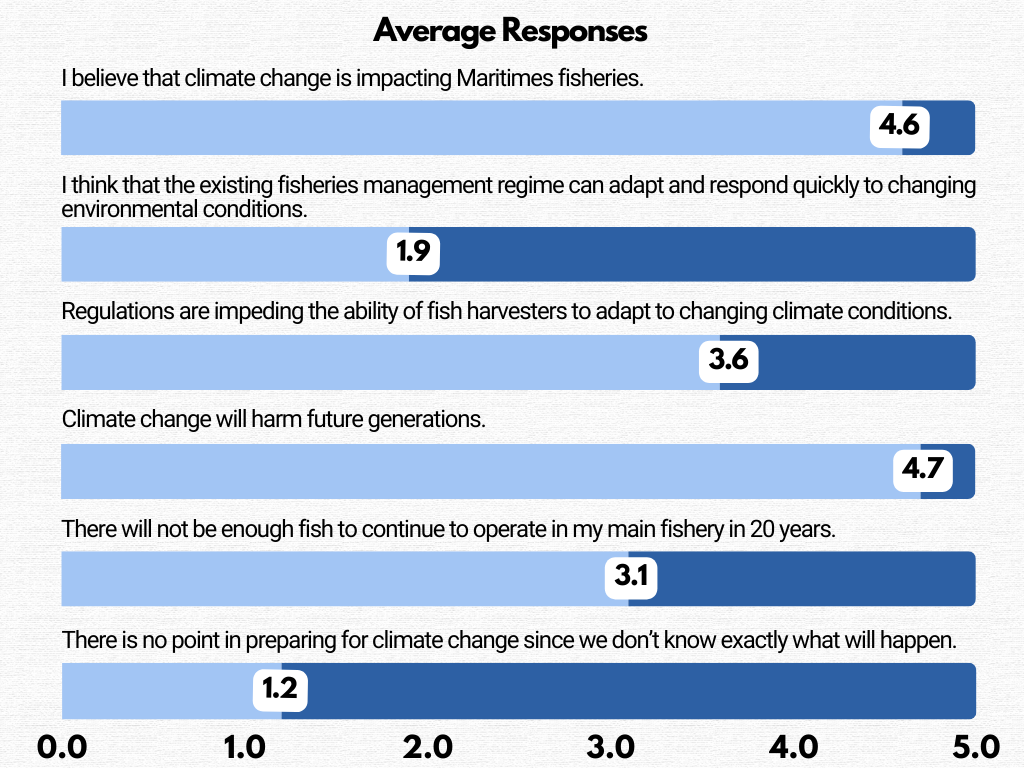
- I believe climate change is impacting Maritimes fisheries. Average response: 4.6
- I think that the existing fisheries management regime can adapt and respond quickly to changing environmental conditions. Average response: 1.9
- Regulations are impeding the ability of fish harvesters to adapt to changing climate conditions. Average response: 3.6
- Climate change will harm future generations. Average response: 4.7
- There will not be enough fish to continue to operate in my main fishery in 20 years. Average response: 3.1
- There is no point in preparing for climate change since we do not know exactly what will happen. Average response 1.2
Question 3: What could increase the agility and flexibility of the fisheries management regime to respond to future challenges
Open text responses:
- Scenario planning to facilitate in-season management decisions and to support long-term planning.
- Stakeholders and managers working together to consider future management scenarios in an anticipatory way – how will decisions be made in a different future? What is needed to prepare?
- Aggregating data and making it available faster.
- Better understanding of the environmental, social, economic and policy contexts.
- More data and analyses that can be incorporated into fisheries modelling and then fisheries management decisions. Climate needs to be looked at as one of the key ecosystem pieces to inform management.
- Strengthening collaboration within DFO and harvester advisory committees.
- Working more closely with the provincial governments.
- DFO will need to be able to make quick and efficient fisheries management decisions with the existing datasets while also building them.
- Doing in-season reviews.
- Changing to the timing of fishing seasons.
- Creating regulatory mechanisms to support flexibility.
- More science directly tied to water temperature (surface and bottom temperature).
- Localized decision making and data.
- Improving engagement with all knowledge holders and more opportunities to work together. We’re all in this together.
- Greater research capacity (data, ship time, personnel), increased decision-making transparency, explicit direction and support from the top to consider climate change in fisheries assessment/decision-making.
- Considering climate change science in decision making and using tools like climate vulnerability assessments and scenario planning.
- Having DFO policy or strategy that directs specific attention and time/resources to addressing management under climate change.
- Developing a climate change action plan from DFO.
- Creating baseline studies so we know what has changed.
- Having dynamic fishing rules in place to address issues like shifts in species distributions (e.g., quote allocation based on distribution of resource and not historical values).
- Incorporating climate change as a main factor (positive and negative) to mortality and reproduction of fish species and habitat.
- Enhancing leadership at the regional level, with more flexibility and decision-making capabilities.
- Regulatory change management: we need agility and speed to adjust (gear innovation, fishing techniques and tools).
- Better and more modern data collection.
- Building in climate considerations to advisory meetings. Providing information to help make good decisions as climate-driven changes occur.
- Focusing on the future of fisheries and coastal communities (social, cultural and economic).
- Better modelling – adjusting existing models to incorporate the level of climate change that harvesters are seeing on the water.
- DFO to prioritize planning for the future and address acute change. Implement EAFM across regions to incorporate ecosystem variables.
- Rebuilding stocks and more precautionary decision making.
- Training programs for things like targeting and handling new/alternate species, using and adopting new equipment.
- Reviewing regulations to ensure agility and flexibility or to identify where these might be lacking.
- Ecosystem based management – A more holistic approach, considering interconnectedness of species, habitats and environmental conditions.
- Adaptive management.
- Integrating new data testing.
- Strategies in real time to adjust fishing, quotas, seasons, closures and help foster resilience against environmental changes.
- Blending scientific data and IK to enhance the understanding of fish behavior and ecosystem changes. Allow for adjustments to protect fish populations and habitats.
- Climate integrated lens. Using climate projections like shown today to predict future habitat, shifts, support, proactive quota and ensure sustainability in changing conditions.
Participant list
Representatives from the following organizations, groups, environmental non-governmental organizations, institutions, and/or governments attended the workshop. In alphabetical order:
- 4VN Management Board
- Assembly of First Nations (AFN)
- Atlantic Salmon Federation
- Bluenose Coastal Action Foundation
- Canadian Wildlife Federation
- Cape Breton Fish Harvesters Association
- Clearwater & FNC Quota Ltd Partnership
- Coldwater Lobster Association
- Confederacy of Mainland Mi'kmaq (CMM)
- Conservation Council of New Brunswick (CCNB)
- Dalhousie University
- Ecology Action Centre (EAC)
- Full Bay Scallop Association
- Fundy North Fishermen's Association
- Fundy Weir
- Guysborough County Inshore Fisherman's Association
- Lobster Council of Canada
- Maritime Aboriginal Peoples Council /MAARS
- Maritime Fishermen's Union
- Maritime Fishermen's Union - Local 6
- Memorial University
- Nature United
- Nova Scotia Federation of Anglers and Hunters
- Oceans North
- Richmond County Inshore Fishermen’s Assoc.
- Scotia Fundy Mobile Gear Fishermen's Association / Mersey Seafoods/ Scotia Harvest
- Southwest Fundy Progressive Protection Council
- St. Margaret’s Bay Trap net fishermen
- University of British Columbia
- Université du Québec à Rimouski
- University of New Brunswick
- University of Victoria
- Wild Ocean Research
- Wolastoqey Nation in New Brunswick
Page details
- Date modified: