
What We Heard: Adapting Gulf fisheries to a changing climate
Note: Fisheries and Oceans Canada (DFO) held a series of 7 regionally focused workshops to discuss climate change impacts, barriers to adaptation, and actions to support the resilience of Canada’s wild-capture fish harvesters and harvesting industry.
What we heard report: regional perspectives on adapting Canadian fisheries to a changing climate
On this page
- Disclaimer
- Executive summary: key takeaways
- Report
- Impacts of a changing climate and barriers to adaptation
- How is climate change impacting your fisheries
- What are your biggest areas of challenge and concern related to these climate impacts
- What has changed the most in your fisheries
- What actions are you taking to respond or adapt to the impacts of changing conditions
- What do you think are the biggest barriers to adaptation
- What do you need to better adapt to the impacts of changing conditions
- Looking to the future
- Results of the polling exercise
- Question 1: Choose all of the following that apply to you and your role
- Question 2: On a scale from 1 to 5 (1 being the lowest and 5 being the highest), please indicate the extent to which you agree or disagree with the following statements
- Question 3: What could increase the agility and flexibility of the fisheries management regime to respond to future challenges
- Participant list
- Impacts of a changing climate and barriers to adaptation
Disclaimer
The following report contains opinions expressed by those who attended the regional workshop sessions and do not necessarily reflect the views of Fisheries and Oceans Canada (DFO).
Throughout this report, participant views are represented as received by DFO. However, in some instances there are discrepancies between participant interpretations and what is authorized by DFO. As such, participant comments may not correspond to the statutory, regulatory, and policy framework as understood by DFO. In addition, participant recommendations noted below reflect general consensus but should not be interpreted as having received unanimous consent.
Executive summary: key takeaways
Participants reported experiencing several impacts as a result of climate change, including:
- Major shifts in species distribution and declines in some fisheries. Participants noted the observation of shifting species distribution and migration patterns, and the decline in certain species including shrimp, mackerel and herring, and Atlantic salmon.
- Increased extreme weather events. Participants reported that increased intensity of post tropical storms, rising ocean temperatures and shifting currents are impacting the vulnerability of certain species and affecting maturation cycles.
- Participants reported an increase in the presence of whales and sharks, causing fisheries closures and gear adjustments.
Participants reported several concerns regarding fisheries in the era of climate change, including:
- Funding concerns: Participants were concerned with Fisheries and Oceans Canada’s (DFO) ability to address climate-driven changes without expanded science funding, and noted that many cannot afford costs associated with adaptation.
- Data gaps: Participants communicated a need for more socioeconomic research on the impacts of climate change on resource users.
Participants are taking several actions to adapt to a changing climate, including:
- Enhancing the scope of research and monitoring of sharks and whale occurrence modelling
- Experimenting with and adopting the use of whale-safe (or ropeless) gear, allowing harvesting activities to continue in closed areas.
- Developing risk assessments, strategies and adaptation plans.
Participants identified several key barriers to adaptation, including:
- Slow and siloed fisheries management systems and regions, causing coordination issues and slow adaptation to climate.
- Lack of coordination among federal and provincial governments and fishing associations.
- Budget uncertainty and cuts leading to inadequate scientific data collection and analysis, leaving fisheries management decisions to be made using outdated information.
Participants identified several key actions to help fisheries adapt to climate change, including:
- Proactive and flexible fisheries management to account for the evolving challenges faced by harvesters, industry, and their communities.
- Implementing more inclusive, collaborative discussions within management committees to identify possible solutions for numerous groups.
- Increasing access for all resource users to more inclusive funding and programs to mitigate the high cost of adaptation.
- Raising public awareness on the impacts of climate change of fisheries, and the importance of fisheries as a vital link to food security in the Gulf.
Report
Impacts of a changing climate and barriers to adaptation
How is climate change impacting your fisheries
Participants identified numerous concerns related to climate change and associated vulnerabilities, primarily the observation of shifting species distribution and migration patterns, and the decline in certain species including shrimp, mackerel, herring and Atlantic salmon. Impacts to habitats, the introduction of new and invasive species, and the resulting interaction between predator and prey are also a concern in terms of the impact on stocks, fisheries management decisions, and stability in fisheries. While many participants discussed the impacts of the significant decrease in Gulf shrimp, the possibility of success stories because of these shifts was identified, specifically the recovery of striped bass in the Gulf of St. Lawrence. However, as a primary predator for Atlantic salmon smolts, participants reported that the increase in striped bass has created conflict among fisheries due to the effects on smolt production and the resulting decline of salmon.
Participants noted that climate change seems to be impacting fisheries and aquaculture much sooner than anticipated, and expressed concerns regarding extreme weather events and patterns such as the increased intensity of post tropical storms, increasing water temperatures, atmospheric heat waves, and the shifting of the Gulf Stream and Labrador currents. Impacts included the vulnerability of certain fisheries during hurricane season, such as tuna, as well as season dates requiring modification in response to earlier warming of sea temperatures. Increased water temperatures have species-specific effects, including rapid changes in seasonality, maturation and molting, and overall quality of lobster, and increases in population in new areas creating perceived inequitable gains. Participants indicated that species like herring and snow crab are shifting their distributions toward deeper, colder waters and different regional territories, impacting existing harvesters and creating issues with gear requirements and policy conflicts.
Changing species distributions and stock rebuilding, while positive in some respects, were a concern for participants who have been impacted by increased sightings and incidental deaths of North Atlantic Right Whales (NARW) and the presence of white sharks in the Gulf of St. Lawrence. While generally beneficial from a conservation perspective, recovering stocks increases prey for sharks and consequently increases their interaction in fisheries and humans. Increasing water temperature has impacted both the timing and migration patterns of NARW, causing them to shift away from traditional feeding areas. This increased presence in the Gulf directly impacts the ability for some harvesters to fish due to fisheries closures, and participants indicated that responsive efforts, such as changing gear to adapt to closures, only works for certain fisheries.
Along with these impacts, we heard significant concerns from participants related to the future stability and predictability of future fishing in the Gulf region, specifically the ability for fisheries management decision-making processes to become responsive and adapt to climate change. Many participants expressed concern related to a perceived lack of timely science data collection by the Department and the knock-on effects to fisheries like Gulf shrimp.
What are your biggest areas of challenge and concern related to these climate impacts
Changes in seasonality came up in discussion with participants frequently, specifically the increased need to adjust season dates due to rising sea temperatures, changes in species abundance, and most notably the impact of shifting NARW migration patterns and timing. Participants noted that these increased whale sightings significantly influence their ability to plan fishing expeditions due to the short evacuation period, the magnitude of area covered by a closure, and the inability to effectively track and predict the presence of whales.
The reduction of Total Available Catch (TAC) in some fisheries due to changes in distribution, increased predation, and changing ocean environment (most notably Gulf shrimp) has caused concern for many participants wondering how other fisheries may respond to these changes and, in turn, how DFO will continue to manage decisions in an effective and time-sensitive manner. Participants shared that the decrease in TAC for Gulf shrimp created considerable difficulties for not only harvesters to maintain their livelihoods but also caused serious financial problems in a fishery with a high debt burden. Additionally, impacts were also felt by processors and plant workers, who were forced to lay off staff, shut down operations, or transform their facilities in order to process different species.
Participants identified that there is an opportunity for DFO to increase the amount of social science research being conducted, which would help to more effectively measure the impacts of fisheries management decisions on people and their communities. They expressed that the resources needed to conduct relevant research and timely tools to inform communities, managers and decision-makers can be difficult to obtain, the process to obtain them is rather lengthy and the amounts are not sufficient to have an impact quickly or as nimbly as is required. Participants felt that increasing overall accessibility to these tools and ensuring that harvester data and feedback regarding issues identified during a fishing season will better enable participants to effectively conduct their business planning. Many expressed the need for more opportunities to communicate with DFO, as well as expanding the breadth of membership in some fora in order to include additional perspectives that could provide a more holistic representation of what is “happening on the water,” including fish processors and buyers. They felt that this approach would improve the Department’s access to available data and ensure a more thorough audience is receiving information that can impact the productivity of coastal communities quickly and more effectively.
The centre of many of the identified challenges includes the difficulty in securing appropriate funding and the perceived lack of considerable investment by DFO into solving increasing complications associated with shifting environmental conditions. Participants noted that improved accessibility of funding by DFO would help make the decision-making processes faster, more efficient, and more flexible, and provide the resources required to conduct accurate and timely research. Many noted that there is a need to adapt the way that problems are identified and solutions are synthesized as a result of climate change. Some expressed frustration with a perceived lack of timely and efficient adaptability in fisheries management decisions, indicating that it is often the case that as they finally become adapted to a change, another is required, and the cycle begins again. Many find themselves unable to financially afford the adaptation needed for new requirements or experience significant difficulty accessing funding outside of highly specified funding eligibility requirements.
Participants identified that funding offered by DFO (such as the Fisheries Funds) is typically too restrictive, focusing more on research and development projects than providing appropriate adaptation assistance to both harvesters and industry. The inability to predict the next big “boom or bust” also has substantial effect on income reliance with a reverberating impact within communities in terms of livelihoods and the ability for harvesters and industry to plan their businesses from one season to the next.
What has changed the most in your fisheries
Participants reported that shifting species distributions are making fisheries more complex to manage, along with rising predator populations that are threatening other species (e.g., such as Striped bass which are threaten species like lobster and Atlantic salmon). Rising temperatures have driven some species into colder, deeper depths which can conflict with species-specific gear, vessels, and enterprise capabilities. Other fisheries are experiencing a significant increase in severe weather events, creating harsh conditions and heightened safety risks. Finally, many participants spoke to the increased presence of NARW adding stress to local economies due to closures and interruptions to fishing accessibility, but also to harvesters themselves.
What actions are you taking to respond or adapt to the impacts of changing conditions
Participants shared several ongoing and planned actions aimed at adapting to the challenges posed by climate change. Several examples of responsive adaptation actions taken were shared by participants, including:
- Experimenting with and adopting the use of whale-safe (or ropeless) gear, giving interested harvesters the opportunity to fish in areas closed due to NARW.
- When funding is denied, pooling resources and shouldering the cost of new gear types to maintain resilience.
- Collaboration between academia and harvesters in the development of ropeless gear trials and accompanying criteria and standards to evaluate various whale-safe systems.
- Creation of the CanFISH Lending Gear Program, which lends new and adaptive whale-safe gear to harvesters shut out of fishing areas due to NARW closures.
- Development of Provincial Climate Change Risk Assessment and Adaptation plans, along with funds to support projects related to climate change such as whale-safe gear, local food, and fishing diversification efforts.
- Increasing the scope of research and monitoring of sharks and whale occurrence modelling.
- Diversifying markets and products with a focus on quality over quantity.
- Exploring Adaptation Fund development.
- Development of Seafood Sector Risk Assessment and Adaptation Strategy.
These collective efforts reflect a comprehensive and multi-faceted approach to adapting to the challenges posed by climate change, with a strong emphasis on research, innovation, collaboration, and the integration of both environmental and social science considerations.
What do you think are the biggest barriers to adaptation
Some of the most significant barriers identified by participants centre around departmental decision making and internal operations. Many noted that, after over a decade of discussions, the continued focus on the ecosystem approach to fisheries management often loses momentum due to staff turnover, a lack of consistent budget approvals, and a slow science process. Others noted that with the changes to biology and behaviour occurring more rapidly than the publication of pertinent scientific data, there is a need for DFO to adapt surveying methodology and timing to be more reflective of the current state of fisheries.
Another discussion noted the fragmented regional organization of the Department was possibly creating an unintended obstacle to engaging appropriate teams required to enable the effective sharing of experiences and best practices in Atlantic Canada. However, participants felt that developing and maintaining a unified and collaborative forward trajectory would be enabled by adapting regionally-specific policies and practices, as well as internal governance structures, to ensure consistent practices and common client service delivery methods.
Participants identified that increased coordination among federal and provincial governments and fishing associations is key to enabling cohesive and collaborative approaches to fisheries management built from shared experiences – visibility in what partners are doing facilitates precise and accelerated interventions that will positively impact the fish and seafood sector as a whole.
What do you need to better adapt to the impacts of changing conditions
Participants highlighted several areas of support that are needed to better adapt to climate change, focusing on proactive, flexible approaches to fisheries management and greater collaboration. The following key themes emerged at the workshop:
- Proactive and flexible management: Participants stressed the importance of adopting a proactive, flexible fisheries management approach that takes into account the evolving challenges faced by harvesters, industry, and their communities. This includes a deeper understanding of species-specific challenges, improved communication quality and speed, and inclusive fisheries management decision-making. Suggestions included added research efforts to gather data on reproduction, larval survival rates, mortality rates, and species recruitment, along with changes to advisory board membership, acceptance of citizen science, and more reactive decision-making. The need for large, targeted investments was identified as a requirement to support rapid and effective adaptations in the absence of a faster regulatory development and implementation process.
- Transparency and inclusivity in decision-making: A key theme was the need for clearer communication and a more inclusive decision-making process. Participants called for more specificity in conveying the information and considerations behind fisheries decisions. They emphasized the importance of improving understanding among harvesters about the complexities of these decisions and called for DFO to review its processes to become more agile and responsive. They also identified room for improvement by increasing transparency between DFO and the sector when it comes to conversations about climate change and the impacts to fisheries, as well as regional communication and collaboration across DFO. Expanding the breadth and focus of scientific research was seen as a critical step for DFO to take in order to gather data required to answer new questions arising from the impacts of climate change.
- Financial stability and accessibility: Participants called for more certainty in helping harvesters to secure financing for rising operating costs, such as the need for new and adaptive technology, fuel prices, and the impending uncertainty of the impacts of a new American administration such as customs and/or tariffs.
- Comprehensive approach to fisheries management: Given the increasing impacts of climate change, participants urged DFO to take a more comprehensive approach to fisheries management that incorporates social aspects into policies. Social, cultural, and economic considerations must be included in setting long-term goals.
- Relationship building: Conflicts among harvesters are increasingly being seen in highly lucrative fisheries such as lobster and elvers, creating unsafe environments and bolstering a belief that compliance is being sacrificed for financial gains and motivations. Participants felt that increased enforcement activities would reduce conflict among harvesters while enhancing trust between the sector and DFO.
In summary, participants called for more flexible, inclusive, and transparent approaches to fisheries management, recognizing the evolution of challenges presented by climate change and incorporating a more holistic approach that integrates the perspectives and knowledge from various groups. Improving data collection and financial stability, building comprehensive and inclusive management processes, and repairing relationships are seen as first steps in working towards more resilient fisheries.
Looking to the future
What is your future vision for climate-adapted Gulf fisheries? What does success look like
A key priority identified at the workshop was minimizing silos in the fisheries sector and reducing conflict, as well as working together and in consultation with as many resource users as possible. A collaborative approach encourages increased access to many different types of solutions from a broad spectrum of groups, leading to an enhanced decision-making process that is responsive to a wide breadth of concerns and issues. Participants noted that while the future vision of fisheries is one that ensures climate-adaptability to support the health of fish populations and the ecosystem, it must also concurrently nurture the sustainability of communities central to the fishing industry and contributors to the local coastal economy.
Participants shared numerous important perspectives defining what a future vision and success could look like. There was significant consensus that the key signs of success would be DFO’s transition from reactive fisheries management to a more proactive approach. This would include using holistic scientific data to provide more comprehensive advice related to the full life cycles of all species, while incorporating the use of different decision-making functions and methodologies such as scenario planning or ‘foresighting’ exercises. This would allow resource users to better predict possible outcomes in different scenarios and to anticipate potential future impacts. A more comprehensive approach would enhance stakeholder’s abilities to weigh the trade-offs of different possible scenarios (e.g., consequences for the stock, consequences for the economics of the fishery, as well as consequences for the social dimensions of coastal communities).
Examining how other countries manage fisheries resources and markets in the face of climate change was seen by participants as a key step in finding new and innovate ways to adapt Canadian practices to reflect more modernized approaches to fisheries management. For example, Alaska’s co-management models were referenced as a possible solution to ensuring a broad spectrum of interests and ideas are captured when making decisions. Additionally, transitioning from single-species fisheries to more adaptable multi-species fisheries was also suggested.
Considering recent distributional shifts and Total Allowable Catch (TAC) reductions, participants noted that the development of fisheries that are focused more on quality, rather than quantity, would help maintain healthy and resilient stocks, as opposed to the existing regime of economically-focused over-exploitation. Participants noted that this would require additional research to find new and effective ways to manage fisheries in ways that allow for profitability while keeping resources in the Gulf healthy, such as incorporating more innovative technologies that are accessible to harvesters and industry.
Participants shared that a more harmonious consultation process with stakeholders in the fisheries management process would be an important signal of success. Enabling information sharing between DFO and the resource users would bolster collaboration among groups. It would also provide an opportunity for fresh ideas and new perspectives to be built upon the vast knowledge of harvesters and industry. Participants also highlighted that expanding membership inclusivity in management committees and boards would have a significant effect on resource users by enhancing a stronger, more integrated sense of connection between government and coastal communities.
Finally, participants noted that improved quality and quantity of research efforts and scientific data would increase support to industry when facing challenges with the rising prevalence of diseases, predation, storms and weather events, and shifting migration patterns. Participants suggested that advancements in data collection would better inform resource users and enable them to make adaptive decisions in response to rapid environmental and social changes, while being nimble and flexible enough to prepare for future challenges. Ensuring that science receives the appropriate levels of funding to support our understanding of, and response to, the escalation of climate-related impacts being observed in the Gulf is seen as paramount to successfully implementing an adaptable and resilient fisheries management regime.
What are the best opportunities to support adaptation to get us there
Participants identified several important opportunities to better position Gulf fisheries to respond to the challenges posed by climate change. These actions focus on improved and more inclusive collaboration efforts, making concerted efforts to understand underlying drivers of climate change, and co-developing a new culture of fishing to help evolve into a more responsive, adaptable, and flexible regime.
- Inclusive collaboration within management committees: Participants stressed the desire to include a wider breadth of membership at committees to ensure a more holistic exchange of cross-cutting issues that overlap with many interests. Including communities, associations, industry members and harvesters, along with those focused on ecosystem management was seen as key to creating synergies and identifying possible solutions that help more than one group.
- Public awareness: Participants highlighted the need to raise public awareness about the impacts of climate change on the fish and seafood sector, including the shared responsibility across all resource users, such as Indigenous groups, commercial operations, and industry. Participants emphasized the importance of educating the public about the impacts of climate change on our oceans and fishing sector, and the vital link between fishing and food security. Participants also felt that fishing should be reframed from an ancillary activity limited to small rural communities to an integral part of Canada’s environmental sustainability and national food security, similar to agriculture.
- Education and training: Participants underscored the importance of incorporating education to harvesters and resource users as part of their training to ensure that their knowledge of existing challenges related to climate change and the continued risk of new and more complex ones and how these will impact their businesses. Participants felt that by providing more awareness of existing risks and sharing experiences, resource users will be able to make more informed decisions when starting up and maintaining a business in the fishing sector. This could potentially help to reduce the request for and reliance on financial support and subsidies.
- Restructuring fisheries management: Participants noted the urgent need to restructure and adapt fisheries management decisions to more accurately respond to current and future uncertainties and challenges facing the sector. This includes moving from a single-species to multi-species approach, and pursuing adaptable management that better allows for responsiveness to change. The accelerating impacts of climate change were cited as a major driver of this need. Participants also pointed to the necessity of modernizing stock assessment methods—such as moving away from fixed survey locations—to reflect shifting species distributions.
- Access to funding and programs: Participants identified increasing access to funding and programs that are inclusive as a key enabler of adaptation. Participants noted that even with new advancements in technology designed to be more sustainable and adaptive, it is the prohibitive cost that prevents many resource users from adopting new designs rather than resistance to change. They explained that supporting small fishing businesses in becoming resilient requires appropriate funding options to enable the implementation and use of new technology and gear, and diversifying fishing portfolios. The creation and or/expansion of insurance programs was also suggested to help reduce costs related to sudden TAC declines or other market shocks, as well as increased weather-related damage to infrastructure and gear.
To ensure the resilience of Gulf fisheries to respond effectively to climate change, participants indicated that increased and inclusive collaboration and more proactive approaches are needed, with key actions including ensuring more inclusive consultation processes, diversifying the sector, and increasing public awareness. Participants felt that a long-term commitment to adaptability and sustainability, with a focus on protecting vital areas and fostering innovation, will be critical in navigating the climate uncertainties of the future.
Results of the polling exercise
During the workshop, participants were asked to take part in an anonymous polling exercise. Participant responses are displayed below. Please note that Question 3 required participants to provide an open-text response; responses reflect the text as submitted.
Question 1: Choose all of the following that apply to you and your role
Figure 1
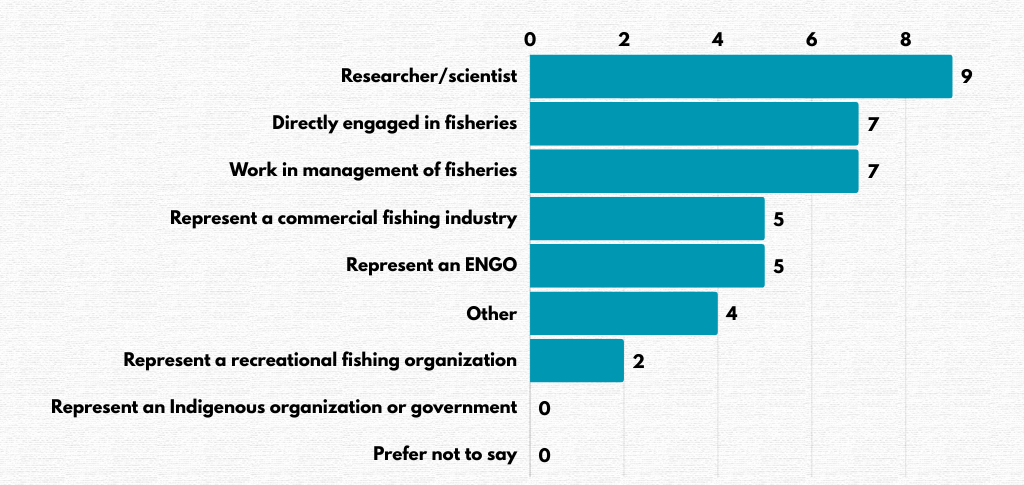
- 9 participants were researchers or scientists
- 7 participants worked in fisheries management
- 7 participants were directly engaged in fisheries
- 5 participants represented a commercial fishing industry
- 5 participants represented an environmental non-governmental organization
- 4 participants selected ‘other’ as their role
- 2 participants represented a recreational fishing organization
Question 2: On a scale from 1 to 5 (1 being the lowest and 5 being the highest), please indicate the extent to which you agree or disagree with the following statements
Figure 2
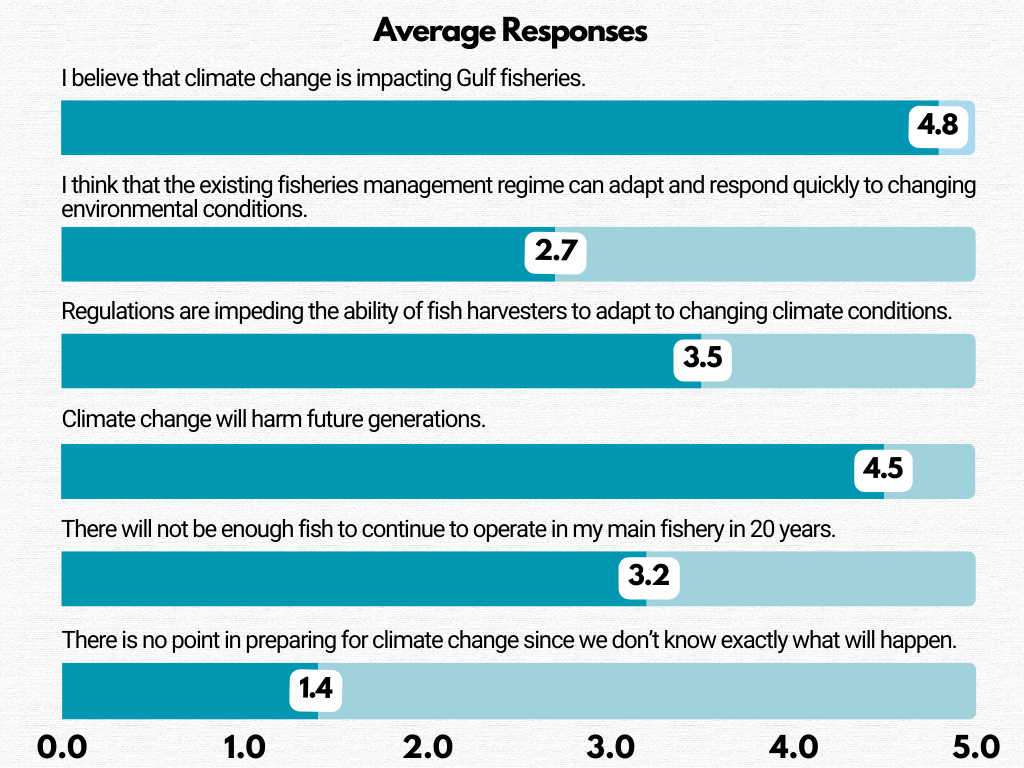
- I believe climate change is impacting Gulf fisheries. Average response: 4.8
- I think that the existing fisheries management regime can adapt and respond quickly to changing environmental conditions. Average response: 2.7
- Regulations are impeding the ability of fish harvesters to adapt to changing climate conditions. Average response: 3.5
- Climate change will harm future generations. Average response: 4.5
- There will not be enough fish to continue to operate in my main fishery in 20 years. Average response: 3.2
- There is no point in preparing for climate change since we do not know exactly what will happen. Average response: 1.4
Question 3: What could increase the agility and flexibility of the fisheries management regime to respond to future challenges
Open text responses:
- More communication between harvesters and DFO, proactive/adaptive management.
- Have more conservation measures with adaptive structure for fisheries restrictions, comparable to the NARW adaptive management examples.
- Include as much data on climate change outcomes in each assessment and stop managing by socioeconomic considerations.
- Ethical, transparent collaboration and real-time fisheries assessments that combine with other sources of data (e.g., whales, pollution).
- More support for climate research, core DFO research (stock assessment), a national climate adaptation strategy for fisheries, a greater separation of science and politics at DFO.
- Increase environmental monitoring and speed up the process of stock assessment year-to-year.
- To get predictions of the impact of known climate change effects on various stocks and find ways to mitigate rather than remediate.
- Region-based approach and approvals rather than Ministerial level where delays and decisions impact capacity and ability to fish responsibly.
- Greater prioritization of climate adaptation and funding. Less interference of political interests, more of DFO science and advice. A unified approach (e.g., National Adaptation Strategy).
- Maintain detailed actions to ensure knowledge transfer to future managers.
- Fisheries management in Canada requires fast tracking toward full adoption of ecosystem management. At this point, focus appears to be on single species and single issues.
- Rebuilding depleted fish populations in place now will aid fisheries management to be flexible in the future. Implementing rebuilding plans for depleted stocks is required for climate resiliency.
- Some experience or mentorship prior to elevation to program or fisheries lead position.
- Clear top-down national policy guidance.
- Decisions based on science and accurate data reporting become more efficient to help policy and regulations adjust with input from key stakeholders.
- Integrate the precautionary approach into fishery management regulations; implement science recommendations in advance of stocks becoming critically depleted and supplement fisheries when needed.
- Revisiting business models.
- Change accounting practices.
- Secure income (citizenship income) to reduce the precarity of fishermen's helpers and dependence on coupons.
- Reliable, high-quality and rapidly available data. Prediction models that take climate change scenarios into account.
- Enhancing the value of an industry focused on the local distribution of resources.
- Rethink the licensing model (speculative-pension scheme).
- Develop operating models based on a collective approach, so that the burden on individuals is minimized (including debt) and the community impact of fisheries is enhanced.
- Putting more emphasis in collecting harvester data.
Participant list
Representatives from the following organizations, groups, environmental non-governmental organizations, institutions, and/or governments attended the workshop. In alphabetical order:
- Area 19 Snow Crab Fishermen’s Association
- Association des pêcheurs spécialistes de poisson de fond
- Atlantic Salmon Federation
- Canadian Wildlife Federation
- Connor Bros / Clover Leaf Seafoods
- Dalhousie University - Ocean Frontier Institute
- Elsipogtog First Nation
- eOceans
- Foundation for Conservation of Atlantic Salmon
- FRAPP
- Gulf Nova Scotia Fishermen’s Coalition
- Maritimes Fishermen's Union
- New Brunswick Department of Agriculture, Aquaculture and Fisheries
- New Brunswick Aboriginal Peoples Council
- New Brunswick Wildlife Federation
- North of Smokey Fishermen's Association
- Oceana Canada
- Oceans North
- Ocearch
- PEI Department of Fisheries
- PEI Snow Crab Fisherman Inc.
- Tuna Charters Nova Scotia Association
- University of Laval
- University of Quebec at Rimouski
- Wild Ocean Research
Page details
- Date modified: