
What We Heard: Adapting Eastern Arctic fisheries to a changing climate
(Nunavut, Nunatsiavut, Nunavik and Baie-James)
Note: Fisheries and Oceans Canada (DFO) held a series of 7 regionally focused workshops to discuss climate change impacts, barriers to adaptation, and actions to support the resilience of Canada's wild-capture fish harvesters and harvesting industry.
What we heard report: regional perspectives on adapting Canadian fisheries to a changing climate
On this page
- Disclaimer
- Executive summary: key takeaways
- Report
- Impacts of a changing climate and barriers to adaptation
- Looking to the future
- Results of the polling exercise
- Question 1: Choose all of the following that apply to you and your role
- Question 2: On a scale from 1 to 5 (1 being the lowest and 5 being the highest), please indicate the extent to which you agree or disagree with the following statements
- Question 3: What could increase the agility and flexibility of the fisheries management regime to respond to future challenges
- Participant list
Disclaimer
The following report contains opinions expressed by those who attended the regional workshop sessions and do not necessarily reflect the views of Fisheries and Oceans Canada (DFO).
Throughout this report, participant views are represented as received by DFO. However, in some instances there are discrepancies between participant interpretations and what is authorized by DFO. As such, participant comments may not correspond to the statutory, regulatory, and policy framework as understood by DFO. In addition, participant recommendations noted below reflect general consensus but should not be interpreted as having received unanimous consent.
Executive summary: key takeaways
Participants reported experiencing several impacts from climate change on their fisheries, including:
- Varying degrees of changes to species distribution, migration patterns and abundance; including impacts to marine mammals.
- The arrival of invasive species.
- Changes in fish health such as increases in disease, and changes to the colour and texture of flesh.
- Increased frequency of storms shifts in wind patterns, and significant impacts to ice conditions are impacting the predictability of fishing seasons and jeopardizing safety.
- Some climate change impacts may also be positive.
Participants are taking several actions to adapt to the impacts of a changing climate, including:
- The use of excluder devices to reduce the number of Greenland shark caught as bycatch.
- The advancement of the Climate Risk Index for Biodiversity - a tool to predict how fish species in specific areas will be affected by climate impacts.
- Numerous community-based actions focused largely on increasing the amount and structure of communication, establishing communication structures, supporting the sharing of information, embracing learning and training opportunities.
Participants highlighted what they consider to be some of the biggest barriers to adaptation, including:
- Insufficient or unreliable funding: Limited investment in science, data collection, new technologies, and long-term maintenance, especially in Inuit communities. Also problematic is funding that ends abruptly, resulting in the collapse of joint projects or priority undertakings.
- Data gaps & limited predictive capacity: Lack of baseline data and predictive tools and processes hinders understanding of climate impacts and future planning capacity.
- Need for localized research: Broad-scale studies do not reflect local fisheries; better integration of Inuit Qaujimajatuqangit (IQ), also referred to as Inuit Traditional Knowledge, with scientific data is needed.
- Need for improved information sharing: Lack of transparency and communication from DFO, regarding how research findings are applied to decision-making. This makes it difficult for stakeholders to access and apply DFO data and research.
- Reactive fisheries management: Current management approaches tend to be reactive rather than proactive, limiting the development and use of predictive tools and slowing DFO's ability to respond effectively.
- DFO structure: Limited coordination across regions and sectors within DFO creates challenges for implementing a comprehensive approach to fisheries management and scientific activities.
- Lack of infrastructure: Inadequate harbors and food-processing facilities limit Inuit participation and climate resilience.
Participants identified several key actions to help fisheries adapt to climate change, including:
- Funding: Explore alternative models, invest in proactive resources, and ensure long-term support for collaboration, research, and community-led initiatives.
- IQ: Integrate IQ at all stages of research and decision-making; co-develop research questions and methodologies and communicate results clearly.
- Future planning and scenario development: Develop tools to predict and plan for ecological, economic, and climate uncertainties, using best- and worst-case projections. Build community-informed adaptation plans.
- Science and data: Focus on gap analyses, coordination across research efforts, innovative tools (e.g., drones, Artificial Intelligence), knowledge integration, and proactive planning for ecosystem-based fisheries management.
- Strengthen communication and cultural respect: Foster ongoing dialogue and continued respect for cultural norms, use plain-language reporting, and integrate IQ values across research and engagement.
- Infrastructure: Invest in northern infrastructure, plan for future harbour needs, and support food-processing facilities for Inuit communities.
- Strengthen communities and build local capacity: Foster community-led fisheries monitoring, education, locally managed research, and ensure equity in data ownership and decision-making.
- Foster innovation and shared responsibility: Explore innovative data collection methods, such as drones and Artificial Intelligence, and develop flexible fisheries management approaches that respond to changing conditions.
- Integration of knowledge sources: Integrate insights from multiple sources, including international examples, to inform adaptive fisheries planning in the eastern Arctic.
Report
Impacts of a changing climate and barriers to adaptation
How is climate change impacting your fisheries? What are your biggest areas of challenge and concern? What has changed the most
The impacts of climate change on fisheries in the Eastern Arctic are complex and multifaceted. Participants reported changes to species distribution, migration and/or lifecycle patterns, abundance and health. It was noted that these types of changes are also being seen amongst marine mammals, which represent key predators in marine food webs. Participants also reported significant changes in weather patterns and ice conditions and noted concerns about climate impacts on food security. Variation in the degree of current climate impacts were noted, as were both areas of concern and potential opportunities. Overall, there was consensus that the degree and speed at which things are occurring should be considered alarming.
Many participants reported observable changes in species distribution and migration patterns. Increasing water temperatures are contributing to shifts in distribution, with an overall movement northward. They reported that species that were once found in more temperate southern areas are moving farther north, while warmer-water species are becoming more abundant in Arctic waters. They mentioned that this is adding to growing concerns about the increased presence of invasive species and their potential to further destabilize local ecosystems and threaten native species. They noted that the migration patterns (e.g., timing and length of stay) of some species also appear to be changing, impacting traditional harvesting practices.
Some species-specific observations were made:
- Increased observations of groundfish, resulting in excellent catch rates for halibut.
- Capelin has been reported as far north as Baffin Island.
- Arctic char was reported as being absent from some traditional fishing areas, while being found in new places. Participants have also observed char migrating upstream and downstream earlier.
- Turbot is not currently showing big changes.
- Participants noted that Arctic skate are not currently demonstrating noticeable distribution shifts, although future challenges are possible resulting from temperature changes.
- Redfish are observed to be more abundant. While there may be potential opportunities that come with this, there are also significant concerns about the threat they pose to shrimp.
- Shrimp abundance was described as variable, with participants generally observing a downward trend.
We were told that Hunters and Trappers Organizations (HTO) and Inuit are particularly concerned about how climate change appears to be impacting marine mammals. Specifically referenced were bowhead, narwhal, and beluga whales, as well as ringed seals. Participants reported seeing an increased abundance of marine mammals; shifts in migration timing; seeing them in new places; and observing them remaining in expected areas for longer periods of time. This is raising questions about what these shifts mean for other species co-existing in the marine environment, including impacts on predator-prey relationships and if/how DFO is integrating changes among top predators into broader ecosystem assessments.
Participants are either increasingly observing, or hearing concerns about, fish with health issues such as disease, injuries, and changes in body condition. For example, the flesh of Arctic char was reported as being paler in colour and softer in texture. This, combined with several fish die-offs in recent years, has raised concerns about the long-term health and sustainability of fish populations in the region.
Changing weather patterns and ice conditions emerged as an area of significant concern. Participants reported experiencing more frequent and severe storms. Additionally, increases in wind strength and changes in wind direction are resulting in high waves and unpredictable harvesting conditions. All of these conditions impact fishing seasons, as harvesters are forced to spend more time waiting out weather conditions, as well as jeopardize harvester safety at sea.
Observable changes to ice conditions were repeatedly raised and were reflected across all three of the breakout groups. Comments generally fell within three categories: freeze/thaw times; ice thickness; and increases in ice calving.
Ice is forming later and melting earlier, and there is more uncertainty and disagreement about when the ice is thick enough to be safe. The variability in freeze/thaw and on/off times is making it harder to predict when fishing seasons can begin or end, disrupting traditional fishing schedules, and creating safety risks for those relying on safe ice conditions for harvesting. Some participants reported snowmobiles going through the water.
The increase in ice calving and the presence of larger icebergs presents new risks to vessels, even those with ice protection. It makes navigation more dangerous, particularly in offshore fisheries, and adds uncertainty to fishing operations.
Some participants stressed that not all current and projected climate impacts in the region are negative. For example:
- As species distribution and migration patterns continue to shift, there may be the potential for pursuing alternative fisheries, and/or increasing economic gain from existing fisheries.
- Changes to freeze/thaw times could result in longer harvest times and more catch. Although this was also noted to have potential adverse effects on things like bycatch of Greenland shark.
- Potential for more food security for the north.
Regardless of if climate impacts were noted as positive or negative, they all contribute to some degree of uncertainty for harvesters about the future of fisheries, ecosystem health, and food security in the Eastern Arctic.
What actions are you taking to respond, or adapt, to the impacts of changing conditions
Participants spoke about some actions being taken at the industry, community or personal level to respond or adapt to climate change. These include mitigation measures to reduce bycatch of the Greenland shark; the advancement of a tool designed to increase predicative capacity; and numerous actions occurring at the community level.
- Mitigation for Greenland shark bycatch: Efforts are underway to develop and deploy excluder devices to reduce bycatch of Greenland sharks, and industry progress was recognized as commendable by non-industry participants. That said, it was noted that there is still work to be done, especially for longline and gillnet fisheries.
- Climate risk index for biodiversity: Developed by Oceans North, the Climate Risk Index for Biodiversity is a tool that maps critical risk areas for over 2000 marine species and 90 fish stocks in the northwest Atlantic Ocean. The tool generates detailed data about how fish species in specific areas will be affected under both high emissions and lower emissions scenarios over the next 75 years.
- Community-based actions: Participants reported a variety of actions being advanced at the community level, with communities working together to support the mobilization and sharing of information. Especially to support the safety of community members. Some examples of specific actions were given:
- Communities are dedicating specific individuals as responsible for ice safety.
- Collaborating with fisheries plants and HTOs to determine if ice is thick enough to be out on.
- Weekly conference calls are being instituted with the HTOs to exchange information on issues of concern, such as ice conditions.
- There has been an increase in the sharing of oral histories, with elders talking more about ice conditions and climate change.
- Wardens are now present in each community that goes out on land and sea. Collaboration with DFO has also been strengthened, as they join patrols with fisheries officers.
Participants also mentioned encouraging community members to capitalize on opportunities to learn about things like inshore fisheries, how to use equipment, etc. There are communities that want to participate in training opportunities and there are community members being trained with regards to science research conducted on a community level. It was noted that people that have that knowledge can share and train other individuals, and that Inuit communities are always thinking of the next generation.
What do you think are the biggest barriers to adaptation
Many themes emerged as part of this discussion on barriers to climate adaptation, including financial barriers, barriers related to science and data, fisheries management, information sharing and communication, the organizational structure of DFO, and critical infrastructure.
The lack of funding invested into science and data collection activities to support filling knowledge gaps and forward planning was raised repeatedly. This funding constraint seemed to be top of mind for the majority of participants. Some of the other commonly cited financial barriers, apart from inadequate investment in science and data collection, were:
- Lack of funding to support investment in research and piloting new approaches. Participants noted that new technologies, equipment, etc. are costly.
- Lack of long-term budgets to support maintenance costs, particularly for equipment installed in Inuit communities (e.g., freezers and processing equipment)
- Lack of funding to support small organizations that do not have the capacity to understand climate impacts to the fisheries and/or respond to community questions and concerns. The following example was given: small organizations do not have the proper infrastructure in place to respond to the risks associated with changing ice conditions. If someone gets stranded on the ice, they do not have the infrastructure to rescue them.
- Unreliable funding (e.g., nonrenewal at the end of a funding cycle) that results in the collapse of joint projects or priority undertakings (Oceans Tracking Network, Baffin Bay Observatory). This is particularly frustrating when money, time and effort has already been invested.
Participants remarked that gaps in data and a lack of baseline information makes it difficult to fully understand how climate change is impacting fisheries in the Eastern Arctic, and to determine with certainty the pace of change or the impacts. Participants noted that there is opportunity for DFO to recognize the importance of data for baseline comparison, and of monitoring at levels sufficient to provide the data needed to detect changes as they occur. Participants repeatedly highlighted the importance of conducting a data gap analysis, and of having access to baseline data, to not only track climate driven changes, but to also support the ability to make future predictions. They noted that an increase in science and data will improve certainty and bolster predictive capacity of harvesters' ability to engage in future planning and make investment decisions. Participants gave some specific examples of science and data improvements that could strengthen adaptation actions: increased insight into predator prey relationships and the spatial scale at which research is done; increased forward-looking data collection; more effective integration of Western science and IQ and improved transparency. Specifically:
- There needs to be an accurate understanding of predator prey relationships and the way in which climate change may be impacting them.
- Research has to occur at the local community and fishery level. Right now, there is a tendency to make broad scale assumptions based only on research done in certain areas, specifically those that support commercial fisheries. However, the Eastern Arctic is vast and these conclusions do not apply to all the local communities and fisheries.
- There is an important need to recognize the value of IQ and integrate it with scientific data. A participant gave the following example: Inuit have been following the whale behavior, movements, and changes for generations and they understand them. Previous disagreements have occurred when tags were placed on a few individual narwhals in specific regions resulting in broader scientific conclusions using limited data (like the issue of spatial scale mentioned above). Inuit know that narwhals are constantly moving in the summer, and their distribution is related to the food they are eating. They could be a great indicator of the entire ecosystem and impacts of climate change.
- The gaps in data impede the ability to predict, forecast and measure changes as they are occurring. Participants highlighted that we must pursue forward looking data collection to support future planning. Doing so will require an evaluation of what information is needed to increase predictive capacities and how we get a better handle on it. For example, it is necessary to try and get an appreciation of the alternatives for fisheries that may exist. There is already an observed increase in redfish, so it is important to track the increased abundance of groundfish, including redfish, to plan and ensure any future fishery is sustainably managed.
- Participants felt that it would be helpful for them to have more access to the results of studies, research projects, and data collected by DFO. Full and transparent access to information, along with more manageable rules around data management and collection, would improve the analytic abilities.
The reactive nature of fisheries management regimes and policies was raised repeatedly as a barrier. Many participants took the position that predictive capacity, cohesion and forward oriented management systems are urgently needed. They noted that proactive fisheries management could be achieved by using predictive tools and processes, and increasing capacity.
A large number of comments could be characterized as reflecting a desire for increased clarity and explanation when communicating information across a variety of sectors, including communication and information sharing between academics and communities; different levels of government; industry; and Inuit harvesters.
The importance of communicating results and findings back to the people who participated in research was raised as a key element for success. Based on participant input, harvesters and community members who contribute to research efforts would like to receive feedback once the research is conducted. Ensuring the communication of results will empower participants by acknowledging their contributions. When departmental results and reports are shared back with communities, participants felt that it would be very useful if some pragmatic suggestions were given on how to take the research in the report and use it to benefit communities, the food system, fisheries, and/or harvesting efforts.
Participants communicated a desire for clarity on how DFO and other organizations use information gathered and how it fits into the broader picture. Returning to the example of the role of marine mammals in the discussion when assessing climate impacts on fisheries ecosystems, participants wonder how marine mammals such as top predators or large species consumers-are accounted for. They noted that if research is focused on shrimp populations, then species like bowhead whales, other shrimp consumers, and the food sources that shrimp rely on should also be considered. The term "ecosystem approach" suggests that all these elements should be integrated, yet there is uncertainty among participants about how this integration is actually taking place.
Participants identified that increased collaboration among DFO regions (e.g., Arctic/Gulf) and across sectors (e.g., science/resource management) would result in improved coordination and connections across regions. This would ensure that region-specific information is incorporated into a big picture synthesis and overview. (e.g., for Atlantic Canada) to better inform resource users.
Participants noted that the necessary harbour infrastructure is not in place to support anticipated future changes. This comment applied to the presence of harbours as well as ensuring any existing infrastructure is climate resilient (ready to withstand the increases in storms, wind, etc.). The absence of food-related infrastructure in communities was identified repeatedly as major barrier for Inuit participation in the industry at the local level. Participants stated it is a challenge from the perspective of both food security and economic development. The following example was given: when community members would like to sell their Arctic char, it must be frozen immediately. If they do not have an active processing plant or freezer there is not the opportunity to freeze the char right away.
Lastly, participants noted there is not always a system of infrastructure in place to support harvesters as ice conditions change. For example, if someone is stranded while fishing, a community is unlikely to have the infrastructure in place to rescue them. Additionally, it was noted that the Coast Guard has not yet adjusted their schedules to reflect the shifts in ice freeze/thaw times.
Looking to the future
What is your future vision for climate-adapted Eastern Arctic fisheries? What does success look like
- Understanding predator-prey relationships and learning from other jurisdictions: Participants shared that predator-prey relationships are well understood by their communities, and this knowledge has the potential to significantly impact decision-making, particularly in the case of marine mammals. They underlined that engaging directly with communities to ensure that local knowledge and IQ is incorporated into decision-making processes is crucial. They noted that it is also important to draw from the observations and experiences of other jurisdictions in relation to managing predators to understand the changes they are making and the management actions they are implementing. Even at a high level, examining these actions can help harvesters in the Eastern Arctic consider potential changes in their own region.
- The importance of collaboration: Participants identified collaboration as essential in addressing the challenges posed by climate change, which affects all sectors, including offshore commercial, inshore, and subsistence fisheries. A cohesive and collaborative approach ensures that everyone benefits. A strong and meaningful partnership between IQ and Western science is crucial for informed decision-making. Incorporating harvester knowledge and IQ alongside scientific research leads to more effective and inclusive outcomes.
- Research, training, and community Leadership: Participants emphasized the importance of identifying research and training priorities, particularly those that are made with and for Inuit communities. This includes work on new or exploratory fisheries. They highlighted the value of training efforts focused on collecting data and standardizing physical sampling techniques, noting that introducing methodologies that Inuit can manage locally can allow them to take the lead while researchers play a supporting role.
- Transparency and information Sharing: Participants stressed that sharing information is key to fostering collaboration and trust. This includes openly distributing data, survey results, and public consultation outcomes. They indicated that transparency should extend beyond merely sharing results-communities must also receive practical guidance on applying research findings to benefit their food systems, fisheries, and harvesting efforts. Participants also highlighted that open communication between sectors, such as commercial fisheries and DFO, ensures that all parties have clear expectations and an understanding of future plans.
- Science, data collection, and future planning: Participants noted that while science and data collection efforts are robust, there are identifiable gaps that require a plan to address them. Collaborative partnerships have been formed where necessary to strengthen research efforts. Baseline assessment tools have been implemented to support data collection and inform future decisions. Given the rapid environmental changes, proactive planning was highlighted as essential. Participants acknowledged that all the information needed may not be available, however, enough data exists to make reasonable predictions about future scenarios, such as warming waters and increased safety threats due to worsening ice conditions and extreme weather. They emphasized that future planning ensures that communities have strategies in place to respond to unexpected developments.
- Community engagement in planning: Participants highlighted the importance of involving communities in planning processes. They emphasized that engaging directly with communities-such as through collaborative mapping exercises-ensures that local knowledge is incorporated into decision-making processes. This participatory approach can lead to more effective and well-rounded strategies that reflect the needs and priorities of the people most affected by environmental and fisheries changes.
- Sustainability and protecting future generations: Participants voiced concerns about the long-term viability of fisheries. They emphasized that overharvesting today could have detrimental effects on future generations and that decision-making must continue to prioritize sustainability, ensuring that resources remain available for those who rely on them in the future. They stressed that responsible resource management is essential to balancing current needs with the needs of future generations.
- The future of James Bay fisheries: Participants shared a future vision for James Bay fisheries that includes contributions to the local economy and food security. They highlighted the need to establish a baseline understanding of coastal waters to support informed decision-making. They emphasized the need for a strong feedback loop to ensure that information is shared back with harvesters and communities, allowing for adaptive and sustainable fisheries management.
What are the best opportunities to support adaptation to get us there? These can include individual and/or collective actions
Funding:
- Explore alternative funding models, including industry-supported research and cross-sector partnerships.
- Invest in equitable access to resources and build capacity for proactive action before crises occur.
- Ensure long-term, reliable funding for sustained collaboration, research, and community-led initiatives.
Integrating IQ:
- Fully integrate IQ at all stages of research and decision-making, co-develop research questions, and incorporate IQ into analysis and outcomes.
- Involve Inuit from the start in formulating research methodologies and frameworks.
- Learn from successful examples where Indigenous and scientific knowledge systems have been integrated.
Future planning and scenario development:
- Develop tools to predict and plan for ecological, economic, and climate-related changes through collaborative scenario planning.
- Create scenarios reflecting best- and worst-case projections, incorporating scientific data, IQ, and community values.
- Design adaptive strategies with policy flexibility to respond to change, ensuring local relevance and support.
- Strengthen data collection to address knowledge gaps and anticipate future developments.
Science and data:
- Conduct gap analyses to prioritize resource investments, improving coordination and reducing duplication across research efforts.
- Utilize innovative data collection methods like drones and AI and develop predictive models for proactive planning.
- Foster integration of IQ with Western science to guide informed, culturally grounded decisions.
- Support ecosystem-based fisheries management by incorporating socio-economic variables and emphasizing proactive planning and transparent data sharing.
Communication and cultural respect:
- Foster ongoing dialogue and improve information sharing between scientists, communities, and government at all levels to build trust.
- Respect oral knowledge traditions and community norms in engagement strategies and ensure accessible formats for research findings.
- Translate materials into Inuit languages and communicate the practical benefits of research to support decision-making and local food systems.
- Encourage mutual learning through culturally grounded spaces, respecting local schedules and community priorities.
Infrastructure:
- Invest in northern infrastructure to support local monitoring, emergency response, and future harbour needs.
- Support the development of food-processing facilities in Inuit communities to enhance food security and economic sustainability.
Strengthening communities and local capacity:
- Focus on practical application of research, providing communities with actionable insights to improve food systems and fisheries.
- Build strong, culturally respectful community-scientist relationships through ongoing, informal engagements.
- Expand education and training to equip youth with skills in science, data collection, and monitoring, and provide communities with tools for leading research.
- Ensure equity in research and data ownership through partnerships that ensure communities retain control over their information.
Fostering innovation and shared responsibility:
- Explore new data collection technologies (e.g., drones, Artificial Intelligence) and foster cross-sector partnerships to address data gaps and strengthen sustainability.
- Develop flexible fisheries management approaches that can adapt to changing conditions, such as adjusting fishing seasons, reallocating quotas, and incorporating IQ into decision-making.
Integration of knowledge sources:
- Integrate insights from multiple sources, including national and global examples, to inform adaptive fisheries management and respond to emerging trends.
- Utilize regional workshops to share knowledge and inform future planning for the Eastern Arctic, ensuring the inclusion of both scientific and IQ in decision-making processes.
What is the most useful way to continue these conversations
When asked about how to continue these discussions, participants indicated that to make future climate change discussions successful, there should regular engagement, clear action plans with tangible outcomes, an effort to integrate insights from international, national, and regional work, meaningful Inuit involvement and accessible communication. These strategies will help ensure that the conversation remains productive and inclusive, with a clear path forward for addressing climate change.
Ongoing and regular engagement
Overall, there was a consensus on the need to continue these discussions. Participants suggested an ongoing forum could be created in order to keep climate change in the forefront of people's minds. Some participants also suggested that existing forums, such as round tables and Advisory Committees could be used to have further discussions like what was done in the workshop itself.
Create a tangible action plan
Participants emphasized that maintaining momentum requires moving beyond discussions and focusing on tangible outcomes. They highlighted the need for a clear work plan with concrete steps, whether that be improving data analysis, addressing data gaps, or identifying available options. This should be an iterative process, inclusive of all stakeholders, and show clear progress. Without this, participants reported that the conversation risks losing momentum.
Integration of knowledge sources
Participants highlighted the importance of integrating insights and findings from multiple sources. They emphasized the need for continuous exposure to these issues, and noted that integrating observations and changes from other jurisdictions can help highlight potential shifts and inspire actionable thinking. Sharing examples from other jurisdictions, even globally, can encourage reflection on possible changes and the kinds of responses that may be needed. Participants mentioned that the work, successes and lessons learned from other harvesting nations (e.g., Australia and Norway), and international bodies, can serve as a starting point.
- The six additional regional workshops that DFO held were also referenced. Participants wanted to know if the What We Heard reports from the other sessions would be accessible. There was interest in seeing how other discussions compared to this one. Participants noted that looking at all the reports in unison can reveal shared challenges and areas of agreement across Canada's regions, while also recognizing and addressing regional differences.
- Additionally, some participants noted that all interested parties should take any opportunity to exchange IQ and science. It was noted that this does not have to occur in a formal setting, such as a big conference or as part of a specific study. Knowledge sharing can be boots on the ground conversations in the field, and in fact some of the best sharing is done in the field.
Inuit engagement
Participants emphasized the importance of continued and meaningful engagement with Inuit communities, designed and led by them. They noted that the success of these engagements should be evaluated by how well they meet the community's needs and how effectively they communicate relevant information.
Clear and accessible communication:
Participants highlighted the need for communications about climate change to be clear and accessible, especially for Inuit communities that may face language barriers or limited access to technical information. They suggested that using plain language and ensuring materials are translated into relevant languages can enhance understanding and participation.
Results of the polling exercise
After the workshop, participants were asked to take part in an anonymous polling exercise. Participant responses are displayed below. Please note that Question 3 required participants to provide an open-text response; responses reflect the text as submitted.
Question 1: Choose all of the following that apply to you and your role
Figure 1
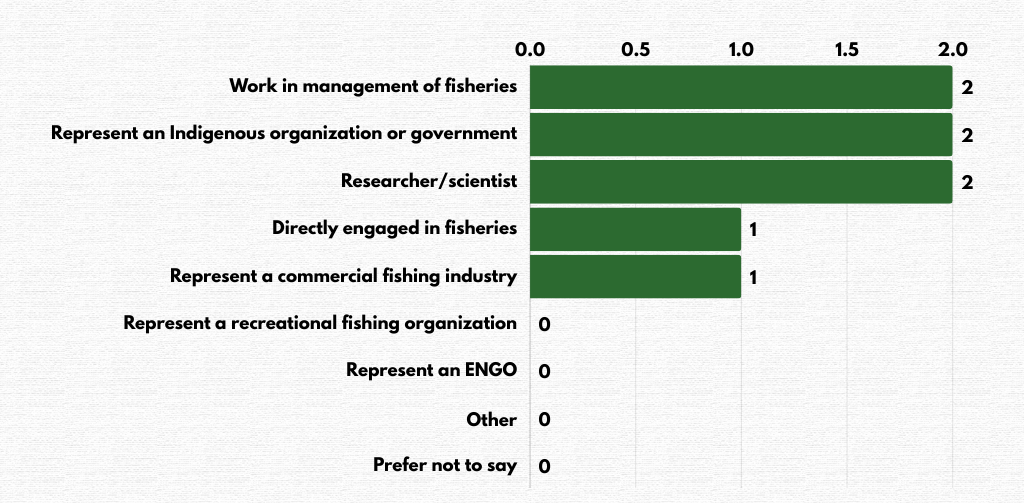
- 2 participants were researchers or scientists
- 2 participants worked in fisheries management
- 2 participants represented an Indigenous organization or government
- 1 participant represented a commercial fishing industry
- 1 participant directly engaged in fisheries
Question 2: On a scale from 1 to 5 (1 being the lowest and 5 being the highest), please indicate the extent to which you agree or disagree with the following statements
Figure 2
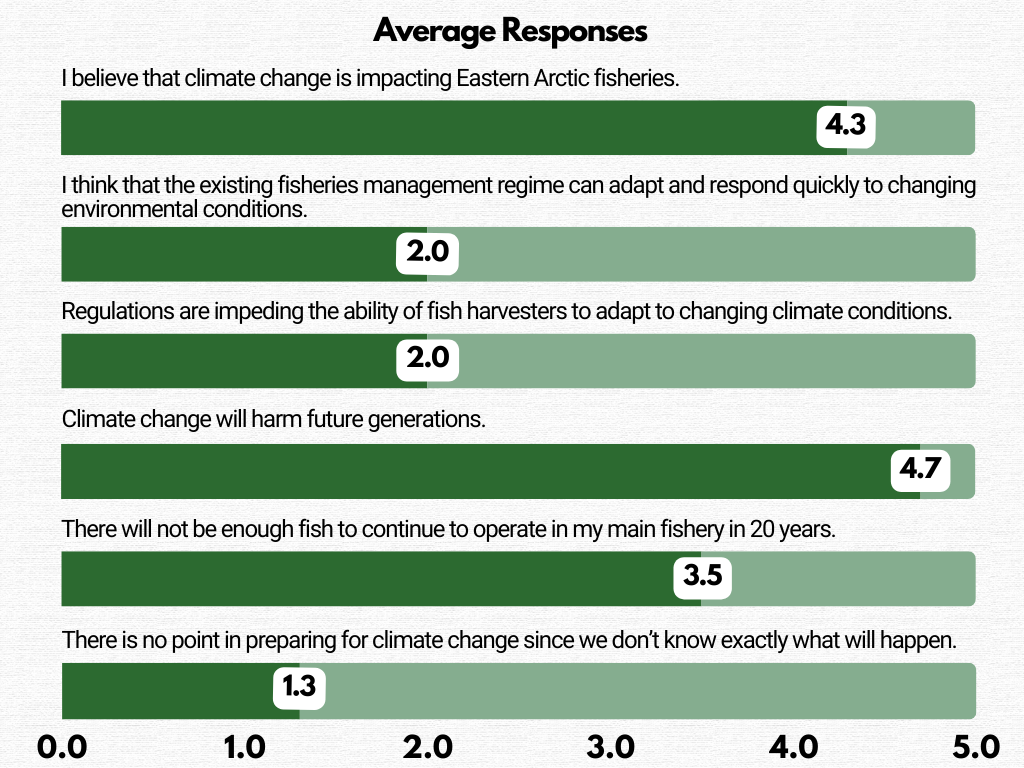
- I believe climate change is impacting Eastern Arctic fisheries. Average response: 4.3
- I think that the existing fisheries management regime can adapt and respond quickly to changing environmental conditions. Average response: 2.0
- Climate change will harm future generations. Average response: 4.7
- There will not be enough fish to continue to operate in my main fishery in 20 years. Average response: 3.5
- There is no point in preparing for climate change since we do not know exactly what will happen. Average response: 1.3
Question 3: What could increase the agility and flexibility of the fisheries management regime to respond to future challenges
Open text responses:
- Increased communication.
- Arctic communities need investment in capacity and infrastructure. Commercial fisheries need flexibility in harvesting times and quotas. Researchers need greater data collection standardizations.
Participant list
Representatives from the following organizations, groups, environmental non-governmental organizations, institutions, and/or governments attended the workshop. In alphabetical order:
- Atlantic Groundfish Council
- Canadian Wildlife Federation
- Eeyou Marine Region Wildlife Board
- eOceans
- Government of Nunavut
- Kativik Regional Government (KRG)
- Kivalliq Wildlife Board
- Makivvik
- Marine Institute of Memorial University
- Memorial University
- Nature United
- Northern Coalition Corporation
- Nunavut Development Corporation
- Nunavut Fisheries Association (NFA)
- Oceans North
- Qikiqtaaluk Corporation
- Qikiqtaaluk Wildlife Board
- Regional Cree Trappers Association
- Torngat Joint Fisheries Board
- TriNav Fisheries Consultants
- Université Laval
- University of British Columbia
- University of Guelph
- University of Quebec at Rimouski
- University of Victoria
- Wild Ocean Research
- Windsor University
Page details
- Date modified: