
What We Heard: Adapting British Columbia’s fisheries to a changing climate
Note: Fisheries and Oceans Canada (DFO) held a series of 7 regionally focused workshops to discuss climate change impacts, barriers to adaptation, and actions to support the resilience of Canada’s wild-capture fish harvesters and harvesting industry.
What we heard report: Regional perspectives on adapting Canadian fisheries to a changing climate
On this page
- Disclaimer
- Executive summary: key takeaways
- Report
- Impacts of a changing climate on British Columbia’s fisheries
- What impacts/vulnerabilities are you experiencing or witnessing from climate change
- What has changed the most (in the fisheries you are familiar with) in recent decades or since you started fishing
- What are the biggest threats to British Columbia’s fisheries in the era of climate change
- Are there any opportunities associated with a changing climate
- Adapting to a changing climate
- What actions are you currently/imminently taking to adapt to a changing climate
- What do you think are the biggest barriers to adaptation
- What are the best opportunities to support adaptation: How can harvesters be better supported in adapting to climate change
- What actions can harvesters take to better adapt to changing fisheries
- Looking to the future
- Mural board responses
- Results of the polling exercise
- Question 1: Choose all of the following that apply to you and your role
- Question 2: On a scale from 1 to 5 (1 being the lowest and 5 being the highest), please indicate the extent to which you agree or disagree with the following statements
- Question 3: What could increase the agility and flexibility of the fisheries management regime to respond to future challenges
- Participant list
- Impacts of a changing climate on British Columbia’s fisheries
Disclaimer
The following report contains opinions expressed by those who attended the regional workshop sessions and do not necessarily reflect the views of Fisheries and Oceans Canada (DFO).
Throughout this report, participant views are represented as received by DFO. However, in some instances there are discrepancies between participant interpretations and what is authorized by DFO. As such, participant comments may not correspond to the statutory, regulatory, and policy framework as understood by DFO. In addition, participant recommendations noted below reflect general consensus but should not be interpreted as having received unanimous consent.
Executive summary: key takeaways
Participants reported experiencing several impacts as a result of climate change, including:
- Environmental changes such as warming water temperatures, reduced snowpack, lower freshwater flows, and habitat loss, which disrupt fish migration, survival, and spawning success, making fish harder to find.
- Shifts in fish stock distributions which are complicating how fisheries are managed.
- Extreme weather events, invasive species, and diseases (e.g., sea lice outbreaks), which further stress ecosystems, fisheries, and traditional fishing practices.
- Economic hardships from fishing closures.
Participants reported several threats to British Columbia’s fisheries in the era of climate change, including:
- Loss of culturally important species such as salmon and herring, habitat loss, and ecosystem stress due to warming waters, invasive species, and extreme weather, all of which threaten traditional harvesting practices and biodiversity.
- The mismatch between rapid climate impacts and slow fisheries management, compounded by external pressures like open-net aquaculture and conflicts over resource distribution.
Participants are taking several actions to adapt to a changing climate, including:
- Focusing on monitoring and data collection, such as tracking water samples, phytoplankton, and fish stocks.
- Adapting fishing gear to account for shifts in bait availability and adjusting boating practices due to shallower rivers.
- Creating climate resilience plans and advocating for co-management of fisheries with Fisheries and Oceans Canada (DFO) and a greater use of Indigenous Knowledge (IK).
Participants identified several key barriers to adaptation, including:
- Rigid funding programs and high costs of adapting to new fisheries, species or gear.
- Slow regulatory processes, lack of coordination between governments, and inadequate data, including the integration of IK.
- The single-species fisheries management approach is too rigid to adapt to changing environmental conditions.
Participants identified several key actions to help fisheries adapt to climate change, including:
- Improving or creating new funding mechanisms, such as a disaster fund and a British Columbia fisheries loan board.
- Updating regulations, policies and licensing to be more flexible and responsive.
- Integrating climate change data into fisheries management, building local capacity for resource monitoring and knowledge application, and increasing collaboration with Indigenous communities and harvesters for more effective adaptation.
- Plan ahead for future risks.
Report
Impacts of a changing climate on British Columbia’s fisheries
What impacts/vulnerabilities are you experiencing or witnessing from climate change
Participants highlighted a variety of climate change impacts and vulnerabilities, particularly the economic hardships linked to fishing closures. Indigenous participants also described how closures have affected their communities’ ability to fish for Food, Social and Ceremonial (FSC) needs. The loss of culturally important species, especially salmon, was a major concern, alongside shifting fish stock distributions and declines populations such as Chinook, Coho, and Sockeye. Participants reported that these changes have complicated the prediction of seasonal abundance, quota management, and the scheduling of fisheries, with some groups struggling to maintain agreements based on changing stock allocations.
Warming water temperatures, decreased snowpack, and low freshwater flows were also reported to exacerbate these issues, impacting salmon migration, survival rates, and spawning success. Additionally, participants raised concerns about shifts in herring spawning patterns, declining forage fish populations, and the increasing frequency of harmful algal blooms. The loss of nearshore habitats, such as kelp forests, and more extreme weather events are adding additional stress to ecosystems and were reported to be occurring at a much higher frequency and severity than in the past.
These challenges have made it increasingly difficult to predict fish availability and abundance and manage fisheries effectively. In addition, the unpredictability of environmental conditions, such as low water levels and increasing water temperatures in freshwater systems, is further disrupting traditional fishing practices and causing thermal stress for fish. In some areas, such as the Fraser River, participants noted that existing infrastructure like fish ladders have become inadequate in times of low water levels and drought, creating barriers for salmon migration. Workshop participants also reported seeing higher levels of invasive species, such as Pacific oysters, and a rise in sea lice outbreaks, particularly during the spring and summer in Clayoquot Sound.
These combined effects leave harvesters and Indigenous communities struggling to adapt and are resulting in a strong sense of concern about the predictability and anticipated loss of fishing in some areas due to climate impacts.
What has changed the most (in the fisheries you are familiar with) in recent decades or since you started fishing
Participants noted several significant changes in fisheries over recent decades, many linked to shifting environmental conditions. One of the most noticeable has been the changes in fish biomass and distribution patterns. For example, in the Strait of Georgia, participants reported that herring have shifted from south to north, which is seemingly causing a significant reduction in both the length and timing of the spawning season. While there is still an abundance of fish, concerns about future biodiversity loss and potential stock collapse due to harsh environmental conditions were raised. Similarly, changes in the timing and location of herring spawning were observed, and crab populations were reported as being increasingly found in deeper waters and their movements have become more unpredictable. A steady decline in salmon numbers, particularly in Fraser River stocks, was also highlighted.
Climate-related factors such as rising temperatures, more frequent droughts, and lower snowpacks were identified as key drivers behind these changes. Participants reported witnessing record-high water temperatures, with rivers warming up to 10 degrees above normal, leading to lower oxygen levels in freshwater systems and adding further stress on fish populations. The growing instability in fisheries was also noted, with concerns about the loss of cultural and IK as well as the increased effort and costs required to maintain fishing operations.
Lastly, while technological advancements in fishing in recent decades have made it easier to catch fish, some stakeholders raised concerns about the sustainability of more efficient methods and their impact on already stressed stocks. Participants emphasized that the combination of these changes has made fishing much more unpredictable and challenging.
What are the biggest threats to British Columbia’s fisheries in the era of climate change
Participants identified several significant threats to British Columbia’s fisheries, most of which are linked to the impacts of climate change. The loss of culturally important species like herring and salmon is a major concern, especially in areas like Haida Gwaii, where the shifting distribution of herring has seemingly shortened spawning seasons, and salmon stocks have become less accessible. Additionally, the decline of kelp beds, riparian zones, and other critical habitats has further stressed ecosystems, disrupting both the ecosystem and traditional harvesting practices.
Salmon populations were specifically noted for their decline, citing reduced reproductive success associated with smaller body sizes and warmer, drier streams. In addition, it was noted that the current fisheries management system, which relies on a single-species approach, could be improved by becoming more flexible to increase adaptability to rapid climate changes. The increasing speed of ecosystem changes compared with the current pace of management responses was highlighted as a significant challenge for the future of fisheries.
Participants also expressed concerns about broader ecosystem impacts, including ocean acidification, invasive species, and habitat loss. Extreme weather events, such as marine heat waves, were cited as an increasing threat, further adding to the pressure on fisheries. The uncertainty surrounding climate projections was seen as a major barrier to effective planning and adaptation. Further, the cumulative impacts of climate change combined with risks from sectors like open-net aquaculture and forestry were noted. Participants expressed concerns about food security, particularly the impact on FSC fishing practices, and emphasized the need to recognize First Nations' rights to fish for FSC purposes. Conflicts over resource management, including shifts in stock distributions and external pressures like Alaskan fisheries, were also highlighted as a key threat to British Columbia’s fisheries.
Are there any opportunities associated with a changing climate
Participants found it challenging to identify many opportunities linked to climate change, but several potential areas for action were highlighted, with a strong sense of urgency to take action immediately. These included ideas such as river restoration and water retention strategies to mitigate the impacts of droughts. Another opportunity was reassessing the commercial potential of species that have become more abundant due to climate change but are not currently harvested, which could open new economic avenues. Emerging fisheries such as bivalves, oysters, and pelagic species like mackerel and sardines were noted as potential options. Some participants suggested that given all the challenges facing fisheries, the time is right to reflect on how fisheries have traditionally been managed and explore opportunities to improve. Shifting towards an ecosystem approach to fisheries management, integrating multiple types of knowledge, and working more closely with Indigenous communities were seen as important ways to improve how fisheries are managed. Finally, fostering joint decision-making and co-management with First Nations was seen as vital for future sustainability.
Adapting to a changing climate
What actions are you currently/imminently taking to adapt to a changing climate
Participants shared several planned and ongoing actions they are taking to adapt to the challenges posed by climate change, with a strong focus on practical measures in monitoring efforts, fishing practices, and habitat restoration. There was a lot of focus on monitoring and data collection as being central to adaptation efforts. Some groups highlighted that they are in the process of developing their own climate change resiliency plans, while another said they are using guardian programs to monitor marine biotoxins, particularly red algae blooms, by collecting water samples and tracking phytoplankton. A shift towards a multi-species approach for science and monitoring was also noted, with selective, non-invasive fishing traps being used to monitor fish stocks and reduce bycatch while assessing shifts in population dynamics. Additionally, some participants are seeking funding for proactive science initiatives and documenting harvesters' individual knowledge including what they are seeing on the water (e.g., changes to crab populations).
Many participants emphasized the importance of collaboration, noting efforts to combine Western science with IK to improve recovery measures. Some groups highlighted that they are adopting “two-eyed seeing” approaches to inform decision-making. Additionally, several participants noted that they continue to advocate for increased co-management of fisheries with Fisheries and Oceans Canada (DFO), and working towards more nimble collaborative management approaches. There was also a focus in discussions on establishing governance tables that include resource users from all sectors to foster collaboration, allowing for a better understanding of climate change impacts and the identification of effective adaptive measures.
Several actions in response to changing conditions were also highlighted, including adapting fishing gear to account for shifts in bait availability and adjusting boating practices due to shallower rivers. Some participants are relocating fish, such as sockeye and coho salmon, during droughts or to mitigate predation threats, ensuring that migration continues despite low water levels. Additionally, the development of new fishways and community-led efforts to build barriers for fish passage were emphasized as critical for supporting salmon and other species. Participants are also exploring enhancement programs, such as emergency salmon enhancement, and have been successful in reducing predator populations such as trout, to help salmon recover to historical numbers within a few years. Lastly, habitat restoration was also noted as being a critical element in building resilience, with ongoing initiatives focused on restoring salmon and shellfish habitats.
What do you think are the biggest barriers to adaptation
Participants in the workshop identified several barriers that are making it harder for harvesters to adapt to the impacts of climate change on fisheries. Financial challenges and a lack of capacity were a major concern, with many participants highlighting the high costs associated with research, monitoring, and upgrading fishing technology. They noted that entering new fisheries or adapting to new species is expensive, and the existing funding programs often present significant barriers to adaptation. They shared that the rigid structure of these programs makes the application process complicated and burdensome for harvesters, while the short duration of the funding fails to support long-term, complex challenges. Some Indigenous participants also noted that rising food costs are increasing reliance on subsistence fishing, yet these fisheries are themselves under growing threat due to the impacts of climate change, making it even harder for communities to adapt.
Ecological challenges were also a major concern. Participants explained the difficulty of managing the impacts caused by changing environmental conditions, such as warming waters and shifting species populations. There were concerns that some species will be unable to adapt to these changes and the availability of other species as alternatives may lead to increased conflict and competition over access. Many participants felt that single-species fisheries management approaches are not adaptable enough to address these challenges. They also shared a perception that ecosystem-based assessments and management approaches are lacking, which they said limits the ability to make more holistic and informed decisions.
Regulatory and policy barriers were issues raised during the workshop. There was a strong sense that existing policies and regulations could be amended to improve the ability to keep pace with the rapidly evolving environmental conditions. Some participants highlighted that decision-making could happen quicker with improved coordination within DFO, as well as between different orders of government (federal, provincial, municipal, etc.), to make it easier to respond quickly in times of crisis. Several participants also mentioned that improved transparency in fisheries management decisions could further reduce barriers to adaptation. With clear and accessible information about future management changes or anticipated impacts to fish stocks, fish harvesters can have more certainty, allowing for them to plan and respond to the challenges posed by climate change. While many participants recognized the importance of a precautionary approach to conservation, some felt that it was another barrier that could place additional strain on harvesters.
Another enhancement identified was the increase of data and the integration of IK with scientific research. Participants emphasized that without a more holistic approach that includes both IK and scientific data, it is difficult to fully understand and address the impacts of climate change on fisheries. Finally, many participants called for more inclusive decision-making processes that engage local communities, especially those involved in fishing. They also called for greater public awareness of how climate change is affecting fisheries, stressing that adaptation requires both new strategies and a willingness from harvesters to embrace change.
What are the best opportunities to support adaptation: How can harvesters be better supported in adapting to climate change
To better support harvesters in adapting to climate change, there was a clear call for greater flexibility in fisheries management. Many emphasized the need for harvesters to diversify into other species as traditional fisheries like salmon face increasing uncertainty. This diversification could be supported through better access to new species, support for marketing those species, and financial tools to give harvesters greater access to capital such as the creation of a British Columbia fisheries loan board, like those which exist in other provinces. Some participants stressed the importance of allowing for smaller harvests of higher-quality products, rather than larger volumes at lower prices, to help harvesters remain economically viable.
The importance of local knowledge and inclusion in decision-making was another key theme. Some participants stressed the need for more decentralized decision-making, with greater authority delegated to local communities, especially Indigenous and coastal communities who are often the first to witness changes in environmental conditions. Ensuring co-management of fisheries was highlighted as being essential, as IK can greatly inform adaptation and decision-making processes. Transparency, timely decisions, and participatory processes were also emphasized to ensure that harvesters can respond effectively to rapid changes brought on by climate change. Additionally, a strong focus was placed on the need for funding to support adaptation efforts, particularly for gear upgrades and the transition to new fisheries. Participants noted the importance of creating long-term, accessible funding mechanisms to address the barriers posed by short-term projects and burdensome reporting requirements. Support for livelihood compensation in the face of lost fishing opportunities or declining stocks was also suggested to support harvesters.
A primary suggestion was to increase flexibility in fisheries management, particularly by allowing harvesters to adjust fishing locations and timing in response to shifts in fish populations. Participants called for responsive licensing processes and regulations that would allow harvesters to target different species as environmental conditions change.
What actions can harvesters take to better adapt to changing fisheries
In response to changing fisheries, workshop participants offered some ideas for actions that harvesters can take. One key suggestion was for harvesters to engage more actively in data collection and monitoring efforts. Participants emphasized that harvesters are in a unique position to provide valuable on-the-water insights and recommended that they be more involved in surveys and sharing their observations with DFO scientists. They also suggested that harvesters explore opportunities to modify their fishing practices, such as adopting more selective gear to reduce bycatch and avoid overfished species. Finally, participants highlighted the value of local adaptation workshops, which could allow harvesters to better understand local challenges, utilize available resources, and share knowledge within their communities. These workshops would also serve to raise awareness within the general public about the impacts climate change is having on fisheries.
Looking to the future
What are the most important steps/actions going forward so that British Columbia’s wild-capture fisheries are better positioned to respond and adapt to a changing climate
Workshop participants identified several important steps to better position British Columbia’s wild capture fisheries to respond to the challenges posed by climate change. A key priority was improving funding mechanisms and the flexibility of regulations, policies, and licensing. Participants called for the establishment of responsive funding sources such as disaster funds to address urgent, unexpected climate adaptation needs, as well as a fisheries loan program to help harvesters access capital and diversify into other fisheries. It was also suggested that the fisheries licensing system and regulations be reviewed and updated to better address British Columbia-specific challenges and ensure they are flexible and responsive to anticipated climate risks.
Building local capacity and integrating climate change data into fisheries management decisions were also seen as crucial for long-term adaptation. Participants emphasized the need to focus on climate change impacts within stock assessments and ensuring that climate data is fully incorporated into fisheries management processes and decisions. Addressing existing gaps in this integration and developing tools to better combine scientific research with local knowledge were identified as key actions to strengthen decision-making and enhance resilience.
Another major focus was increasing collaboration by involving Indigenous communities and local harvesters in management processes, which was seen as essential for more effective, on-the-ground adaptation efforts. Additionally, fostering stronger partnerships between various orders of government and sectors was highlighted as a way to improve coordination and responsiveness. Participants also stressed the importance of communication, consultation, and planning. Transparent decision-making processes, and early and accessible engagement, especially for remote communities, were identified as essential for effective climate adaptation. The importance of planning for future risks, including emergency measures such as salmon enhancement and drought management strategies, were also highlighted. Lastly, the participants emphasized the need to invest in habitat restoration, particularly for critical species such as salmon and shellfish, and to explore innovative solutions, such as the use of artificial intelligence for stock management.
Mural board responses
This section reflects participants’ responses to a mural board exercise that was done in this workshop.
Over the next 12 months, suggested key actions that were identified by participants for adapting British Columbia’s fisheries to climate change included:
- Increasing agility in fisheries management: Identifying steps that DFO can take to become more agile in managing fisheries, including quicker responses to changing conditions and more flexible regulations.
- Adhering to the precautionary approach: Ensuring that if data is insufficient, fishing is not increased until sufficient data is available to support it.
- Implementing an ecosystem approach to fisheries management (EAFM): Putting EAFM into practice and accelerating research to better understand and incorporate environmental variables in stock assessments and management decisions.
- Integrating climate change in fisheries management decisions: Ensuring that climate change impacts are integrated into all stock assessments and Integrated Fisheries Management Plans to guide more informed decision-making.
- Rebuilding fish stocks: Prioritizing the development and implementation of fish stock rebuilding plans that include climate change impacts as a consideration.
- Developing guidance on new and emerging species: Developing clear guidance for managing newly emerged species in Canadian waters that are currently not covered by existing policies.
- Respecting Aboriginal Rights and Title: In all efforts to adapt to climate change, ensure that Aboriginal Rights and Title are fully respected and upheld in fisheries management and adaptation strategies.
- Increasing funding for First Nations-led restoration and monitoring: Prioritizing funding and support for First Nations-led restoration and monitoring programs to address climate impacts on fisheries.
- Incorporating IK: Actively incorporating IK into fisheries management decision-making and management practices. Ensure that IK holders are present in discussions on climate change adaptation, providing their insights alongside scientific data in all climate-related decision-making processes.
- Strengthening co-governance and co-management with Indigenous Peoples: Ensuring that Indigenous communities have a meaningful role in the decision-making processes that impact their fisheries and rights.
- Increasing funding for climate adaptation: Prioritizing increased funding for climate change adaptation projects, including understanding the impacts of climate change on fisheries and supporting necessary mitigation measures.
- Supporting under-funded initiatives: Ensuring the North Pacific Salmon Expedition and other under-funded research projects receive appropriate funding and attention, as these are vital for understanding the impacts of climate change on salmon populations.
- Investing in habitat restoration: Investing in efforts that focus on rebuilding ecosystems affected by climate change, including salmon and shellfish habitats, to promote long-term resilience.
- Expanding monitoring programs: Investing in monitoring programs to ensure that adequate data is collected on the health of fish populations, water quality, and habitat conditions in order to support the development of effective adaptive measures.
- Building stronger networks: Creating or strengthen local, regional, and national networks to facilitate collaboration and information sharing between all parties involved in fisheries management.
- Improving data sharing: Focusing on improving the timely sharing of accessible data and information between DFO, Indigenous groups, and other stakeholders.
- Focusing on disaster preparedness: Planning for the worst-case scenarios (e.g., emergency salmon enhancement programs) to mitigate risks and ensure the resilience of fisheries, particularly during droughts and other extreme climate events.
Over the next 5 years, suggested key actions for adapting British Columbia’s fisheries to climate change included:
- Meaningful engagement: Deepening engagement with Indigenous Peoples and exploring methods to increase participation of harvesters in fisheries management processes through alternative methods such as an app to collect local, real-time information.
- Developing climate adaptation strategies: For example, developing a national climate adaptation policy for fisheries, establish a drought management strategy for salmon, and a watershed-scale response plan.
- Working towards the implementation of ecosystem-based fisheries management (EBFM): With the implementation of an ecosystem approach to fisheries management (EAFM) across all fished species, building the science and management capacity to transition to ecosystem-based management approaches.
- Modernizing fisheries licensing, policies and regulations for an era of climate change: Developing nimble licensing policies that can respond to changing opportunities and establish a licensing and quota registry. Introduce stronger regulations to limit vessel discharges in British Columbia waters and stronger measures to reduce bycatch.
- Respecting Indigenous rights and co-management: Ensuring Indigenous Peoples are co-managers of fisheries, prioritizing FSC fishing and treaty rights alongside conservation efforts.
- Increasing scientific research funding and monitoring efforts: Enhancing salmon stock assessments and harvest monitoring to detect changes in productivity and abundance, and ensuring adequate funding for scientific research, monitoring, and data collection to respond to fisheries management needs and climate related changes. Enhancing collaborative monitoring with Indigenous groups to support informed fisheries management decisions through increased funding.
- Supporting socio-economic research: For example, assessing how climate change and loss of commercial fisheries access intersect, and evaluating the economic impacts of climate change impacts on harvesters and coastal communities with the goal of developing mitigation strategies.
- Strengthening governance and decision-making: Promoting timely and transparent decision-making, multi-stakeholder decision making processes, and a shifting to co-management of fisheries between Indigenous Peoples and DFO. Initiating a centre of excellence for climate change and bridge gaps between departments to streamline and enhance adaptation efforts.
- Investing in habitat restoration and planning: Prioritizing investment in habitat restoration efforts, moving beyond salmon to include other species for conservation, knowledge gathering, and adaptation. Planning at a watershed level to ensure resilience in ecosystems and fisheries.
Results of the polling exercise
During the workshop, participants were asked to take part in an anonymous polling exercise. Responses are displayed below. Please note that Question 3 required participants to provide an open-text response; responses reflect the text as submitted.
Question 1: Choose all of the following that apply to you and your role
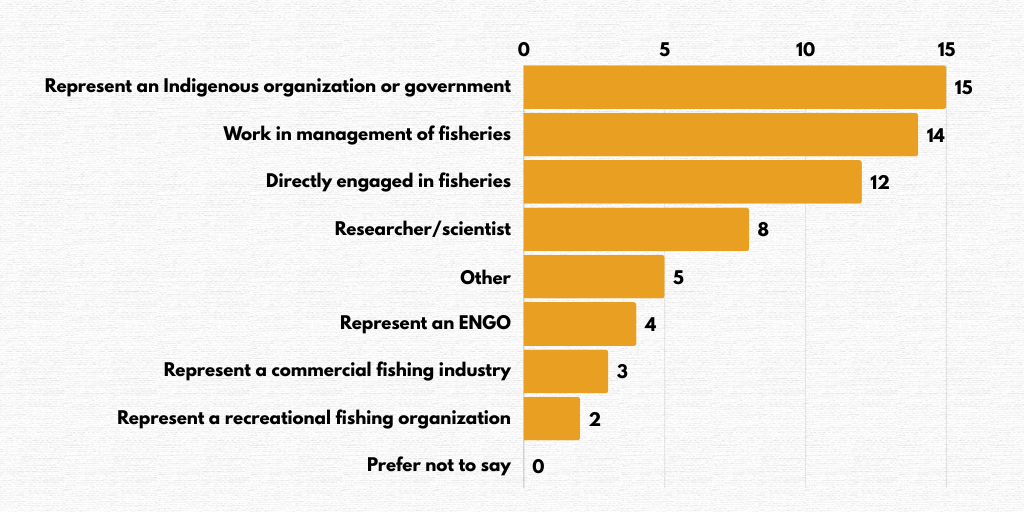
- 15 participants represented an Indigenous organization or government
- 14 participants worked in fisheries management
- 12 participants were directly engaged in fisheries
- 8 participants were researchers or scientists
- 5 participants selected ‘other’ as their role
- 4 participants represented an environmental non-governmental organization (ENGO)
- 3 participants represented a commercial fishing industry
- 2 participants represented a recreational fishing industry
- No participants selected ‘prefer not to say’ as their role
Question 2: On a scale from 1 to 5 (1 being the lowest and 5 being the highest), please indicate the extent to which you agree or disagree with the following statements
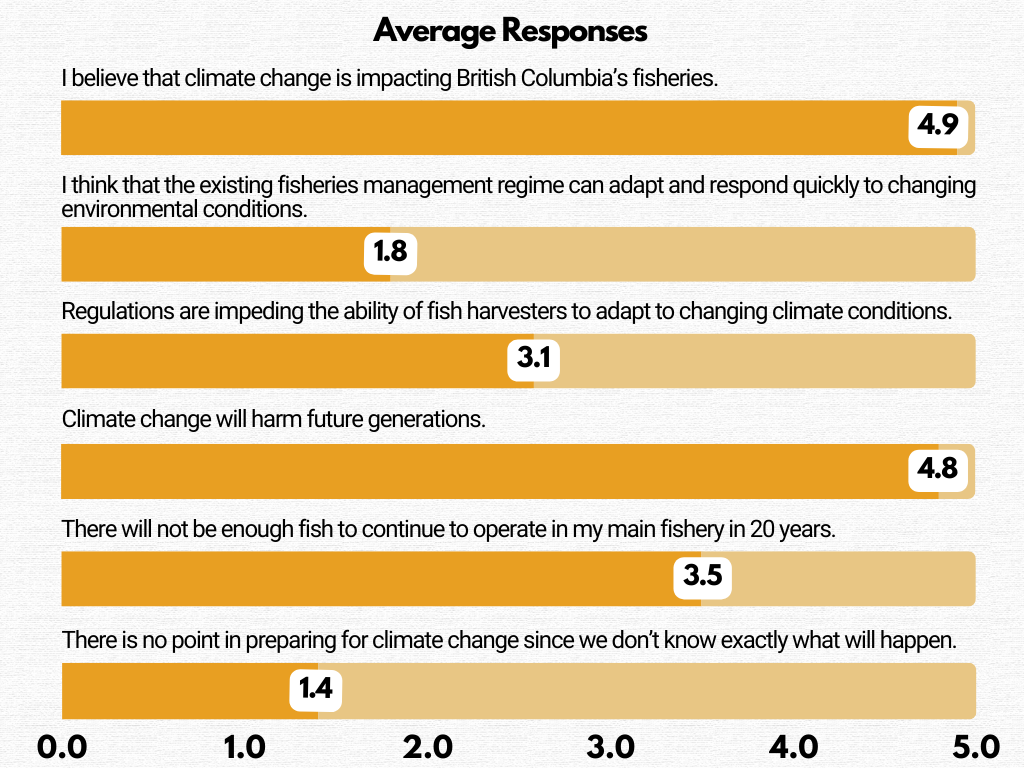
- I believe climate change is impacting British Columbia’s fisheries. Average response: 4.9
- I think that the existing fisheries management regime can adapt and respond quickly to changing environmental conditions. Average response: 1.8
- Regulations are impeding the ability of fish harvesters to adapt to changing climate conditions. Average response: 3.1
- Climate change will harm future generations. Average response: 4.8
- There will not be enough fish to continue to operate in my main fishery in 20 years. Average response: 3.5
- There is no point in preparing for climate change since we do not know exactly what will happen. Average response: 1.4
Question 3: What could increase the agility and flexibility of the fisheries management regime to respond to future challenges
Open text responses:
- Ability to adapt processes that are quicker. E.g., we expect that smaller salmon systems will crash, and we are preparing to move these smaller populations to healthier systems that may survive climate change.
- Recognizing that it will take collaboration to make an impact. Local First Nation decision making powers. Climate change is a threat, not the only threat.
- Reviewing treaty fishery allocations, advancing aquaculture technology to support species impacted.
- Need to look at habitat restorations to mitigate and adapt. This should become a larger focus.
- There is a need for adoption of measures in support of more adaptive, equitable and flexible fisheries management and ocean governance to support resilient fisheries.
- Focus on climate change solutions such as direct air capture (DAC) and sequestration. Support research in marine carbon dioxide removal. British Columbia is well positioned to support this kind of research through real-time monitoring.
- More in-season management.
- Involve Indigenous organizations and local fishers in decision-making and learn from local communities.
- More coordination from science and management.
- A transparent, consistent mechanism to apply local and regional knowledge into decision making.
- Taking a two-eyed seeing approach with Indigenous people.
- Clearer timelines and structures within government to adapt existing regulatory regimes to climate change impacts.
- Support legislative and policy change to better enable co-management with Indigenous Peoples.
- Increase collaboration within DFO (avoid the stock vs spatial protection approach), and support IK and leadership (including co-management).
- Work with Indigenous Peoples to jointly manage and respond to climate change.
- DFO redesigning their process for fisheries management and working more collaboratively with harvesters.
- Improve change management capabilities within DFO and develop a change management centre of expertise or a change management unit in the organization.
- Shift towards more “generalist” approaches to fishing, greater flexibility of fishers to respond to in-season changes, address uncertainty via more precautionary catch limits and risk-based approaches.
- Enable increased control of the management of fisheries to communities. Many First Nations are directly impacted by these changes and often observe them in real time before science data is collected.
- Be precautionary. Use science to inform of current productivity and conditions. Invest in monitoring and DNA lab capacity.
- Increased resourcing to stock assessment including improved harvest monitoring for all salmon species and fisheries.
- Increased use of in-season monitoring to detect stock composition and abundance.
- Improved quality and quantity of timely and accurate catch data from all sectors.
- Increase flexibility in fisheries management to allow harvesters to target those emerging species due to climate change. Also, more flexibility on the fishing period/seasons would help.
- A regime shift away from fisheries solely as an economic commodity and towards sustainability, with First Nations rights at the forefront.
- Reduce commercial fishing.
- Address negative impacts that fisheries regulations may have on Indigenous communities as part of climate mitigation strategies.
- For salmon fisheries, there needs to be an abundance-based management framework developed to guide fishing, this would include escapement goals and management benchmarks. In-season management is also needed.
- Assist nations to identify species and populations that have similar traits and habitats, where populations can be transplanted (inland).
- Increase First Nations participation at the management table.
- A national approach to fish stock management; open and transparent sharing of data and results.
- Enable management or co-management by First Nations who have valuable knowledge of their waters that can be shared with DFO managers.
- Combine harvester knowledge into fisheries management.
- Offer more flexibility for fishers to rapidly shift (e.g., licensing allowing changes in target species in-season), but more precaution in setting catch levels for any one stock.
- Use ecosystem-based approaches but also understand underlying evolutionary processes at play; preserve genetic diversity between and among populations and runs to aid in resilience to change.
- Continue to support real-time ocean monitoring over long-time periods off the coast of British Columbia and elsewhere across Canada and make sure these data are open.
- Continue to work with local communities.
Participant list
Representatives from the following organizations, groups, environmental non-governmental organizations, institutions, and/or governments attended the workshop. In alphabetical order:
- Area A Crab Association (British Columbia)
- British Columbia Crab Fishermen's Association
- Canadian Parks and Wilderness Society (British Columbia)
- Central Coast Indigenous Resource Alliance
- Coastal First Nations
- David Suzuki Foundation
- Fraser Salmon Management Council
- Gitanyow Fisheries Authority
- Government of British Columbia - Ministry of Water, Land, and Resource Stewardship
- Gulf Trollers Association (Salmon)
- Ka:’yu:’k’t’h’/Che:k’tles7et’h’ First Nations
- Maa-nulth Treaty Society
- Native Fishing Association
- Nisga’a Lisims Government
- North Coast Skeena First Nations Stewardship Society
- Northern Native Fishing Corporation
- Oceana
- Pacific Halibut Management Association
- Pacific Prawn Fishermen's Association
- Q’ul-lhanumutsun Aquatic Resources Society
- Secretariat of the Haida Nation
- Secwepemc Fisheries Commission
- Sport Fishing Advisory Board
- Sport Fishing Institute of British Columbia
- T.Buck Suzuki Environmental Foundation
- The United Nations Ocean Decade Regional Collaborative Center for the Northeast Pacific
- Tla’amin Nation
- Tsawwassen First Nation
- University of British Columbia - Institute for the Oceans and Fisheries
- University of Victoria
- Xwisten First Nation
Page details
- Date modified: