
Newfoundland and Labrador Food Fishery Survey – What We Heard Report
On this page
Executive summary
Cod fishing has shaped the lives of Newfoundland and Labradorians for generations. The Newfoundland and Labrador Recreational Groundfish Fishery, known locally as the food fishery, plays a vital role in this tradition and reflects the province’s deep cultural connection with cod and the sea.
Participation in the food fishery allows residents and visitors to catch limited amounts of groundfish (including cod) for personal use only, during the established season, with no requirement for a licence or reporting of catch. Management measures for the 2025 season allowed participants to keep up to five fish per person per day (maximum 15 per boat).
The management measures for the food fishery have been the subject of considerable public discussion in recent years. The purpose of this Public Opinion Research survey was for the department to engage with recreational fishers and the general public to gather perspectives on the future management of this fishery.
The survey sought feedback on key aspects of this fishery including level of participation, awareness of the health of three cod stocks that are fished, and management measures such as length of season and catch limits.
With more than 9,500 surveys fully completed, and 95% of respondents residing in Newfoundland and Labrador, participants emphasized that access to food is the primary reason for taking part in the fishery. There was near unanimous support for continuing the food fishery, with strong recognition of ensuring access for future generations. Most respondents reported being aware, or somewhat aware, of the differing health of the three different cod stocks in Newfoundland and Labrador, and the majority supported rules directly linked to health of each specific cod stock. When asked about potential changes, to management measures, there was strong support for a longer season (more days and not limited to weekends and Mondays), higher individual bag limit, and an increased or no boat limit. Survey responses showed mixed views on introducing reporting measures, with slightly less than half of respondents opposing any new requirements and others expressing varying levels of support for tools such as an app, tags, or individual licences.
The survey results will inform the management decision for the 2026 season and beyond.
Methodology
The online survey was open from November 17, 2025, to January 9, 2026, and was compliant with Government of Canada Accessibility standards. In addition to selecting answers in the survey, respondents could provide written feedback in the survey or by email.
The survey received a high level of engagement with 9,518 surveys fully completed and with the inclusion of partially completed surveys, the total was over 10,000. An additional 117 written submissions were received.
A copy of the survey questions can be found in Appendix A.
Background
There are three distinct cod stocks fished in the Newfoundland and Labrador Recreational Groundfish Fishery:
- Northern cod (Northwest Atlantic Fisheries Organization [NAFO] Divisions 2J3KL)
- 3Ps cod (NAFO Division 3Ps)
- Northern Gulf of St. Lawrence cod (NAFO Divisions 3Pn4RS)
A commercial fishery was reopened in 2J3KL in 2024 with a total allowable catch (TAC) of 38,000 tonnes (t) for the 2025-26 season. There is a limited commercial fishery for cod in 3Ps with a TAC of 1,251 t in 2025-26. The 3Pn4RS commercial cod fishery has been under moratorium since 2022, with only food, social, ceremonial and recreational access.
The number of participants in the food fishery each year is not known. In 2025, to support accessibility and participation, 2,841 disability designations were issued to individuals with a permanent disability, confirmed by a medical doctor. This is in the range of the number of designations issued in previous years.
Stock status and characteristics
Northern cod (NAFO Divisions 2J3KL):
- Found from the eastern side of the Avalon Peninsula, along the northeast coast of Newfoundland, and up to the east coast of Labrador
- The 2J3KL Northern cod stock is the largest cod stock in Canada and a key driver of Newfoundland and Labrador’s inshore fishery
- Following the 1992 moratorium, the stock has rebuilt significantly and in 2025 was above the limit reference point, in the cautious zone under the Precautionary Approach
- Fish in this stock commonly range from 45 to 80 cm, with larger individuals exceeding 100 cm
- A commercial fishery reopened in 2024 after more than 30 years of closure and increased in 2025
3Ps cod (NAFO Division 3Ps):
- Located from the southwestern side of the Avalon Peninsula, extending along much of the island’s south coast
- The 3Ps cod stock is an important regional stock off southern Newfoundland, supporting a primarily inshore fishery and recreational fishery.
- The stock remains in the critical zone under the Precautionary Approach
- Fish commonly range from 40 to 70 cm, with some individuals exceeding 90 cm
- There is a very limited commercial fishery
Northern Gulf of St. Lawrence cod (NAFO Divisions 3Pn4RS):
- Found from the tip of the Northern Peninsula, down the west coast of Newfoundland, and along Quebec’s lower north shore
- The stock remains in the critical zone under the Precautionary Approach, with rebuilding requirements
- Biomass remains low despite some signs of stabilization in recent years.
- Fish commonly range from 35 to 65 cm, with fewer large individuals observed compared to historical levels
- This stock has been under moratorium since 2022
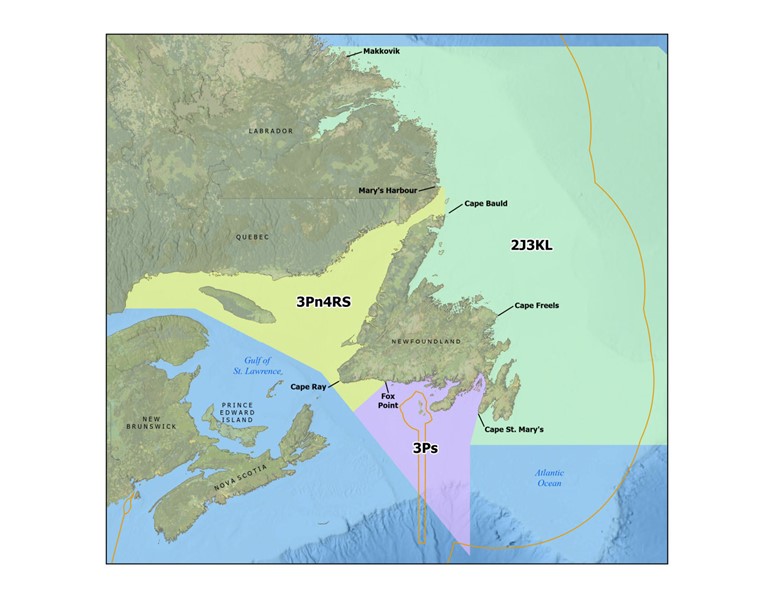
NAFO fishing zones map - Text version
A map indicating the three primary Atlantic cod stocks in Newfoundland and Labrador waters, identified by the Northwest Atlantic Fisheries Organization (NAFO) Division where they are found. Northern cod, located in NAFO Divisions 2J3KL extends from the eastern side of the Avalon Peninsula and along the northeast coast of the island all the way to the east coast of Labrador. Cod in NAFO Division 3Ps range from the south-western side of the Avalon Peninsula along much of the south coast of the island. Cod in NAFO Divisions 3Pn4RS is known as Northern Gulf of St. Lawrence cod and is found from the tip of the Northern Peninsula south, all the way along the west coast of the island.
Detailed results by survey category
Demographic profile
The majority of respondents were
- male (74%)
- between the ages of 36 to 65 (64%)
- 8% between 26 and 35
- 20% between 66 to 75
The majority of respondents were residents of Newfoundland and Labrador (95%) with the remainder, residents of Canada (4%) and outside Canada (1%).
Fishery participation
96% of respondents indicated that they have participated in the food fishery at some point since it was established in 2006. The participation rate varied during season:
- 21% indicated they fished every weekend
- 21% fished seven or more times per season
- 17% fished five to six times per season
- 21% fished three to four times per season
- 17% fished one to two times per season
- 3% with no participation
Over half of respondents (56%) reported fishing during both the summer and fall seasons, while 39% fished only during the summer season, and 3% only in the fall.
Fishing as a food source (92%) was the primary reason for respondents’ participation in the fishery followed by recreation (44%), tradition (37%), tourism (4%), or other (3%). In the other category, 339 respondents provided additional reasons for fishing, with the most frequently mentioned being helping others (access to boat, sharing food).
Awareness
The majority of survey respondents (79%) primarily fished in NAFO Divisions 2J3KL with 11% indicating they fish in Division 3Ps, 10% in 3Pn4RS, and 2% that do not participate. A significant number of respondents (67%) reported that they were aware that the rules for recreational fishing are different in other parts of Canada with 26% somewhat aware, and 6% not aware.
Over half of the respondents (54%) were aware of the variation in the health of the three different cod stocks in Newfoundland and Labrador, 38% were somewhat aware, and 8% were not aware. Two-thirds of respondents (66%) supported rules directly linked to the health of each specific cod stock while 21% opposed such rules, and 14% indicated they did not know or required more information.
Familiarity with the current rules in Newfoundland and Labrador was high, with 73% indicating they were familiar, 25% somewhat familiar and 2% unfamiliar. A significant number of respondents (62%) found the rules easy to understand whether they agreed with them or not, 35% found the rules somewhat easy, and 4% indicated they were not easy to understand.
A total of 396 respondents provided feedback on why they found the rules not easy to understand. The most common issue was the boat limit of 15 fish per boat (unnecessary and/or unclear if this is enforceable). Others said it was difficult to find information about the rules or that the season dates were unclear.
Respondents indicated that the Fisheries and Oceans Canada (DFO) website was their primary source of information for the food fishery and its rules (60%), followed by local news (52%), social media (45%), word of mouth (34%), and by other means (3%).
Opinions on current management measures
There was near unanimous support by respondents for the continuation of the fishery (98%). On the individual bag limit of five fish per person:
- 34% supported the current bag limit
- 63% favored a higher bag limit
- 2% supported a lower bag limit
- 2% were uncertain
On the boat limit of 15 fish:
- 52% supported a higher boat limit
- 30% supported no boat limit
- 16% supported the current boat limit
- 2% supported a lower boat limit
- 1% were uncertain
Similarly, there was strong support for a longer season (84%), with 11% supporting the current 39 day season, 3% supporting a shorter season, and 1% uncertain. Regarding the season schedule:
- 57% preferred the fishery open all week during the summer period (July and August)
- 15% preferred a variety of dates that included weekdays
- 7% supported the current schedule
- 5% did not support the current schedule
- 4% preferred more fishing days in the Fall
- 2% preferred Fridays instead of Mondays
About 10% of respondents made their own suggestion on the season schedule. The most frequent suggestion was greater flexibility to account for bad weather and place a priority on safety at sea, followed by more fall fishing days, open every day during the season, open year round, and introduction of mandatory tags instead of fixed fishing days.
Respondents were asked what challenges they encountered while participating in the food fishery with:
- 87% indicating weather
- 55% work schedule
- 31% rules that are too prohibitive
- 26% vacation schedule
- 24% fishing dates that are announced too late
- 13% lacked access to a boat
- 6% indicated they had not encountered any challenges to participation
A total of 566 respondents identified other challenges, the most frequent challenge being fuel costs/expense associated with participation followed by safety concerns, season overlap with commercial activity, low fish availability in their area, tour boat activity, clarity of the rules, and boat ramp/wharf congestion.
Mechanisms for change
Regarding reporting measures in the food fishery (individual licence, app to record catch, tagging system, paper log book or e-log):
- 46% did not support the introduction of any of the reporting measures presented
- 27% supported introduction of an app to record catch
- 26% supported the introduction of a tagging system
- 24% supported the introduction of an individual licence
- 11% supported the introduction of a paper log book or e-log
When asked about the introduction of an app-based reporting system to share general location, number of fish caught, estimated length and weight, and time spent fishing:
- 43% indicated support on a voluntary basis
- 29% opposed such a system
- 15% suggested it should be on mandatory basis
- 14% indicated they were unsure or required more information
Respondents were asked to share why they would not be interested in an app-based reporting system:
- 62% noted they did not think it was necessary
- 33% expressed concerns with technical issues or internet access
- 9% preferred a different system
- 6% did not use a cellular phone
For the 15% (986) of respondents that chose to identify other reasons, the most frequent reason was concern about complexity, followed by possible cost to user, preference for a paper log or tag system, privacy, practicality when on the water, and that reporting was not a requirement in other parts of Canada.
When respondents were asked whether they would be willing to report their catch (for example through an app or online form or by tagging your fish) if it meant more fishing opportunities such as a longer season, a highly daily bag limit, or more fishing days per week, 40% indicated yes, 39% indicated they may be willing depending on the kind of reporting that would be required, 16% did not support reporting their catch, and 5% were unsure.
Of those that did not support catch reporting:
- 57% indicated it was because it was not required in other recreational groundfish fisheries in Atlantic Canada
- 37% indicated it would be too complicated
- 33% indicated there was potential for greater restrictions on access
- 20% noted an anticipated added cost to participate
- Some respondents (12%) identified other concerns and noted accuracy of data, enforceability, and privacy concerns. Some indicated a preference for tags or alternative voluntary system
When respondents were asked which best described their position among only two options, 86% supported a mandatory reporting system that allowed for increased fishing days and the number of fish caught while 14% supporting no mandatory reporting with fewer fishing days and fewer fish caught.
Views on management and conservation
There was near unanimous recognition (95%) of the importance of ensuring future generations have access to the food fishery, with four per cent indicating it was somewhat important, and one per cent indicating it was not important.
Open feedback
When asked for any suggestions to improve the food fishery, respondents most often highlighted the need for more flexibility on when they can fish as well as more access (number of days per season) to the fishery, which was frequently linked to safety at sea concerns. There was some support for the introduction of tags and/or a licence. Other suggestions included:
- a higher daily bag limit
- improved access for older adults or those without access to a boat
- access to additional species other than groundfish
- the importance of decisions based on science and conservation
- the need for consistency of measures across all Atlantic provinces
The survey also allowed participants to provide written submissions in addition to the survey questions. Over a hundred (117) submissions were received and responses largely aligned with the results of the open feedback.
Appendix A: Survey questions
Newfoundland and Labrador Recreational Groundfish Fishery survey
This survey is your opportunity to let Fisheries and Oceans Canada (DFO) know what you think about the Newfoundland and Labrador Recreational Groundfish Fishery, known as the food fishery. On June 18, 2025, DFO announced that it would seek public input about the Newfoundland and Labrador food fishery, in the Fall of 2025. Your participation in this survey will help inform the rules for this fishery in 2026.
This survey is administered on behalf of the Minister by the Fisheries Management Branch in the Newfoundland and Labrador Region. Your participation is confidential, voluntary, and will remain anonymous.
The survey will take about 15 minutes to complete.
Privacy notice
The personal information is collected on a voluntary basis pursuant to the Financial Administration Act and in accordance with the Policy on Communications and Federal Identity. The anonymous data will be used by the Public Opinion Research Directorate of Public Services and Procurement Canada (PSPC) to improve its advisory services. As the collection of information will be strictly anonymous, it will be impossible to identify the participants. The personal information is described in the Standard Personal Information Banks Public Communication PSU 914 and Outreach Activities PSU 938. Your personal information is protected, used, and disclosed in accordance with the Privacy Act. Do not disclose confidential information about yourself or other individuals unnecessarily.
If you require clarification about this privacy notice, you may contact the Public Services and Procurement Canada’s Access to Information and Privacy Directorate by email at mailto:TPSGC.ViePrivee-Privacy.PWGSC@tpsgc-pwgsc.gc.ca.
If you are not satisfied with the response to your privacy concern, you may wish to contact the Office of the Privacy Commissioner of Canada.
What is your gender?
- Female
- Male
- Or, please specify
- Prefer not to answer
What is your age group?
- Less than 18 years of age
- 18-25 years of age
- 26-35 years of age
- 36-55 years of age
- 56-65 years of age
- 66-75 years of age
- 76 years of age or older
- Prefer not to answer
Which statement best describes you?
- Resident of Newfoundland and Labrador
- Resident of Canada, but not Newfoundland and Labrador
- Reside internationally, outside of Canada (Specify)
What are the first 3 characters of your home postal code? (Leave blank if outside of Canada)
Participation
Have you ever taken part in the Newfoundland and Labrador food fishery since it started in 2006?
- Yes
- No
- Don't recall
During the season, how often would you typically participate?
- Every weekend
- 1 to 2 times per season
- 3 to 4 times per season
- 5 to 6 times per season
- 7 or more times per season
- I don’t participate
In which part of the season do you typically participate?
- Summer only (July and August)
- Summer (July and August) and Fall (September)
- Fall only (September)
- None of the above
What is your main reason for participating in the food fishery? Select all that apply.
- Food source
- Tradition
- Recreational activity
- Tourism activity
- Other (Specify)
Awareness
There are 3 primary cod stocks in Newfoundland and Labrador, identified by the Northwest Atlantic Fisheries Organization (NAFO) Division, where they are found. Northern cod, located in NAFO Divisions 2J3KL extends from the eastern side of the Avalon Peninsula and along the northeast coast of the island all the way to the east coast of Labrador.
Cod in NAFO Division 3Ps range from the south-western side of the Avalon Peninsula along much of the south coast of the island.
Cod in NAFO Division 3Pn4RS is known as Northern Gulf of St. Lawrence cod and is found from the tip of the Northern Peninsula south, all the way along the west coast of the island.
NAFO fishing zones map - Text version
A map indicating the three primary Atlantic cod stocks in Newfoundland and Labrador waters, identified by the Northwest Atlantic Fisheries Organization (NAFO) Division where they are found. Northern cod, located in NAFO Divisions 2J3KL extends from the eastern side of the Avalon Peninsula and along the northeast coast of the island all the way to the east coast of Labrador. Cod in NAFO Division 3Ps range from the south-western side of the Avalon Peninsula along much of the south coast of the island. Cod in NAFO Divisions 3Pn4RS is known as Northern Gulf of St. Lawrence cod and is found from the tip of the Northern Peninsula south, all the way along the west coast of the island.
In what area do you primarily fish in the Newfoundland and Labrador food fishery? Please reference which zone found on the map.
- 2J3KL (St. Mary’s Bay, Conception Bay, Trinity Bay, Bonavista Bay, Notre Dame Bay, White Bay, east of Northern Peninsula, and along the Labrador coast, north of Lodge Bay)
- 3Ps (Placentia Bay, Fortune Bay, and along the south coast of the island portion)
- 3Pn4RS (South of Lodge Bay Labrador, Strait of Belle Isle, all the way along the west coast of the island)
- I don’t participate in the food fishery
The rules for recreational groundfish fishing in Canada vary widely across the country, depending on what the participants are fishing, the health and availability of these species, and the level of participation.
For example:
- In Newfoundland and Labrador, the main species is cod, while in parts of Nova Scotia it is a mix of haddock, pollock and cod.
- In parts of Quebec, the fishery works similarly to Newfoundland and Labrador with a 39-day season. In some other parts there is a 37-day season, and there is a limit of no more than 5 cod and/or white hake.
- In parts of Nova Scotia, cod may only be fished from the third Saturday in June to early September, while in Newfoundland and Labrador the current schedule for the food fishery runs until the end of September.
- In British Columbia, a recreational fishing licence is required, while in Newfoundland and Labrador no licence is required.
- In New Brunswick coastal waters in the Gulf and Strait, retention of cod and hake is not authorized in all areas. Where access to cod and hake is authorized, the season is 37 days running from mid-July to mid-August, and there is a limit of no more than 5 cod and/or white hake.
Did you know the rules for Recreational Groundfish Fisheries are different in other parts of Canada?
- Aware
- Somewhat aware
- Was not aware
The most recent scientific assessments for the health of cod stocks in Newfoundland and Labrador are available online:
- NAFO Subdivision 3Ps Atlantic Cod Stock Assessment in 2024
- Northern Gulf of St. Lawrence (3Pn, 4RS) Atlantic Cod Stock Assessment in 2024
- Northern Cod (2J3KL) Atlantic Cod Stock Assessment in 2025
The most recent assessments of these stocks allow for:
- 3Ps Cod allows for a very limited commercial fishery
- 3Pn4RS allows for no commercial fishery, due to low stock health
- 2J3KL allows for a recently increased commercial fishery
Before this survey, were you aware that the health of the three different cod stocks in Newfoundland and Labrador varies?
- Aware
- Somewhat aware
- Was not aware
Do you support rules that are directly linked to the health of each specific cod stock in Newfoundland and Labrador? (This means catch limits or fishing days that could go up or down depending on the health of each stock, and different stocks could have different rules based on how healthy they are.)
- Yes
- No
- I don't know / I need to know more
How familiar are you with the current rules (management measures and regulations) of the Newfoundland and Labrador food fishery?
- Familiar
- Somewhat familiar
- Unfamiliar
Do you find the current rules easy to understand, regardless of whether you agree with them or not?
- Yes
- Somewhat
- No
- Please specify
From which of the following sources do you typically get information about the food fishery and its rules? (E.g. dates, bag limit, etc.) Select all that apply.
- DFO website
- Social media
- Local news
- Word of mouth
- Other
Opinions on current management measures
Do you support the continuation of a food fishery in Newfoundland and Labrador?
- Yes
- No
A daily bag limit is the maximum number of fish 1 person can catch in a day. Do you support the current daily bag limit (5 fish per person per day)?
- Support the current bag limit
- Support a higher bag limit
- Support a lower bag limit
- I don’t know
A boat limit is the maximum amount of individual fish that can be onboard at one time. Do you support the current boat limit (15 fish per boat when 3 people or more are in the boat)?
- Support the current boat limit
- Support a higher boat limit
- Support a lower boat limit
- There shouldn’t be a boat limit
- I don’t know
The current fishery is managed by a set number of days per year. In 2024, there were 39 fishing days. Do you support:
- The current 39-day season
- A longer season
- A shorter season
- I don’t know
Do you support the current schedule of the fishery, which is primarily open on the weekends and Mondays?
- Yes
- No
- No, would prefer more variety of dates (including weekdays)
- No, would prefer Friday instead of Monday
- No, would prefer the fishery open all week during the summer (i.e. July and August)
- No, would prefer more fishing days in the fall (i.e. September and October)
- Other (please specify)
Which of the following challenges have you encountered while participating in the food fishery? Select all that apply.
- I have not encountered any challenges
- Access to a boat
- Weather
- Work schedule
- Vacation schedule
- Fishing dates are announced too late
- Rules are too prohibitive
- Other (Please specify)
Mechanisms for change
In fisheries, a reporting system is a set of record-keeping tools that monitor catch to help sustainably manage the fishery. This could include things like an individual licence that would set the number of fish you can catch for a season, an app where you would record details about how many fish you caught and where, length and weight, etc., a log book or e-log to record your catch, or a tagging system where you would receive a certain number of tags in a season, which must be attached to each fish caught.
A reporting system would help broaden the understanding of all 3 cod stocks in NL, and help protect their health for future generations.
Some have called for a variety of different reporting measures in the food fishery. Do you support (check all that apply):
- Introduction of an individual licence
- Introduction of an app to record your catch
- Introduction of a tagging system
- Introduction of a paper log book or e-log
- None of the above
Catch information helps broaden our understanding of the health of cod stocks. If an app-based reporting system were introduced that asked you to report your general location, number of fish caught, estimated length and weight, and time spent fishing, would you support it?
- On a mandatory basis
- On a voluntary basis
- No, it should not be introduced
- Not sure / I require more information
If you are not currently interested in using an app-based reporting system, why? (Select all that apply)
- Technical issues / Internet access issues
- I don’t use a cell phone
- I prefer a different system
- I don’t think it’s necessary
- Other (specify)
Would you be willing to report your catch (for example, through an app, or an online form, or by tagging your fish) if it meant more fishing opportunities, such as a longer season, a higher daily bag limit, or more fishing days per week?
- Yes
- Maybe, depending on the reporting that would be required
- No, I would not support reporting my catch
- Unsure
If not supportive, what would be your primary concern with reporting your catch? Share all that apply:
- Anticipated added cost to participate
- Not required in other recreational groundfish fisheries in Atlantic Canada
- Potential for greater restrictions on access
- Too complicated
- Other (Specify)
If you had to choose between the following 2 options, which best describes your position?
- Support a mandatory reporting system to allow for increased fishing days and the number of fish caught.
- Support no mandatory reporting system with fewer fishing days and fewer fish caught.
Views on management and conservation
How important is it to ensure that future generations have access to the food fishery?
- Important
- Somewhat important
- Not important
Open feedback
- Do you have any suggestions for improving the food fishery?
- What changes would you like to see in the food fishery?
- Any further comments?
Thank you for your time and input. If we have questions about your feedback, would you consent to a follow-up e-mail? (Optional)
- Yes
- No
Enter your contact information
Page details
- Date modified: