
C3 - Provincial and Territorial Relationships
Purpose
- Outline provincial and territorial responsibilities
- Outline the Minister’s leadership role for the Canadian Council of Fisheries and Aquaculture Ministers (CCFAM) and role in other multilateral fora
- Highlight key provincial and territorial interests
Provincial and Territorial Responsibilities
- In non-tidal waters in a province (i.e., freshwater), the constitutional jurisdiction over fisheries is shared, but in practice, has been largely delegated to provinces.
- Fisheries in non-tidal waters are generally referred to as recreational fisheries or inland commercial fisheries (e.g., Manitoba, Saskatchewan, Northwest Territories, Ontario).
- With respect to freshwater, provinces and territories are generally responsible for fisheries management, including licensing and enforcement. That said, a mix of federal, provincial, and territorial management responsibilities has evolved over time, with different variations by jurisdiction
- These responsibilities are based on judicial interpretations, as well as specific federal/provincial/territorial agreements and memoranda of understanding.
- The different approaches across Canada reflect the diversity of regional needs.
- The Government of Canada has worked to devolve power to the territories, with devolution occurring in Yukon (2003), the Northwest Territories (2014), and Nunavut (2024).
Aquaculture Management in Canada
- Aquaculture management in Canada is a shared responsibility among federal and provincial/territorial governments.
- Constitutional authorities, legal rulings, and federal-provincial agreements have resulted in three different aquaculture management regimes in place across the country.
- In British Columbia, the federal government regulates aquaculture activities, issues licences, and has authority over day-to-day operations and oversight, as well as monitoring of aquaculture activities.
- In Prince Edward Island, the province has a special arrangement with the federal government for DFO to manage aquaculture in their jurisdiction.
- In all other jurisdictions, the day-to-day management of the aquaculture industry is primarily the responsibility of provincial governments.
The Canadian Council of Fisheries and Aquaculture Ministers (CCFAM)
- CCFAM provides a structured, regular mechanism for federal, provincial, and territorial ministers to address fisheries and aquaculture issues of national importance.
- The Canadian Council of Fisheries and Aquaculture Ministers (CCFAM) is the Minister’s primary forum for multilateral engagement with provinces and territories.
- CCFAM provides a structured, regular mechanism for federal, provincial, and territorial ministers to address fisheries and aquaculture issues of national importance
- Formalized through the 1999 Agreement on Interjurisdictional Cooperation with Respect to Fisheries and Aquaculture.
- Convened annually.
- Permanently co-chaired by the Minister and a rotating provincial or territorial counterpart.
- The current PT co-chair is British Columbia.
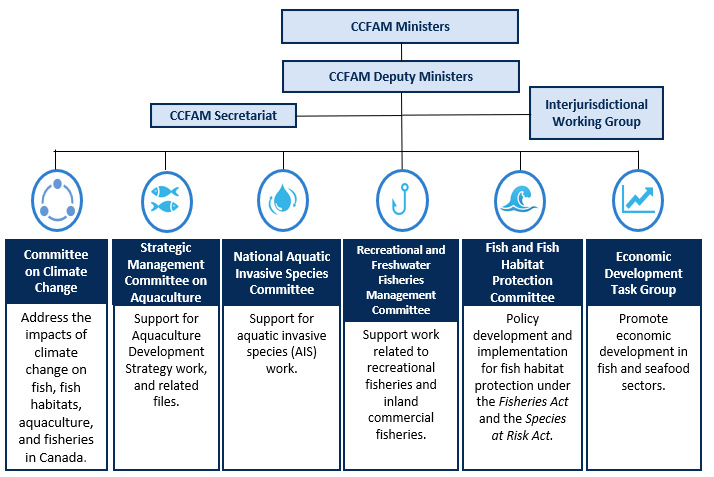
Text version
- CCFAM Ministers
- CCFAM Deputy Ministers
- CCFAM Secretariat
- Interjurisdictional Working Groups
- Committees
- Committee on Climate Change: Address the impacts of climate change on fish, fish habitats, aquaculture, and fisheries in Canada.
- Strategic management Committee on Aquaculture: Support for Aquaculture Development Strategy work and related files.
- National Aquatic Invasive Species Committee: Support for aquatic invasive species (AIS) work.
- Recreational and Freshwater Fisheries Management Committee: Support work related to recreational fisheries and inland commercial fisheries.
- Fisher and Fish Habitat Protection Committee: Policy development and implementation for fish habitat protection under the Fisheries Act and the Species at Risk Act.
- Economic Development Task Force Group: Promote economic development in fish and seafood sectors.
Other Multilateral Fora are Available and Can be Convened as Needed…
When the need arises, additional ad hoc multilateral mechanisms can be established.
Eastern Fisheries and Aquaculture Ministers (EFAM) forum: Ministers from Canada, Quebec, New Brunswick, Nova Scotia, Prince Edward Island, and Newfoundland and Labrador meet from time to time in the EFAM forum. This body also sometimes convenes at the DM level.
Regional CCFAM forums (not currently active): In addition to the CCFAM, two regional intergovernmental ministerial forums exist: the Atlantic Council of Fisheries and Aquaculture Ministers (ACFAM); and the Pacific Council of Fisheries and Aquaculture Ministers (PCFAM). Neither of these regional forums are currently active.
Provincial and Territorial Governments, Premiers and Ministers from CCFAM
British Columbia
- BC CCFAM Minister: Randene Neill, Minister of Land, Water, and Resource Stewardship
- Premier: David Eby (BC NDP Party – elected July 18, 2017)
Alberta
- AB CCFAM Minister: Grant Hunter, Minister of Environment and Protected Areas
- Premier: Danielle Smith (United Conservative Party – assumed office October 11, 2022)
Saskatchewan
- SK CCFAM Minister: Darlene Rowden, Minister of Environment
- Premier: Scott Moe (Saskatchewan Party – appointed February 2, 2018)
Manitoba
- MB CCFAM Minister: Ian Bushie, Minister of Natural Resources and Indigenous Futures
- Premier: Wab Kinew (MB New Democratic Party – sworn in October 18, 2023)
Yukon
- YK CCFAM Minister: Wade Istchenko, Minister of Environment
- Premier: Currie Dixon (Yukon Party – sworn in November 22, 2025)
Ontario
- ON CCFAM Minister: Mike Harris, Minister of Natural Resources
- Premier: Doug Ford (ON Progressive Conservative Party – appointed June 29, 2018)
Newfoundland & Labrador
- NL CCFAM Minister: Loyola O'Driscoll, Minister of Fisheries and Aquaculture
- Premier: Tony Wakeham (NL Progressive Conservative Party – appointed October 29, 2025)
Nova Scotia
- NS CCFAM Minister: Kent Smith, Minister of Fisheries and Aquaculture
- Premier: Tim Houston (NS Progressive Conservatives – appointed August 31, 2021)
New Brunswick
- NB CCFAM Minister: Pat Finnigan, Minister of Agriculture, Aquaculture and Fisheries
- Premier: Susan Holt (NB Liberal Party – sworn in November 2, 2024)
Nunavut
- NU CCFAM Minister: Craig Simailak, Minister of Community Services (includes responsibility for fisheries and sealing)
- Premier: John Main (No party system – sworn in November 20, 2025)
Northwest Territories
- NWT CCFAM Minister: Jay Macdonald, Minister of Environment and Climate Change
- Premier: R.J. Simpson (No party system – elected November 14, 2023)
Quebec
- QC CCFAM Minister: Donald Martel, Minister of Agriculture, Fisheries and Food
- Premier: Resignation is pending (Premier François Legault announced pending resignation January 14, 2026)
Prince Edward Island
- PEI CCFAM Minister: Ernie Hudson, Minister of Fisheries, Tourism, Sport and Culture
- Premier: Rob Lantz (PEI Progressive Conservative Party – as of February 9, 2026)
Provincial and Territorial Interests
Newfoundland and Labrador
- CUSMA review
- AFF renewal
- US tariffs / reducing domestic trade barriers
- Joint fisheries management
- Economic development in oceans (fisheries, oil and gas)
- Aquaculture: sustainable growth
- Atlantic salmon and devolution of inland fisheries management
- Independence of inshore/owner operator and fleet separation
Nova Scotia
- AFF renewal
- CUSMA review
- US tariffs / reducing domestic trade barriers
- Illegal fishing, unreported landings, cash sales, and associated criminal acts
- Climate change
- Rights implementation / Moderate livelihood
- Aquaculture legislative reforms
- MSX/Dermo in oysters
Prince Edward Island
- MSX/Dermo in oysters, financial support to harvesters
- AFF renewal
- CUSMA review
- US tariffs / reducing domestic trade barriers
- Climate change
- Aquaculture
- Independence of inshore/owner operator and fleet separation
New Brunswick
- AFF renewal
- Support for aquaculture industry
- CUSMA review
- US tariffs / reducing domestic trade barriers
- Gulf shrimp fishery
- Importance of domestic market
- Sustainable fisheries and eco-certification
- Climate change
- Illegal fishing, unreported landings, and cash sales/elvers
- Rights implementation / Moderate livelihood
- Independence of inshore/owner operator and fleet separation
- MSX/Dermo in oysters
Nunavut
- Domestic product marketing and consumption
- EU seal ban / market access
- Nunavut Fishery Regulations
- Access to offshore fisheries
Quebec
- CUSMA review
- QFF renewal
- Financial support for harvesters
- Gulf shrimp fishery
- Importance of domestic market
- Sustainable fisheries and eco-certification
- Marine infrastructure
- Inland aquaculture
Ontario
- CUSMA review
- US tariffs / reducing domestic trade barriers
- Freshwater fisheries
- Labour issues in fisheries
- Aquaculture
Alberta
- CUSMA review
- Aquatic invasive species
- Species at risk: trout
- Red tape reduction (impact of Fisheries Act and other federal legislation)
- Impacts of drought
Yukon
- CUSMA review
- Aquatic invasive species
- US tariffs / reducing domestic trade barriers
- Impacts of natural resource projects
Northwest Territories
- CUSMA review
- Great Slave Lake Fishery and Hay River Fish Plant revitalization
- Freshwater Fish Marketing Corporation (FFMC) divestiture
- Aquatic invasive species
- Climate change
- Data sharing and use of Indigenous Knowledge
Saskatchewan
- CUSMA review
- Aquatic invasive species
- Freshwater Fish Marketing Corporation (FFMC) divestiture
- Fisheries Act
British Columbia
- CUSMA review
- BCSRIF renewal / protection of wild salmon
- Aquatic invasive species (concern about mussels moving west)
- US tariffs / reducing domestic trade barriers
- Aquaculture transition plan
- Species at risk (whales, steelhead, salmon, sturgeon)
- Fisheries treaty negotiations with the US
- Accelerating major projects
Manitoba
- CUSMA review
- Aquatic invasive species
- Freshwater Fish Marketing Corporation (FFMC) divestiture
- Sustainable fisheries and eco-certification
Page details
- Date modified: