
C2 - Crown-Indigenous Relationship Overview
Purpose
- Provide an overview of Indigenous rights and how they pertain to the Department's mandate and relationships with Indigenous Peoples
- Outline departmental initiatives and programs supporting Indigenous rights, interests, and relationships
Constitutional Framework
Constitution Act, 1982 Section 35
- Aboriginal and treaty rights are recognized and affirmed under Subsection 35(1) of the Constitution Act, 1982. They are collective rights held by Indigenous communities.
- The Department does not define, interpret or determine the rights of Indigenous Peoples – it enables Indigenous communities to exercise their rights and interests.
Aboriginal and Treaty Rights
- Aboriginal rights refer to practices, traditions and customs that distinguish the unique culture of each First Nation and were practiced prior to European contact.
- E.g., the right to hunt, fish and carry-on traditional way of life on ancestral lands, and self-governance.
- Treaty rights are rights that are set out in historic treaties (signed between 1701 and 1975) or modern treaties (signed post-1975).
- E.g., the right to fish, hunt, and gather in pursuit of a moderate livelihood.
Court Decisions and Treaty Obligations
The Crown–Indigenous Relationship is not based on a single event or law. It is a continuing legal and political relationship, shaped by constitutional and treaty commitments, clarified by the courts, and advanced today through legislative, regulatory, policy, and program tools.
Court Decisions:
- R. v. Sparrow (1990): Affirmed Aboriginal right to fish for food, social and ceremonial purposes (FSC)
- R. v. Gladstone (1996); R. v. Marshall (1999); R. v. Ahousaht (2013): Affirmed Aboriginal and Treaty rights to fish for commercial purposes in limited and specific circumstances.
Treaty Obligations:
- Fisheries-related issues are often a key component of treaty negotiations.
- The Department works to implement obligations arising from 26 modern treaties and four standalone self-government agreements.
See Annexes A, B and C for more information on historic and modern treaties and negotiation tables
Departmental Mandate
The Minister of Fisheries is responsible for:
- Fish access and allocation, including to Indigenous communities and organizations;
- Management of fisheries, including Indigenous fisheries, in collaboration with Indigenous governments, communities and organizations;
- Decisions on major project proposals that impact Indigenous rights and interests;
- Responding to litigation and implementing Court decisions involving Indigenous fishing rights; and,
- Negotiating and implementing modern treaties and time-limited rights reconciliation agreements
Fisheries in Canada are:
- Of great social, cultural, and economic significance to many Indigenous communities;
- A public resource to which Indigenous Peoples have unique rights and interests;
- An important focus at Treaty and other negotiating tables; and,
- An economic driver and opportunity for self-determination for Indigenous Peoples.
DFO’s Work with Indigenous Peoples Has Changed Over Time...
From responding to rights recognized through court decisions:
- Targeted policies and programs that supported collaborative management and increased fish access (e.g., Aboriginal Fisheries Strategy; Aboriginal Aquatic Resource and Oceans Management; Atlantic, Pacific, and Northern Integrated Commercial Fisheries Initiatives).
- Rights-based discussions at treaty negotiating tables only.
- Limited oversight of modern treaty implementation.
To broader relationship building that enables the implementation of Indigenous rights and interests:
- Investments in Indigenous commercial and collaborative fisheries programming contribute approximately $100 million annually to Indigenous capacity and relationship building.
- Continued implementation of the Marshall decisions (moderate livelihood) with 34 Mi’kmaq and Wolastoqey First Nations in the Maritime provinces and Gaspé region of Quebec, as well as the Peskotomuhkati Nation at Skutik.
- Negotiating tables have moved toward the recognition of rights and interests as a starting point for negotiations, with more non-treaty tools available to enable the implementation of Indigenous rights and interests.
- Increasing oversight and accountability mechanisms to ensure the timely and effective implementation of modern treaty obligations
...And Has a Strong Regional and Operational Dimension
North:
- The North is mostly covered by comprehensive land claim agreements (i.e., “modern treaties”) and self-government agreements.
- DFO-Indigenous relationship in the North is demonstrably linked to implementing these agreements.
West:
- Implementing the right to fish for FSC purposes.
- Implementing the right to fish for commercial purposes in specific locations and circumstances.
- Few existing treaties → multiple First Nations are negotiating treaties or time limited agreements
Inland:
- Inland area is largely covered by pre-1975 treaties with First Nations (i.e., “historic treaties”).
- Provinces and territories manage inland fishing – including Indigenous fishing - in most cases, while inland aquatic habitats remain under federal jurisdiction.
East:
- Implementing the right to fish for FSC purposes.
- Implementing the right to fish in pursuit of a moderate livelihood for 35 Treaty Nations.
- Some historic treaties and three Modern Treaties (Quebec and Labrador) →some Indigenous groups are currently negotiating time-limited agreements.
Priorities and Expectations
- Indigenous communities across Canada have different histories, priorities, and perspectives – many have expressed an interest in increased and diversified fisheries opportunities, Indigenous-led conservation, and a greater role in decision-making and management activities, including:
- More access to fish for FSC and commercial purposes, as well as aquaculture opportunities;
- Flexibility to choose how and when to fish;
- Means with which to harvest, add value, grow, and diversify economically including greater flexibility to harvest in alignment with community objectives;
- Greater self-determination and self-government in their traditional territories and waters through joint or shared decision-making and recognition of Indigenous laws;
- Greater roles in fisheries, oceans, aquatic habitat, aquatic species at risk, aquatic invasive species, and marine waterways management activities; and,
- Management of legal risk related to the assertion of the right to fish and sell fish in certain regions (e.g., BC).
The Department Has a Range of Tools to Support Renewed Relationships and Partnerships...
- Indigenous Programs: Includes a range of programs such as the Atlantic, Pacific, and Northern Integrated Commercial Fisheries Initiatives, the Indigenous Collaborative Programs, and the Indigenous Fisheries Monitoring Fund.
- Policy and Legislation: Encompasses legislative reviews, policy initiatives, and specific decisions that may affect Aboriginal and treaty rights and interests.
- Treaty Negotiations: Generally, address issues such as access/allocations, as well as collaborative fisheries and oceans management. Self-government agreements are also negotiated – led by Crown-Indigenous Relations and Northern Affairs Canada.
- Non-Treaty Negotiations: Includes time-limited agreements that generally address similar issues as treaties but do not define rights and are not perpetual – intended to build relationships, develop capacity, and/or manage legal risk
- Engagement / Consultation: Touches on fisheries management plans and activities; science; fisheries and habitat protection; and marine use planning. Many modern treaties also include consultation obligations.
...And is Enhancing Existing Tools and Developing New Approaches to Support the Implementation of the United Nations Declaration on the Rights of Indigenous Peoples Action Plan in Line with Partner Aspirations:
- Meaningful Change: Changes sought to legislation, regulations, or policies that provide for more meaningful implementation of Indigenous fishing rights, and participation in decision-making.
- Capacity Funding: New mechanisms and agreements in the management of fisheries and the protection of fish habitat that allow for collaborative governance and a greater role for Indigenous partners in decision-making.
- Collaboration: Commitment to the co-development, co-design and co-delivery of sustainable, long-term capacity building platforms and services for Indigenous communities and organizations.
- Indigenous Knowledge: Incorporation of Indigenous Knowledge in decision-making for fisheries and oceans management
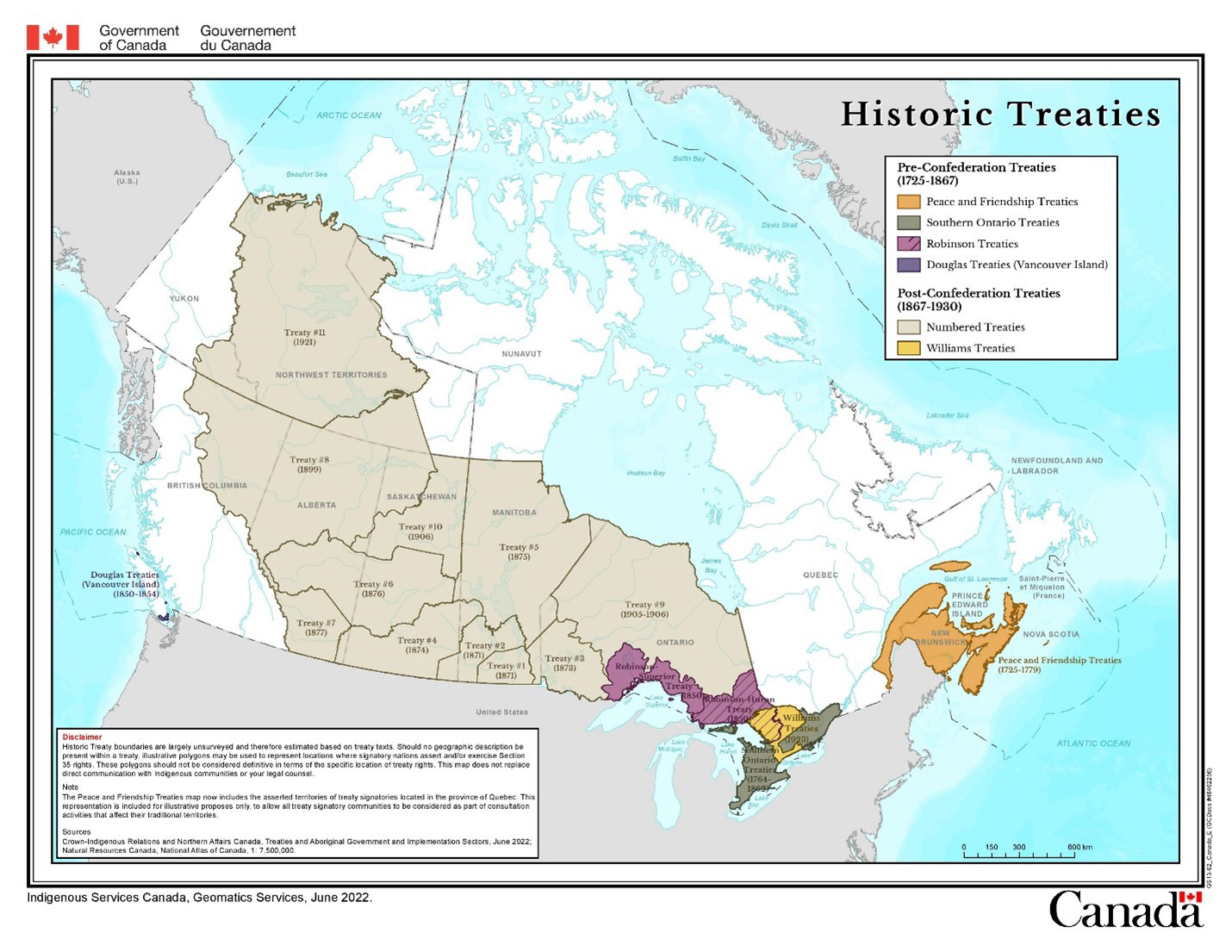
Annex A: Map of “Historic Treaties” (pre-1975) - Text version
This image visually represents the geographic distribution of historic treaties across Canada, divided into two main categories: Pre-Confederation Treaties (1725–1867) and Post-Confederation Treaties (1867–1990).
Pre-Confederation Treaties include:
- Peace and Friendship Treaties, primarily located in the eastern provinces.
- Southern Ontario Treaties, covering parts of southern Ontario.
- Robinson Treaties, found in central Ontario.
- Douglas Treaties, located on Vancouver Island in British Columbia.
Post-Confederation Treaties include:
- Numbered Treaties, spanning large areas of central and western Canada.
- Williams Treaties, situated in south-central Ontario.
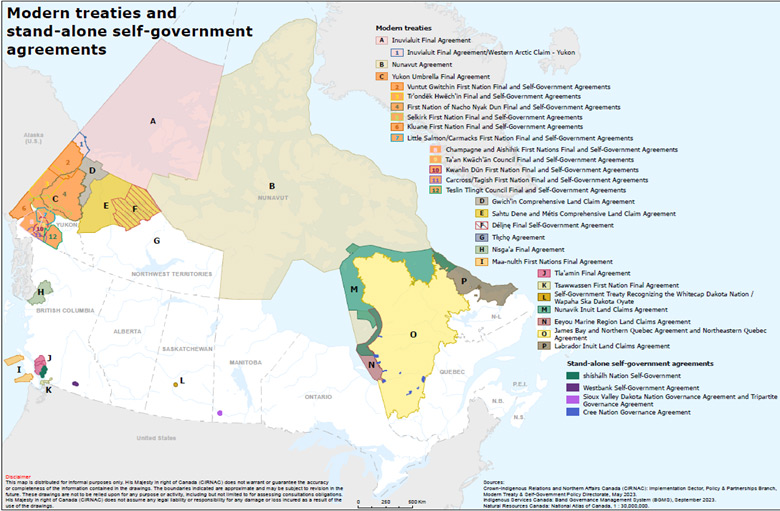
Annex B: Map of Comprehensive Land Claims Agreements (“Modern Treaties”) and Self-Government Agreements - Text version
This image visually represents the geographic distribution of modern treaties and self-government agreements across Canada.
Modern treaties include:
- Inuvialuit Final Agreement
- Nunavut Agreement
- Yukon Umbrella Final Agreement
- Gwich'in Comprehensive Land Claim Agreement
- Sahtu Dene and Métis Comprehensive Land Claim Agreement
- Délı̨nę Final Self-Government Agreement
- Tłı̨chǫ Agreement
- Nisga’a Final Agreement
- Maa-nulth First Nations Final Agreement
- Tla’amin Final Agreement
- Tsawwassen First Nation Final Agreement
- Self-Government Treaty Recognizing the Whitecap Dakota Nation / Wapaha Ska Dakota Oyate
- Nunavik Inuit Land Claims Agreement
- Eeyou Marine Region Land Claims Agreement
- James Bay and Northern Quebec Agreement and Northeastern Quebec Agreement
- Labrador Inuit Land Claims Agreement
Stand-alone self-government agreements include:
- shíshálh Nation Self-Government
- Westbank Self-Government Agreement
- Sioux Valley Dakota Nation Governance Agreement and Tripartite Governance Agreement
- Cree Nation Governance Agreement
Annex C: Federal Negotiations Landscape
- Canada is actively involved in172 treaty or reconciliation negotiation tables nationwide (Métis, Inuit, and First Nations).
- The Department is involved in over 80 of these processes.
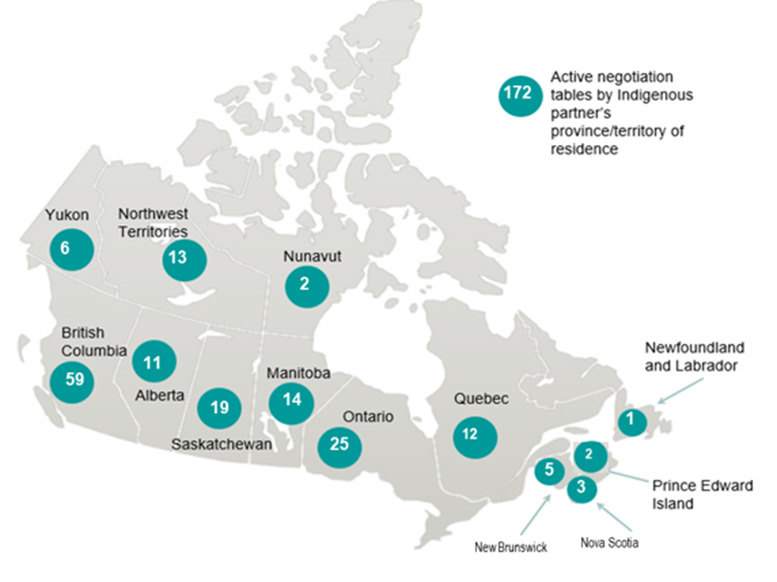
Text version
This image is a map of Canada illustrating the number of active negotiation tables involving Indigenous partners, categorized by their province or territory of residence. The total number of active negotiation tables across Canada is 172.
The breakdown by province/territory is as follows:
- Yukon: 6
- Northwest Territories: 13
- Nunavut: 2
- British Columbia: 59
- Alberta: 11
- Saskatchewan: 19
- Manitoba: 14
- Ontario: 25
- Quebec: 12
- Newfoundland and Labrador: 1
- New Brunswick: 5
- Nova Scotia: 3
- Prince Edward Island: 2
Annex D: Duty to Consult
The Government of Canada is subject to the constitutional duty to consult and accommodate, and the requirement to justify any infringements of rights.
Duty to Consult:
Where the Crown contemplates conduct that might have an adverse impact on established or asserted Aboriginal or treaty rights, it has a legal duty to consult with those Indigenous groups who hold (or potentially hold) those rights, and, where appropriate, accommodate their interests or concerns.
Duty to justify infringements of rights:
Where legislation, its implementation, or other government action infringes an Aboriginal or treaty right, the infringement must be justified in accordance with the test set out by the Supreme Court of Canada
Page details
- Date modified: