
B8 - Marine Planning and Conservation
Purpose
To provide an overview of powers and responsibilities of the Minister of Fisheries in four areas:
- Marine conservation
- Project Finance for Permanence
- Marine environmental quality
- Integrated ocean management
Background
- The Minister of Fisheries is the lead federal authority for ocean-related matters with a mandate to ensure the health, sustainability, and economic viability of Canada’s three oceans.
- This involves balancing conservation efforts with economic opportunities for coastal and Indigenous communities.
- Working with provinces, territories, and other federal organizations (e.g., Transport Canada, Environment and Climate Change Canada) that have authorities and share responsibilities in the ocean and marine environment.
Domestic and International Commitments
- Domestically, Canada has committed to conserving 30 per cent of our marine and coastal areas by 2030.
- These actions contribute to Canada’s commitment to Target 3 of the Kunming-Montreal Global Biodiversity Framework (KMGBF) to support efforts to conserve 30 per cent of marine and coastal areas globally by 2030.
- Canada’s efforts to advance integrated ocean management (IOM) also support our international commitments centered around sustainable management (Target 1 KMGBF and 100 per cent sustainable management under the Ocean Panel).
1. Marine Conservation
- The Minister has the power to establish marine protected areas (under the Oceans Act) and recognize marine refuges (under the Fisheries Act).
- Fisheries and Oceans Canada (DFO) creates long-term spatial protection for marine biodiversity through two primary mechanisms.
- Under the Oceans Act, the Minister recommends that the Governor-in-Council (GiC) establish marine protected areas (MPAs) through regulations.
- The Minister may also establish MPAs for up to five years through Ministerial Order (MO) regulations.
- Under the Fisheries Act, the Minister may establish:
- Fisheries management measures that restrict certain activities in defined areas; these may be recognized as other effective area-based conservation measures (OECMs) and contribute to Canada’s marine conservation targets. These areas are known as marine refuges.
- Under the Oceans Act, the Minister recommends that the Governor-in-Council (GiC) establish marine protected areas (MPAs) through regulations.
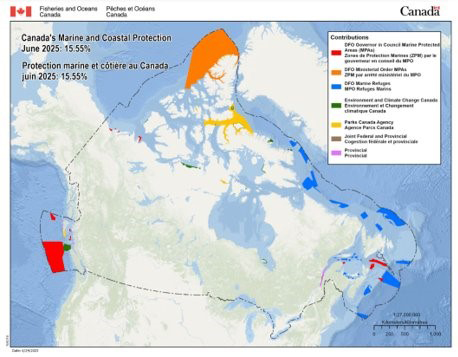
- To date, Canada has protected 15.55 per cent of its oceans.
Oceans Act MPA Establishment and Management Process
- Step 1: Pre-Planning
- Outcome: Areas of Interest (AOI), Selection and Announcement
- Step 2: Site Design and Policy Development, socio-economic analysis
- Outcome: Decision to proceed with regulatory process
- Step 3: Regulatory Development, Cost Benefit analysis
- Outcome: GIC MPA Designation
- Step 4: Management Planning
- Outcome: Management and Monitoring Approach established
- Step 5: Ongoing Management, Management Plan
- Outcome: Management and Monitoring Approach implemented and evaluated
2. Project Finance for Permanence
- Project Finance for Permanence (PFP) is a financing model that can be used to advance conservation and secure large-scale, long-term protection in the marine environment.
- Supports Indigenous leadership in conservation
- Indigenous-led project model based on partnership between Indigenous organizations, governments and the philanthropic community.
- Supports sustainable conservation
- Based on a unified vision for a conservation plan.
- Single deal moment ensures everything is in place for successful implementation.
- Innovative financial model that:
- Provides long-term funding for conservation projects, including marine areas.
- Manages and disburses funds as conservation milestones are met through an independent fund administrator.
- Incorporates private funds within the funding model.
- Recent investments by the Government are supporting three PFP initiatives, including two led by DFO: the Great Bear Sea (Northern Shelf Bioregion) and SINAA in the Qikiqtani Region of Nunavut.
3. Marine Environmental Quality
- Under the Oceans Act, the Minister may establish marine environmental quality (MEQ) guidelines, objectives, criteria, standards, and requirements respecting estuaries, coastal waters and marine waters.
- These MEQ management measures are to be established in collaboration with partners, including provinces, territories, Indigenous Peoples, and coastal communities.
- The non-regulatory tools (e.g., objectives, guidelines) may be established by the Minister and regulatory measures (e.g., standards, requirements) are implemented by the GiC, on the recommendation of the Minister.
- These integrated and evidence-based tools and strategies can be developed to understand environmental stressors; evaluate existing management measures or strategies; and adjust existing measures and/or develop new ones.
Key priorities include:
- Minimizing the impacts of marine stressors such as ocean noise, marine debris, and nutrient enrichment on marine life.
- Supporting marine planning by developing management measures and providing advice.
- Supporting effective management of MPAs and marine refuges through acoustic monitoring, vessel slowdowns, and other initiatives.
4. Integrated Ocean Management
- Integrated ocean management (IOM) offers a holistic and strategic form of governance for sustainable development and seeks to address multiple objectives across ocean uses, rather than a single objective or ocean use.
- The Minister shall undertake IOM in accordance with section 31 of the Oceans Act.
- Advancing IOM supports oceans-related priorities, including:
- Providing a mechanism to support Canada's ocean economy and sustainability priorities;
- Advancing collaborative relationships and governance structures with other federal organizations, provinces, territories and Indigenous Peoples; and
- Supporting Canada’s domestic and international commitments to marine conservation and protection.
Decision Making is Informed By
Science & Knowledge
- Improve the collective understanding of oceans using integrated science and knowledge to support all processes (i.e., ecological and socio-economic data, Indigenous Knowledge, local stakeholder and community knowledge)
Standards
- Protection standards for federal MPAs and OECMs
Socio-economic and Cultural Considerations
- Analysis of impacts of conservation decisions on marine resource users, stakeholders, and coastal communities. Analysis of data on diverse ocean topics for IOM processes
Partner Collaboration and Stakeholder Engagement
- Collaborative governance with OGDs, Provinces/Territories and Indigenous peoples. Active participation of stakeholders (industry, environmental groups, and coastal communities)
Annex A: Protected and Conserved Areas
Text version
Map of Canada’s marine and coastal protection. June 2025: 15.55%.
Contributions
- DFO governor in council marine protected areas (MPAs)
- DFO ministerial orders MPAs
- DFO marine refuges
- Environment and Climate Change Canada
- Parks Canada Agency
- Joint federal and provincial
- Provincial
Page details
- Date modified: