
A4 - DFO Regional Profiles
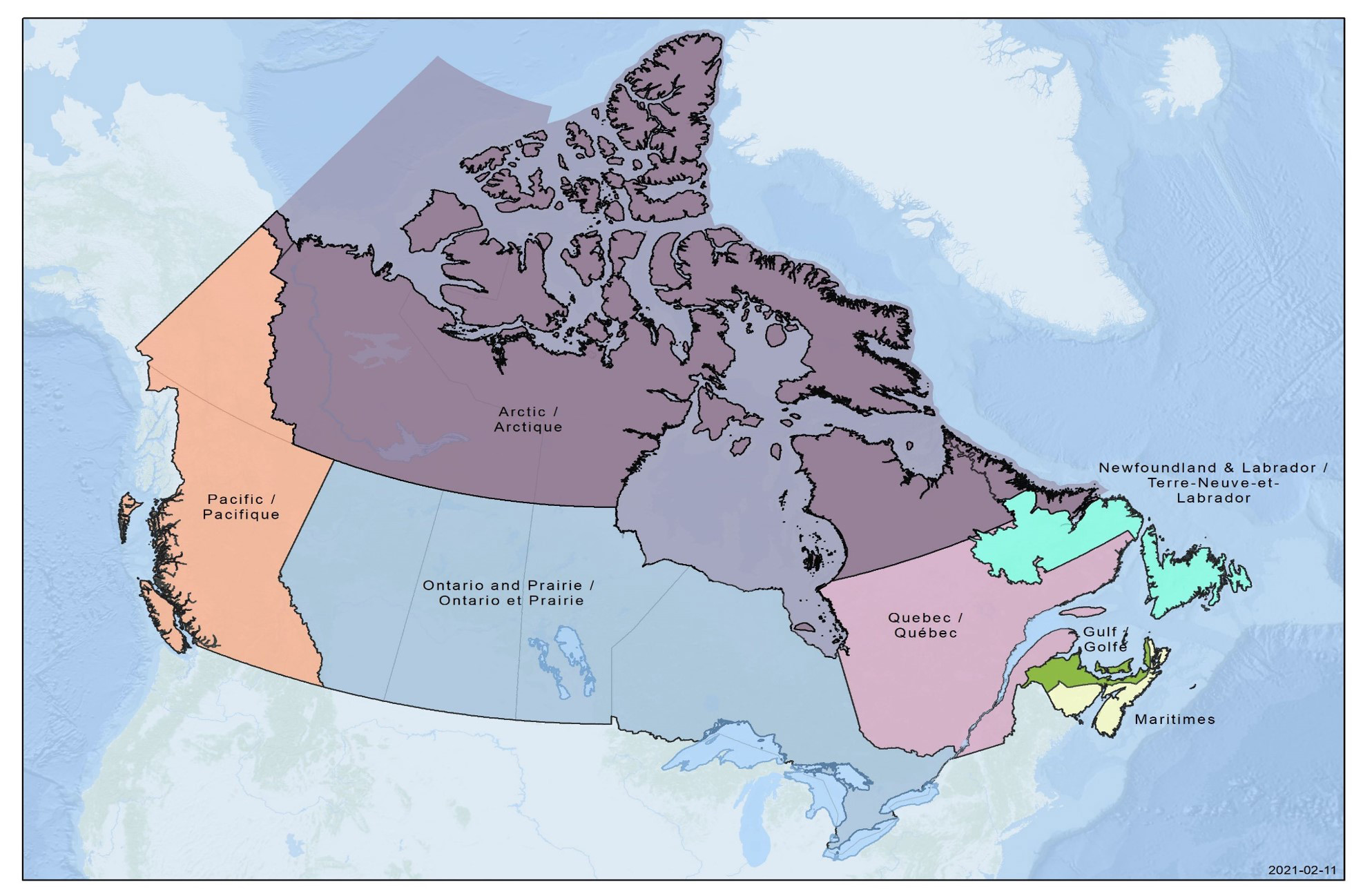
DFO Administrative Regions - Text version
- The Arctic Region is inclusive of the Yukon North slope, Northwest Territories, Nunavut, Nunavik, Nunatsiavut, and Hudson and James Bay. This boundary is inclusive of Inuit Nunangat.
- The Pacific Region consists of British-Columbia and Yukon, minus the Yukon slope.
- The Ontario and Prairie Region consists of Ontario, Manitoba, Saskatchewan and Alberta.
- The Quebec Region consists of Quebec, minus the Nunavik region in northern Quebec.
- The Gulf Region extends from the New Brunswick-Quebec border to the northern tip of Cape Breton.
- The Maritimes Region extends from the northern tip of Cape Breton to the New Brunswick-Maine border.
- The Newfoundland and Labrador Region consists of Newfoundland and Labrador, minus the Nunatsiavut region in Labrador.
DFO – Newfoundland and Labrador Region
Regional HQ: St. John’s, NL
Three Area Offices:
- Grand Falls-Windsor
- Corner Brook
- Happy Valley-Goose Bay
Key Facts
- Province of NL has 29,000 km of coastline and ~18% of Canada’s total ocean area
- Three Marine Protected Areas + five Marine Refuges
- 313 Small Craft Harbours
- Top species: snow crab, shrimp, lobster
- Approximate direct employment by the fishery, processing and aquaculture sectors* (2024): 3,961
- Total landed value of the commercial fishery (2024): $1.0 billion
- Total value of aquaculture in Newfoundland (2024): $263 million
*In Newfoundland
Key Priorities
- Supporting sustainable and commercially viable fisheries
- Advancing reconciliation through partnerships in fisheries, conservation, and habitat restoration
- Strengthening ocean science
- Protecting biodiversity and advancing clean energy
DFO – Maritimes Region
Regional HQ: Dartmouth, NS
Three Area Offices:
- Sydney, NS
- Yarmouth, NS
- St. George, NB
Key Facts
- 8,600 km of coastline from the tip of Cape Breton to the Canada-U.S. border
- Three Marine Protected Areas + six Marine Refuges
- 171 Small Craft Harbours
- Top commercially fished species: lobster, scallop, halibut
- Approximate direct employment by the fishery, processing, and aquaculture sectors* (2024): 18,675
- Total landed value of the commercial fishery (2024): $1.5 billion
- Total value of aquaculture* (2024): $424 million
* In NS and NB, NS aquaculture value preliminary
Key Priorities
- Managing Canada’s largest commercial fishery to support continued prosperity
- Supporting Indigenous economic inclusion and rights-based fishing for Indigenous communities
- Rebuilding forage fish stocks
- Supporting biodiversity, major project development, and advancing clean energy
DFO – Gulf Region
Regional HQ: Moncton, NB
Three Area Offices:
- Tracadie, NB
- Antigonish, NS
- Charlottetown, PEI
Key Facts
- 7,000 km coastline includes NB’s east coast, the Northumberland Strait coast of NS, western Cape Breton Island, and Prince Edward Island. Rivers, lakes and wetlands represent over 17,000 km2 of freshwater habitat
- One Marine Protected Area + five Marine Refuges
- 114 Small Craft Harbours
- Top species: lobster, snow crab, tuna
- Approximate direct employment by the fishery, processing and aquaculture sectors* (2024): 20,858
- Total landed value of the commercial fishery (2024): $779 million
- Total value of aquaculture* (2024): $478 million
*In NS, NB, PEI
Key Priorities
- Supporting sustainable and commercially viable fisheries
- Advancing reconciliation and implementing rights-based fisheries
- Protecting North Atlantic right whales while supporting sustainable fisheries
- Supporting Small Craft Harbours and maintaining infrastructure
- Protecting biodiversity
- Adapting to change – new diseases like MSX/Dermo for oysters; fish population shifts
DFO – Quebec Region
Regional HQ: Quebec City, QC
Three Area Offices:
- Sept-Îles
- Gaspé
- Cap-aux-Meules
Key Facts
- Province of Quebec and a large portion of the Gulf of St. Lawrence, encompassing approximately 430 river systems and 400,000 lakes
- One Marine Protected Area + 13 Marine Refuges
- 78 Small Craft Harbours
- Top species: lobster, snow crab, shrimp
- Approximate direct employment by the fishery, processing and aquaculture sectors* (2024): 2,403
- Total landed value of the commercial fishery (2024): $364 million
- Total value of aquaculture* (2024): $11.3 million
*In Quebec
Key Priorities:
- Supporting sustainable and commercially viable fisheries
- Advancing reconciliation and implementing rights-based fisheries
- Supporting Small Craft Harbours and maintaining infrastructure
- Protecting freshwater and marine biodiversity and advancing clean energy
- Supporting negotiations on the renewal of the Canada–Quebec Agreement on the St. Lawrence
DFO – Ontario and Prairie Region
Regional Offices:
- Winnipeg. MB
- Burlington, ON
- Sarnia, ON
Local Offices:
- Edmonton, AB
- Regina, SK
- Sault Ste. Marie, ON
Key Facts
- 20% of world’s freshwater supply is in the Great Lakes; 63% of Canada’s GDP; and 57% of Canada’s population
- 155 Small Craft Harbours
- Top species: yellow pickerel, perch, whitefish
- Approximate employment by the fishery, processing and aquaculture sectors* (2023): 3,400
- Total landed value of the commercial fishery** (2024): $83 million
- Total value of aquaculture* (2024): $50 million
*In ON, MB, SK, and AB/ **In ON, MB, and SK
Key Priorities
- Advancing environmental and critical minerals work as part of the Government’s Build Canada agenda
- Working with U.S. counterparts and the Great Lakes Fishery Commission on collaborative fishery management
- Protecting freshwater biodiversity and fish and fish habitat
- Advancing freshwater and transboundary water science; Supporting safe and efficient navigation in the Great Lakes and St. Lawrence Seaway
- Leading on ballast water research
DFO – Arctic Region
Regional HQ: Inuvik, NT
Additional offices:
- Iqaluit, NU
- Rankin Inlet, NU
- Yellowknife, NWT
- Hay River, NWT
- Winnipeg, MB
- Various satellite locations
Key Facts
- More than 50% of Canada’s coastline; DFO’s stand-alone Arctic Region provides an important federal presence in the North, supporting collaboration with Inuit, First Nation and Métis Nation organizations and governments, provinces and territories and other partners
- Three Marine Protected Areas + three marine refuges
- 6 Small Craft Harbours; Clyde River opening 2026; Arctic Bay starting construction in 2026
- Top species: Greenland halibut, shrimp, whitefish, Arctic char, marine mammals
- Approximate employment by the fishery, processing and aquaculture sectors* (2024): 150
- Total landed value of the commercial fishery** (2024): $141 million
- Total value of aquaculture* (2024): N/A
*NWT fishers and helpers (data on other territories currently unavailable) / **Northwest Territories and Nunavut
Key Priorities
- Establishing governance frameworks with northern and Indigenous partners, including co-management on shared priorities
- Building a representative workforce and implementing land claim obligations
- Advancing sustainable fisheries and aquatic ecosystems through scientific and economic research
DFO – Pacific Region
Regional HQ: Vancouver, BC
Four Area Offices:
- South Coast
- Fraser and Interior
- North Coast
- Yukon and Transboundary
Key Facts
- 27,000 km of coastline + 105 river systems (Old Crow flats in Yukon to southern tip of Vancouver Island)
- Three Marine Protected Areas
- 101 Small Craft Harbours
- Top species: crab, prawn, geoduck
- Approximate direct employment by the fishery, processing and aquaculture sectors* (2024): 4,532
- Total landed value of the commercial fishery (2024): $385 million
- Total value of aquaculture* (2024): $563 million
* In British Columbia
Key Priorities:
- Protecting Pacific salmon
- Sustainable aquaculture development
- Advancing reconciliation and implementing rights-based fisheries
- Protecting biodiversity and enhancing the region’s aquatic ecosystems
- Supporting economic growth through permitting efficiency
Page details
- Date modified: