
Process to establish and manage Governor in Council (GiC): Oceans Act Marine Protected Areas
Release date: March 2026
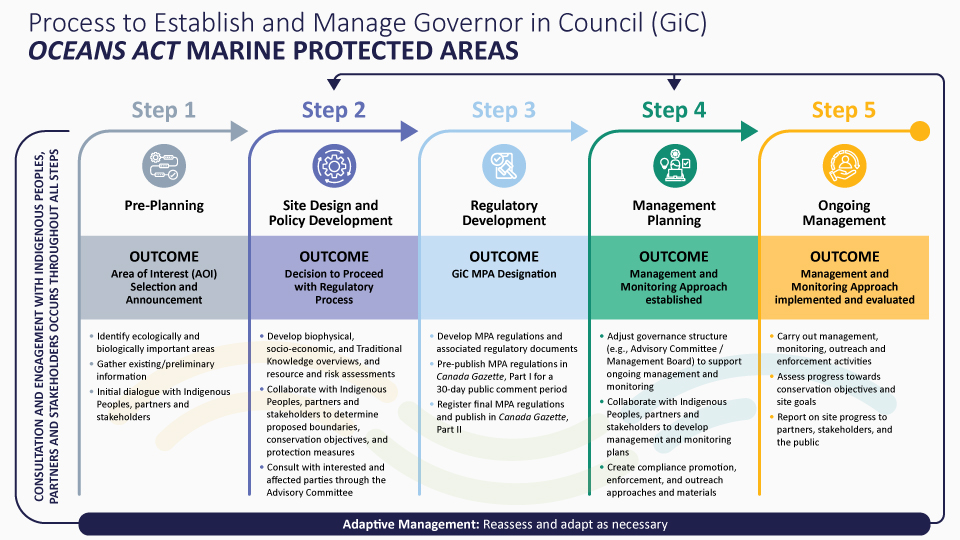
Description: Process to establish and manage Governor in Council (GiC): Oceans Act Marine Protected Areas
Consultation and engagement with Indigenous Peoples, partners and stakeholders occurs throughout all steps.
Step 1: pre-planning
Outcome: Area of Interest (AOI) selection and announcement
- Identify ecologically and biologically important areas.
- Gather existing/preliminary information.
- Initial dialogue with Indigenous Peoples, partners and stakeholders.
Step 2: site design and policy development
Outcome: decision to proceed with regulatory process
- Develop biophysical, ecological and Traditional Knowledge overviews, and resource and risk assessments.
- Collaborate with Indigenous Peoples, partners and stakeholders to determine proposed boundaries, conservation objectives and protection measures.
- Consult with interested and affected parties through the Advisory Committee.
Step 3: regulatory development
Outcome: GiC MPA designation
- Develop MPA regulations and associated regulatory documents.
- Pre-publish MPA regulations in Canada Gazette, Part I for a 30‑day public comment period.
- Register final MPA regulations and publish in Canada Gazette, Part II.
Step 4: management planning
Outcome: management and monitoring approach established
- Adjust governance structure (for example, Advisory committee/Management board) to support ongoing management and monitoring.
- Collaborate with Indigenous Peoples, partners and stakeholders to develop management and monitoring plans.
- Create compliance promotion, enforcement and outreach materials.
Step 5: Ongoing management
Outcome: Management and monitoring approach implemented and evaluated
- Carry out management, monitoring, outreach and enforcement activities.
- Assess progress toward conservation objectives and site goals.
- Report on site progress to partners, stakeholders and the public.
Adaptive management: reassess and adapt as necessary.
- Date modified: