
Strengthening the Inshore Regulations
 Strengthening the Inshore Regulations
(PDF, 841 KB)
Strengthening the Inshore Regulations – Engagement video series: Discussion paper
Purpose
This document is intended to support the Department of Fisheries and Oceans (referred to as DFO throughout this document) in conducting the comprehensive review of the Inshore Regulations. It outlines what the Inshore Regulations are and how they are applied. It then summarizes some identified concerns with the regulations in their current form and offers ideas for discussion about where future efforts may be targeted. The ideas for discussion are intended to help get a sense of the types of options stakeholders think DFO could pursue to respond to the issues laid out in this document. Following the comprehensive review, DFO will use all feedback received to develop options for what to do next.
Introduction
What are the Inshore Regulations and what do they do
The Inshore Regulations: Part III of the Atlantic Fishery Regulations, 1985 and the Part I.1 of the Maritime Provinces Fishery Regulations
DFO uses the Inshore Regulations to guide licensing in the inshore and coastal sectors in Atlantic Canada and Quebec.
The Inshore Regulations are rules that clarify who can hold a licence, who must do the fishing, and who can make decisions about the fishing activities.
They were made to ensure licence holders own, operate, and control their enterprises, prevent unauthorized control by others, support independent owner operators, and keep benefits in local communities.
How does DFO apply the regulations
When an inshore licence is issued, the licence holder receives the benefits (referred to as the rights and privileges). Only the licence holder can use and control the rights and privileges that come from holding a licence. When DFO receives a request to reissue a licence to a different individual the following steps are taken:
- DFO checks whether the person requesting the licence is eligible to receive it
- If the recipient is eligible, DFO requests all agreements that are part of the transaction for review
- DFO evaluates whether all requirements are met and makes its decision
While reviewing the agreements, DFO is ultimately looking at:
- Who makes the decisions
- Who controls the licence in practice
- Whether someone has control or influence over the licence holder
- Who receives the benefits
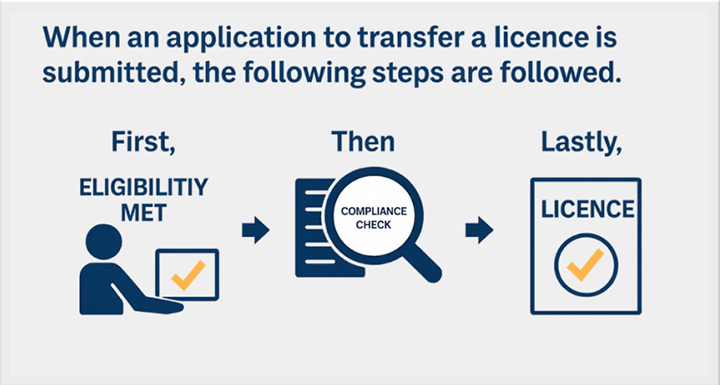
How does DFO apply the regulations? (1) - Text version
Stylized three‑panel process graphic. From left to right, the panels show: a person presenting documentation labeled “Eligibility met”; documents examined through a magnifying glass indicating compliance review; and a fishing licence with a checkmark representing approval and issuance. Arrows connect each step to show the sequence.
When a transfer of rights and privileges requires follow up enforcement by DFO’s Conservation and Protection program (C&P), the following steps are taken: Information is gathered from multiple sources, including from licensing, members of the public, and directly by Conservation and Protection officers. Once information is received, it is carefully reviewed and assessed to determine whether follow-up action is required. Then an investigation may be opened, which can vary in scope and complexity. When sufficient evidence is gathered, investigators prepare Reports to Crown Counsel along with full disclosure packages.
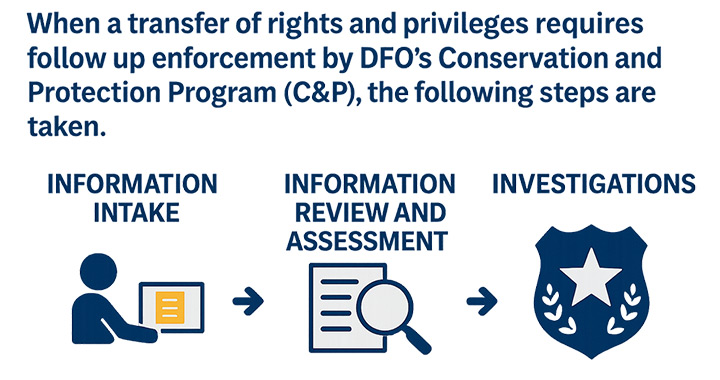
How does DFO apply the regulations? (2) - Text version
Graphic showing a three-step process for DFO’s Conservation and Protection Program enforcement follow-up: Information Intake (person using a computer), Information Review and Assessment (document with magnifying glass), and Investigations (shield with a star), connected by arrows from left to right.
Experience from implementation
Experience shows that attempts to obtain control over a licence can happen through a variety of agreements, such as lending, supply, and service contracts. These agreements may not change who is the legal title holder (i.e., the licence holder), but can have effects on day‑to‑day fishery operations and who benefits from the licence (the beneficial owner).
Control is not all‑or‑nothing. It can be small or big, direct or indirect. Sometimes it is hard to tell when an agreement crosses the line and needs further review to ensure compliance.
Areas of focus
There are four key areas where DFO is interested in gathering views on the impact of the current regulations. These were identified through discussions with frontline staff, stakeholder feedback, and by witnesses at the House of Commons Standing Committee on Fisheries and Oceans.
1. Understanding use, control, and transfer
The concepts of use, control, and transfer are central to the inshore rules. Licence holders are expected to decide, when, where, and with whom to fish, and are restricted from separating the rights and privileges under a licence to a third party. Third parties are prohibited from controlling or using the rights and privileges that are granted by a licence, except in a limited number of circumstances outlined in the regulations.
- Rights
-
- the right to engage in an exclusive fishery under the conditions imposed by the licence (including decision-making over fishing activities authorized by the licence)
- the proprietary right to the fish caught under the licence (including, but not limited to, decision-making over the benefits resulting from their catch)
- Privileges
-
Granted through policy, include but are not limited to, the ability to make requests:
- for substitute operators
- licence renewal
- licence reissuance
- quota transfers
Three (3) central concepts:
- Use — Doing the activities allowed by the licence, or making choices about those activities and the results.
- Control — Making choices about the licence or telling someone else how to use it. Control by a third party can occur through loans, supply agreements, or buyer rules. Even if the licence is still in the licence holder’s name, operational decisions may be made by someone else.
- Transfer — When the rights or privileges of a licence are given to someone else to use or control. Transfer means rights and privileges are no longer fully with the licence holder in practice.
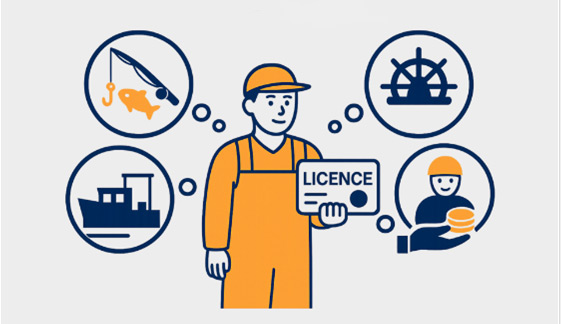
Understanding what it means to use a licence - Text version
Illustration showing a person holding a licence card, surrounded by icons representing fishing activities and outcomes, including a fish on a line, a fishing vessel, a ship wheel, and an exchange of money, indicating the use of a licence to fish, operate a vessel, and generate income.
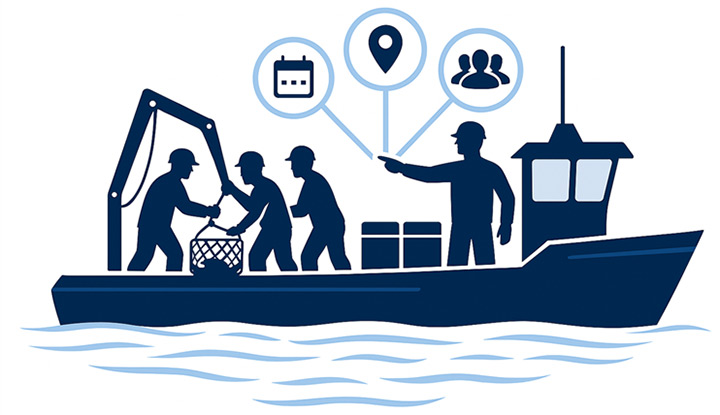
Understanding what control means (1) - Text version
Blue-toned illustration of a fishing boat on open water with several crew members working together to hoist a net using deck machinery and stow containers, while another person points toward graphic icons above the deck representing scheduling, geographic location, and team coordination.
Understanding how these concepts apply in real life can be difficult. Licence holders may need to hire crew, services, borrow money, or share gear, that’s normal. But if another person decides when, where, or how you fish, that may be a problem.
DFO looks at each agreement by itself and all agreements together to see if they break any of the rules about separation by identifying who controls, who can make choices about daily operations, and who receives the benefits (money from the catch). Essentially, DFO asks: does this agreement take away the licence holder’s own right to decide? Or does it take the benefits away from the licence holder?
Ideas for discussion
Should DFO:
- Develop some real‑life examples of use (what it looks like when the licence holder truly fishes under the licence)
- Develop some real‑life examples of control (what it looks like when someone else is calling the shots)
- Set clear lines (thresholds) that could be considered a transfer, such as:
- 60% of revenue goes to paying debt associated with a lending agreement
- Loan principal (the amount borrowed) grows even when you make payments
- In an Individual Transferable Quota fishery, the licence holder transfers all their quota every season and never fishes in person
- Identify clauses (terms and conditions of an agreement) that should not be allowed (especially for third party lenders):
- Clauses that lead to default because of supply or other side rules (e.g. requirement to land at a particular place)
- Clauses that let the lender set or influence daily fishing choices (crew selection, or when, where, and how to fish)
- Clauses that let the lender influence who gets the licence next (reissuance)
- Clauses that assign licence rights (like payments in fish instead of money)
- Clauses that force the borrower to sign future unknown deals or pay undefined future costs
2. Using money to control a licence
Starting and running a fishing business can be expensive. Many harvesters take out loans to fund their enterprise, sometimes from more than one lender. Loans can become a primary way for others to try to control a licence.
Some lenders create agreements that make a licence holder fully dependent on them rather than being an independent owner operator. It is important for DFO to find the right balance: support access to money while maintaining harvester control.
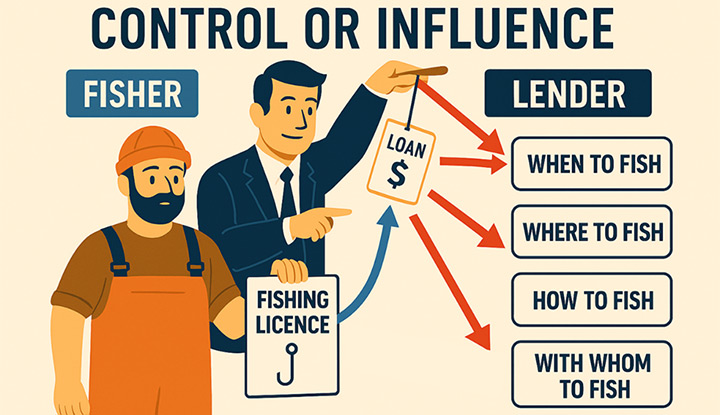
Control or influence - Text version
Illustration titled “Control or influence” showing a fisher holding a fishing licence beside a lender holding a loan agreement. Arrows from the loan point to decisions controlled by the lender, including when to fish, where to fish, how to fish, and with whom to fish, illustrating lender influence over fishing activities.
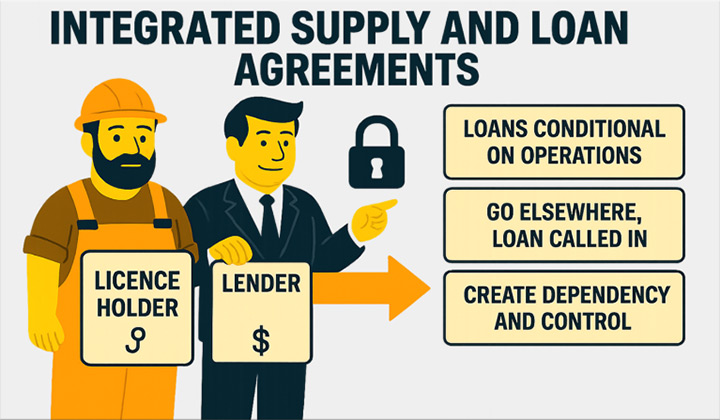
Integrated Loan and Supply Agreements - Text version
Infographic titled ‘Integrated Supply and Loan Agreements.’ On the left, a licence holder in work clothing is shown next to a lender in a suit. An arrow and lock icon connect the two, indicating restricted or binding conditions. On the right, text boxes list impacts of the arrangement: loans are conditional on how the business operates, loans may be called in if the licence holder goes elsewhere, and the arrangement creates dependency and control.
Some participants (most often new entrants) may be offered appealing terms, but the loan terms can lock borrowers into the lender’s wishes. For example, licence holders may be required to sell the supply to only one buyer, make payments in fish, or follow the agreement longer than the loan. If any of these conditions are not met, the lender may attempt to call in the collateral and gain control of the licence.
In some cases, lenders trigger agreement default clauses to take control of the licence and recommend a new licence holder who fits their own business interests. This can include a non-financial default, which occurs if the terms of any agreement are breached, even though loan payments are made.
When a licence holder requires a guarantor or co-signer independence can be further reduced. A party with commercial interests (like a buyer or processor) who guarantees or co‑signs a loan might only agree to it if certain requirements are met, such as requiring the licence holder to use their services or sell to them exclusively. This puts the guarantor or co‑signer in a position to influence how the licence holder operates.
Some recognized lenders prefer and/or require a guarantor/cosigner to help approve a loan when an applicant (e.g., an existing owner operator or new entrant) does not have enough credit or experience. Depending on the terms, and the inclusion of third party corporate interests, guarantors and cosigners can be used as a way to gain control or leverage over an enterprise by a third party.

Exclusivity - Text version
Illustration labeled “Exclusivity” showing a licence holder and a lender connected by a locked arrangement. The licence holder stands beside the lender, and an arrow points to a list of impacts: no option to sell elsewhere, requirement that terms continue even after the loan period, inability to negotiate price, and reduced competition.
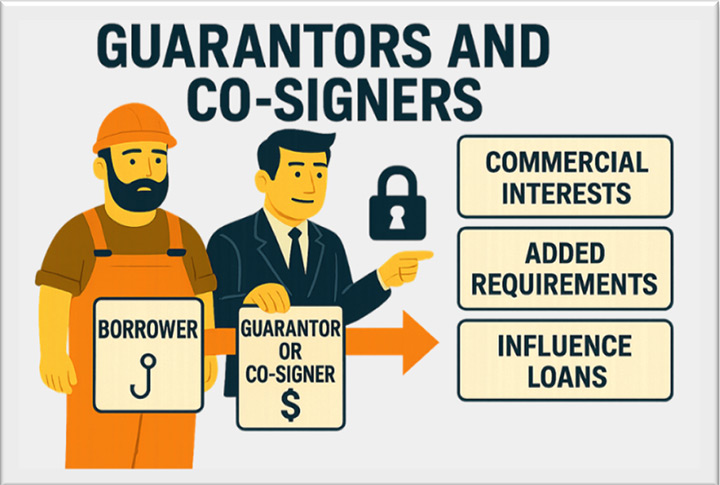
Guarantors and co-signers - Text version
Illustration titled ‘Guarantors and Co-signers’ depicting a borrower and a guarantor or co-signer. The guarantor points toward a list reading ‘Commercial interests,’ ‘Added requirements,’ and ‘Influence loans,’ illustrating how guarantors or co-signers can affect loan conditions.
Ideas for discussion
Should DFO:
- Work towards increasing access to loans from recognized lenders (like banks or credit unions)
- Talk with banks and public lenders (like the Business Development Bank of Canada) about how they decide on their lending to harvesters
- Explore how fishers work together for better terms
- Let fisher associations help members deal with lenders
- Look at shared services for finance and business support
- Place stronger limits on non‑recognized lenders
- Limit or ban some lenders or types of agreements:
- Remove the ability for non‑recognized lenders from naming the next licence holder (General Securities Agreement rules to be clarified)
- Ban integrated agreements that link loan defaults to supply conditions
- Limit or ban some lenders or types of agreements:
- Set different rules for processors, family members, or other harvesters (when they act as lenders)
- Limit or ban guarantors/co‑signers if the guarantee is linked to supply
- Require guarantors or co‑signers to disclose any commercial interests
3. Intergenerational transfers (passing on the business)
The inshore sector is aging with many licence holders nearing retirement age who are looking to pass on their business to a new entrant. Passing on the business (also called intergenerational transfer or succession) is important to keep skills and renew the fleet. But, DFO has heard that the current owner operator model can make slow, mentored hand‑overs difficult, including within families.
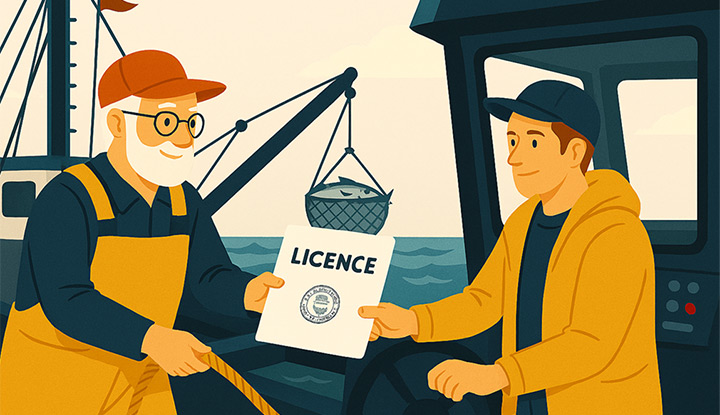
Intergenerational transfers - Text version
Illustration of two people on a fishing vessel transferring a licence document. One individual in fishing gear hands a “Licence” paper to another person (a new entrant) at the wheel of the boat, with fishing equipment and a catch of fish visible in the background, representing the transfer of a fishing licence from one generation to the next.
Getting started also takes time and includes taking courses, understanding rules (safety, navigation, environment, and more), and spending time on the water. New entrants are looking for a clear pathway to get skills and certification.
There is often a need for large amounts of money to get started which can push people into loans that reduce their independence. Turn-key enterprises offer an all-in option (licences, crew, vessels, gear, etc.) but can result in operational decisions being made by someone other than the licence holder. When new entrants agree to a turn-key enterprise they may end up more like employees. The future of the sector and coastal communities rely on the next generation of true owner operators.
Additionally, the current definition of family allows licence holders to share the benefits of their enterprise only with those who are in their or their spouse’s immediate family (parents, siblings, and children). However, DFO knows that fishing skills and responsibilities are often passed between aunts, uncles, cousins, nieces, nephews, or other close relatives, who do not meet the current definition. DFO is interested in definitions that would help licence holders share the benefits of their enterprise with family members, while respecting the owner operator principle.
Ideas for discussion
Should DFO:
- Identify supports to attract and retain new entrants
- Consider shared ownership or partnership for a set time, or buy‑in over time, to help with transition planning
- Expand the scope of who is included as family (such as, cousins, uncles, etc.)
4. Licence holder education and obligations
Being an owner operator includes more than fishing, it also includes managing an enterprise. It requires licence holders to be aware of their regulatory requirements. Some licence holders require help from trained advisors, such as lawyers, accountants, or management companies. These advisors help provide independent advice so licence holders better understand what they need to do and get help running parts of the business. But, in smaller communities access can be difficult.
Sometimes, professionals provide services to licence holders while being paid by a lender. This is referred to as dual representation. When one advisor works for both a licence holder and a third party at the same time it can make it impossible for the advisor to be fair to both sides. Because each group wants different things the advice may favour the one paying the bill.
When the advisor is acting on behalf of a lender yet providing services to the licence holder it can create a “conflict of interest”. Even when advisors act in good faith, the perception of a conflict can cause doubt and lower trust.

Managing the enterprise - Text version
Illustration of a person in fishing attire considering how to run a fishing enterprise. The person is shown beside a clipboard labeled “Running the Enterprise,” with surrounding thought bubbles depicting key factors such as business growth, operating a vessel, financial considerations, and regulatory obligations.

Dual representation and conflicts of interest - Text version
Illustration showing a potential conflict of interest. A licence holder stands on one side, while a lender holding a loan document stands on the other. In the center, an advisor or lawyer holds two signs reading “Duty to Licence Holder” and “Duty to Lender,” with a warning symbol and the label “Conflict of Interest (Dual Representation),” highlighting competing obligations between the two parties.
Ideas for discussion
Should DFO:
- Develop information or guidance documents to help licence holders better understand their regulatory obligations
- Require business plans in non-RFI funding
- Identify ways to support licence holders in obtaining independent advice
- Identify ways to address conflicts of interest
Finding the right balance
For all of the ideas discussed in this document, DFO realizes that trade-offs exist.
For many inshore licence holders, the value of their enterprise is not just a business asset, it also represents a significant portion of their retirement plan and long-term financial security.
This also points to broader economic and social considerations that need to be taken into account. Options that might affect market prices of licences and enterprises have the potential to create financial strain for licence holders, and could have downstream effects on the coastal communities that depend on inshore fisheries for prosperity.
As licences can be used as collateral for financing vessels, gear, and operational costs, changes to eligibility, Owner Operator rules, or third-party lending rules can affect access to capital used for daily business operations. Rules that are too narrow may slow transactions, while ones that are too broad may allow more outside involvement, which can undermine licence holder independence.
The impacts will also be felt differently by individuals. DFO is interested in hearing your perspective. We want to know what’s important to you as we look to strengthen the Inshore Regulations.
Conclusion
The Inshore Regulations help keep independent harvesters in control. They support local fisheries and make sure the benefits of Canada’s ocean resources stay with the people who fish them and the communities where they live.
With clear rules, fair changes, and by talking with licence holders and communities, the inshore regime can keep doing what it is intended to do: support fair and sustainable fishing, protect and promote coastal jobs, and serve the public interest for years to come.
We look forward to hearing your views and your ideas.
Page details
- Date modified: